
Learning From Data
Prof. Yaser Abu-MostafaYaser Abu-Mostafa's famed Caltech course on statistical learning theory: Hoeffding's inequality, VC dimension, bias-variance tradeoff, regularization, support vector machines, and neural nets.
Syllabus
18Lecture 01 - The Learning Problem
This inaugural lecture for Caltech's CS 156 introduces the core components of the learning problem, distinguishing between supervised, unsupervised, and reinforcement learning paradigms. It establishes foundational concepts for algorithmic inference.

Lecture 02 - Is Learning Feasible?
This lecture explores the fundamental question of generalization in machine learning: how to infer properties of an entire space from a limited sample. It introduces the relationship between in-sample and out-of-sample error, laying the groundwork for statistical learning theory.
Lecture 03 -The Linear Model I
This lecture introduces the foundational concepts of the linear model, covering both linear classification and linear regression. It also explores methods for extending the applicability of linear models through nonlinear transformations of input features.
Lecture 04 - Error and Noise
This lecture, part of Caltech's CS 156, formally introduces principled choices for error measures in machine learning contexts. It examines the implications of noisy target functions on learning algorithms and model performance.

Lecture 05 - Training Versus Testing
This lecture formally distinguishes training and testing phases in machine learning, exploring the mathematical conditions for model generalization. It addresses the core challenge of ensuring learned models perform effectively on unseen data.
Lecture 06 - Theory of Generalization
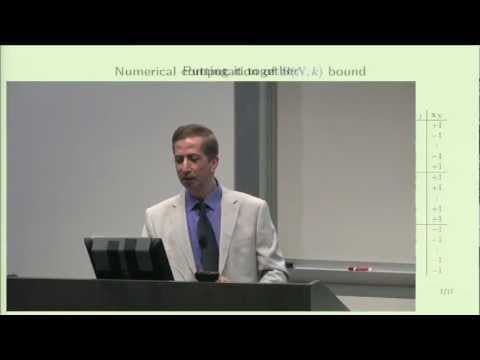
This lecture formalizes the core concept of generalization in machine learning, exploring how models can learn from finite samples. It introduces foundational theoretical results, including the VC dimension and its role in establishing generalization bounds.
Lecture 07 - The VC Dimension
This lecture introduces the Vapnik-Chervonenkis (VC) dimension as a fundamental measure of the capacity of a hypothesis space, explaining its relationship to model complexity and generalization error in statistical learning theory.
Lecture 08 - Bias-Variance Tradeoff
Professor Abu-Mostafa elucidates the fundamental bias-variance tradeoff in machine learning, decomposing prediction error into irreducible noise, bias from model assumptions, and variance from finite training data. The lecture details the impact on generalization performance.
Lecture 9: The Linear Model II (CS 156)
This lecture delves into advanced linear models, covering logistic regression, the principles of maximum likelihood estimation, and the iterative optimization process of gradient descent.
Lecture 10: Neural Networks (CS 156)
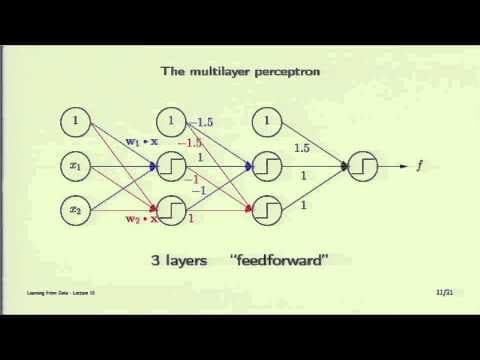
This session introduces biologically inspired neural networks, detailing their architecture, the role of hidden layers, and the efficient backpropagation algorithm for training.

Lecture 11: Overfitting (CS 156)
This lecture explores the phenomenon of overfitting, differentiating between deterministic and stochastic noise as factors contributing to models that fit data too well.
Lecture 12: Regularization (CS 156)
This session examines regularization techniques to mitigate overfitting, discussing hard and soft constraints, augmented error formulations, and the concept of weight decay.
Lecture 13: Validation (CS 156)
This lecture covers validation methods for robust model selection, addressing data contamination and introducing cross-validation techniques for out-of-sample evaluation.
Lecture 14: Support Vector Machines (CS 156)
This session introduces Support Vector Machines (SVMs), detailing their mechanism for achieving complex decision boundaries while maintaining a simple underlying model structure.
Lecture 15: Kernel Methods (CS 156)
This lecture explores kernel methods, extending SVM capabilities to infinite-dimensional spaces using the kernel trick and handling non-separable data through soft margins.
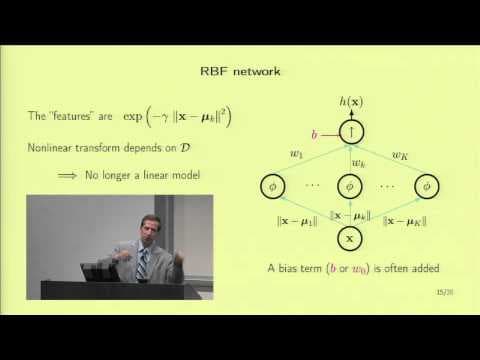
Lecture 16: Radial Basis Functions (CS 156)
This session introduces Radial Basis Functions (RBFs) as a key learning model, highlighting their connections to various machine learning techniques and architectures.

Lecture 17: Three Learning Principles (CS 156)
This lecture outlines critical pitfalls in machine learning practice, discussing Occam's razor for model simplicity, the impact of sampling bias, and the dangers of data snooping.
Lecture 18: Epilogue (CS 156)
The concluding lecture provides an overview of the machine learning landscape, briefly touching upon Bayesian learning paradigms and aggregation methods for improved model performance.