
The Character of Physical Law (Messenger Lectures)
Richard Feynman's landmark seven-part Messenger Lecture series delivered at Cornell University in 1964, examining gravitation, the relation of mathematics to physics, conservation principles, symmetry, the arrow of time, quantum probability, and the discovery of new laws.
Syllabus
7The Law of Gravitation, an Example of Physical Law
Richard Feynman's iconic first lecture from the 1964 Cornell Messenger Lectures, elucidating the fundamental principles and historical development of Newton's law of universal gravitation.
The Relation of Mathematics to Physics
Richard Feynman's second Messenger Lecture at Cornell, exploring the intricate and often surprising relationship between mathematical structures and their application in physical theory.
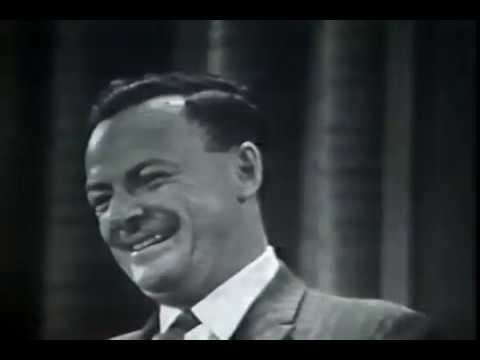
The Great Conservation Principles
Richard Feynman discusses the foundational conservation principles in physics—energy, momentum, and angular momentum—highlighting their profound implications for understanding natural phenomena.
Symmetry in Physical Law
Richard Feynman presents the ubiquitous role of symmetry in shaping physical laws, revealing how principles of invariance underlie the structure and behavior of the universe.
The Distinction of Past and Future
Traces how microscopic time-reversible dynamical laws give rise to macroscopic irreversibility, thermodynamic entropy growth, and a cosmological low-entropy boundary condition.
Probability and Uncertainty: The Quantum Mechanical View of Nature
Richard Feynman introduces the revolutionary quantum mechanical perspective, grappling with the concepts of probability and inherent uncertainty at the fundamental scale of reality.
Seeking New Laws: Theory, Prediction, and Observation
Richard Feynman's final Messenger Lecture, reflecting on the scientific process itself—the interplay between theoretical models, empirical predictions, and the role of observation in validating knowledge.