
Probability
Prof. Joe BlitzsteinHarvard's celebrated probability sequence building story proofs, conditioning, Bayes' theorem, indicator random variables, continuous distributions, moment generating functions, and Markov chains.
Syllabus
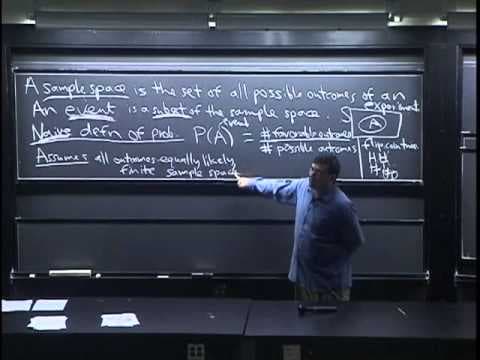
21Lecture 1: Probability and Counting | Statistics 110
This introductory lecture establishes the naive definition of probability, emphasizing the foundational role of counting. It covers the multiplication rule, binomial coefficients, and the sampling table for various replacement and order scenarios.
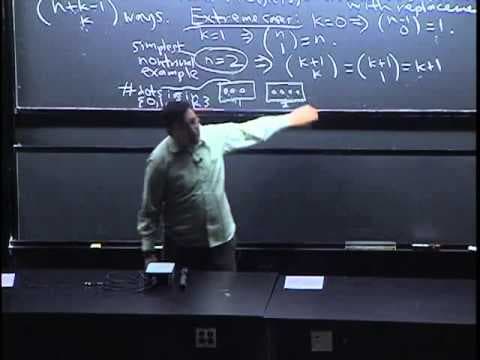
Lecture 2: Story Proofs, Axioms of Probability | Statistics 110
This lecture introduces combinatorial 'story proofs' as a method for establishing identities like Vandermonde's identity, emphasizing intuitive insight over algebraic manipulation. It then lays the foundational axioms of probability theory, including discussion of Bose-Einstein sampling.
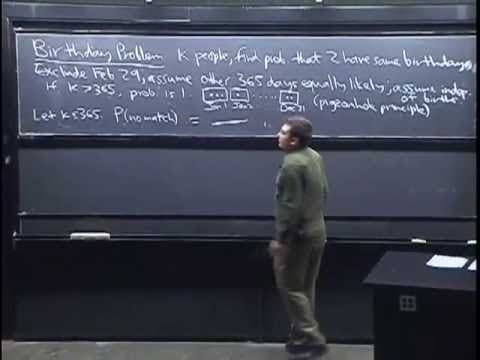
Lecture 3: Birthday Problem, Properties of Probability | Statistics 110
We discuss the birthday problem (how many people do you need to have a 50% chance of there being 2 with the same birthday?), the matching problem (de Montmort), inclusion-exclusion, and properties of probability.
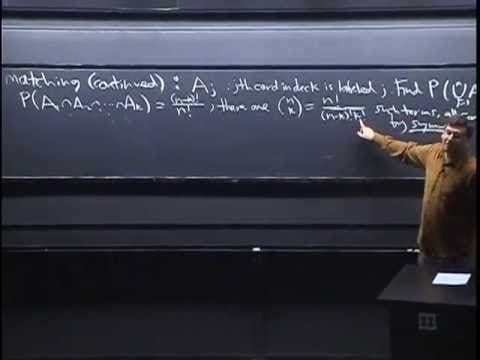
Lecture 4: Conditional Probability | Statistics 110
We introduce conditional probability, independence of events, and Bayes' rule.
Lecture 5: Conditioning Continued, Law of Total Probability | Statistics 110
We continue further with conditional probability, and discuss the law of total probability, the so-called prosecutor's fallacy, a disease testing example, and the crucial distinction between independence and conditional independence.
Lecture 6: Monty Hall, Simpson's Paradox | Statistics 110
We show how conditional probability sheds light on two of the most famous puzzles in statistics, both of which are often counterintuitive (at first): the Monty Hall problem and Simpson's paradox.
Lecture 7: Gambler's Ruin and Random Variables | Statistics 110
This lecture analyzes the classic Gambler's Ruin problem, modeling a finite-state absorbing Markov chain. It then introduces the fundamental concept of random variables and details the Bernoulli and Binomial probability distributions.
Lecture 8: Random Variables and Their Distributions | Statistics 110
This lecture introduces the foundational concepts of random variables and their distributions. It formally defines cumulative distribution functions (CDFs) and probability mass functions (PMFs), culminating in an analysis of the Hypergeometric distribution.
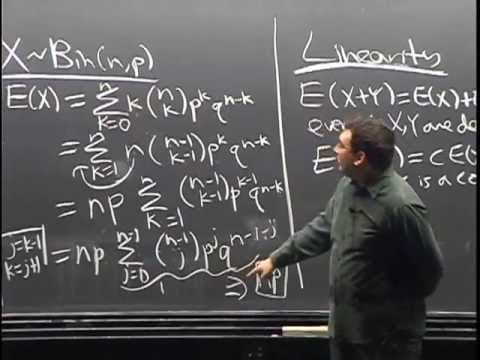
Lecture 9: Expectation, Indicator Random Variables, Linearity (STAT 110)
This lecture introduces expected values, exploring indicator random variables and the principle of linearity to calculate means. It also establishes the fundamental bridge between probability and expectation and presents the Geometric distribution.
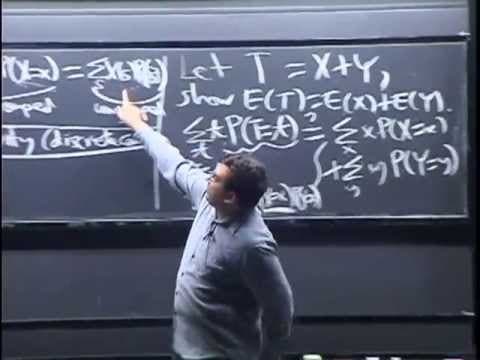
Lecture 10: Expectation Continued (STAT 110)
This session rigorously proves linearity of expectation and applies it to solve a Putnam problem. It introduces the Negative Binomial distribution and analyzes the intriguing St. Petersburg Paradox.
Lecture 11: The Poisson Distribution (STAT 110)
This lecture introduces the Poisson distribution, highlighting its significance as a fundamental discrete distribution in statistics. It examines its applications as an approximation and its relationship with the Binomial distribution.
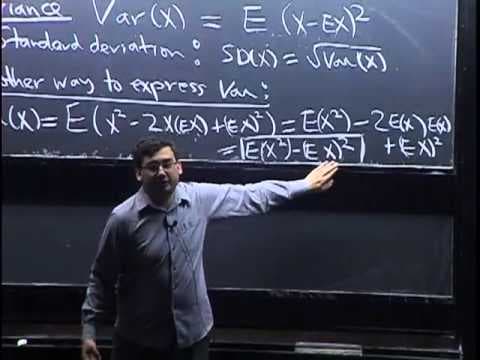
Lecture 12: Discrete vs. Continuous, the Uniform (STAT 110)
This lecture delineates the distinctions between discrete and continuous probability distributions, introducing probability density functions (PDFs). It also covers variance, standard deviation, and the Uniform distribution.
Lecture 13: Normal Distribution (STAT 110)
This session introduces the Normal distribution, emphasizing its pervasive importance and widespread application across various fields of statistics. It establishes its foundational role in probabilistic modeling.
Lecture 14: Location, Scale, and LOTUS (STAT 110)
This lecture examines location and scale parameters in distributions, along with standardization techniques. It thoroughly explains the Law of the Unconscious Statistician (LOTUS) and applies it to derive the variance of a Poisson distribution.
Lecture 16: Exponential Distribution (STAT 110)
This lecture introduces the Exponential distribution, which is distinctly characterized by its memoryless property. The session, though concise due to midterm discussions, covers the core aspects of this crucial continuous distribution.
Lecture 17: Moment Generating Functions (STAT 110)
This session introduces moment generating functions (MGFs), detailing their diverse applications in probability theory. It also discusses Laplace's rule of succession and the hybrid form of Bayes' rule.
Lecture 18: MGFs Continued (STAT 110)
Building on prior knowledge, this lecture employs MGFs to derive moments for Exponential and Normal distributions and determine the distribution of sums of Poissons. It also initiates the discussion on joint distributions.
Lecture 19: Joint, Conditional, and Marginal Distributions (STAT 110)
This lecture elaborates on joint, conditional, and marginal distributions, introducing the 2-D LOTUS. It establishes the condition E(XY)=E(X)E(Y) for independent variables and solves the expected distance and chicken-egg problems.
Lecture 20: Multinomial and Cauchy (STAT 110)
This lecture introduces the Multinomial distribution, highlighting its properties and applications as a key multivariate discrete distribution. It also includes an example involving the Cauchy distribution.
Lecture 21: Covariance and Correlation (STAT 110)
This session introduces the concepts of covariance and correlation, demonstrating their roles in measuring variable relationships. It shows how to calculate the variance of a sum, including for a Hypergeometric random variable.
Lecture 22: Transformations and Convolutions (STAT 110)
This lecture explores transformations of random variables (change of variables) and introduces the LogNormal distribution. It covers convolutions for sums of variables and demonstrates how probability can be used to prove existence.