
Real Analysis
Prof. Francis SuDedekind cuts construction of the reals, metric space topology, compactness, Heine-Borel theorem, connected sets, Cauchy sequences, uniform continuity, and function spaces.
Syllabus
22Real Analysis, Lecture 1: Constructing the Rational Numbers
Professor Francis Su introduces foundational concepts in real analysis by rigorously constructing the rational numbers. This lecture examines field axioms and their implications for number system properties.
Real Analysis, Lecture 2: Properties of Q
This lecture delves into the axiomatic properties of the rational numbers (Q) as a field, specifically examining their order structure and limitations in representing certain real numbers. It establishes foundational concepts for formal real analysis.
Real Analysis, Lecture 3: Construction of the Reals
This lecture rigorously constructs the field of real numbers, R, from the rational numbers, Q, using Dedekind cuts. It establishes the completeness property of the real numbers.
Real Analysis, Lecture 4: The Least Upper Bound Property
This lecture introduces the foundational Least Upper Bound Property (completeness axiom for real numbers) and its implications, demonstrating its role in characterizing ordered fields.
Real Analysis, Lecture 5: Complex Numbers
This lecture from Harvey Mudd's Real Analysis course introduces the fundamental properties of complex numbers, covering their algebraic structure, geometric interpretation, and basic operations within the field.
Real Analysis, Lecture 6: Principle of Induction
This lecture from Harvey Mudd's Real Analysis course rigorously introduces the Principle of Mathematical Induction, demonstrating its application through foundational proofs relevant to number theory and analysis.
Real Analysis, Lecture 7: Countable and Uncountable Sets
Professor Francis Su develops the formal definitions of countable and uncountable sets, demonstrating key proof techniques, including Cantor's diagonalization argument, to establish the uncountability of the real numbers.
Real Analysis, Lecture 8: Cantor Diagonalization and Metric Spaces
This lecture introduces Cantor's diagonalization argument to demonstrate the uncountability of real numbers, then transitions into the foundational definitions and properties of metric spaces, including examples and basic topological concepts.
Lecture 9: Limit Points (MATH 131)
This lecture rigorously defines limit points, also known as cluster points or accumulation points, establishing their fundamental role in understanding the topological structure of sets in real analysis.
Lecture 10: The Relationship Between Open and Closed Sets (MATH 131)
This session meticulously examines the definitions and interconnections of open and closed sets in metric spaces, illustrating their complementary roles and formal properties essential for advanced analysis.
Lecture 11: Compact Sets (MATH 131)
This lecture introduces the concept of compact sets, exploring their definition via open covers and demonstrating their significance in ensuring the existence of extrema for continuous functions.
Lecture 12: Relationship of Compact Sets to Closed Sets (MATH 131)
This session investigates the crucial relationship between compact and closed sets, proving that in metric spaces, compact sets are always closed and bounded, a foundational result in topology.
Lecture 13: Compactness and the Heine-Borel Theorem (MATH 131)
This lecture rigorously establishes the Heine-Borel Theorem, proving the equivalence of compactness, closedness, and boundedness for subsets of Euclidean space R^n, a cornerstone of real analysis.
Lecture 14: Connected Sets, Cantor Sets (MATH 131)
This lecture defines connected sets and explores their topological properties, then introduces the fascinating and counterintuitive construction of Cantor sets, highlighting their pathological features.
Lecture 15: Convergence of Sequences (MATH 131)
This session formally defines the convergence of sequences in metric spaces using epsilon-delta arguments, exploring properties like uniqueness of limits and boundedness of convergent sequences.
Lecture 16: Subsequences, Cauchy Sequences (MATH 131)
This lecture introduces subsequences and their convergence properties, then delves into Cauchy sequences, demonstrating their role as a criterion for convergence in complete metric spaces.
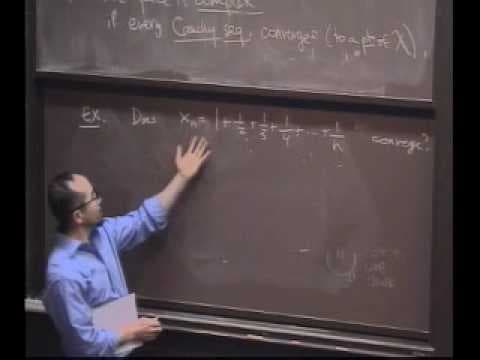
Lecture 17: Complete Spaces (MATH 131)
This session defines complete metric spaces as those where every Cauchy sequence converges within the space, illustrating the importance of completeness for foundational theorems like the Contraction Mapping Principle.
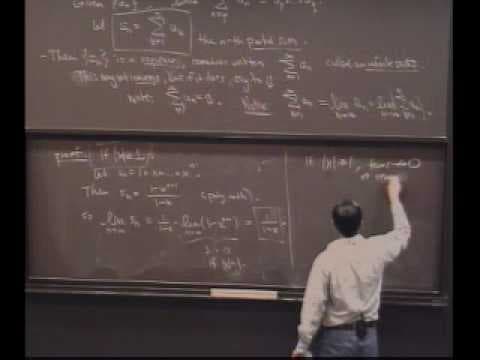
Lecture 18: Series (MATH 131)
This lecture introduces infinite series, defining convergence based on the limit of partial sums and exploring fundamental properties, including the necessary condition for convergence.
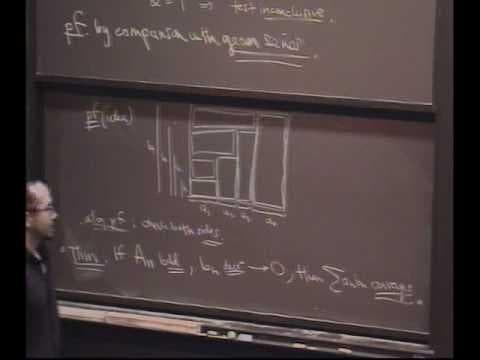
Lecture 19: Series Convergence Tests, Absolute Convergence (MATH 131)
This session covers crucial tests for series convergence, such as the Comparison Test and Ratio Test, and differentiates between absolute and conditional convergence, explaining their implications.
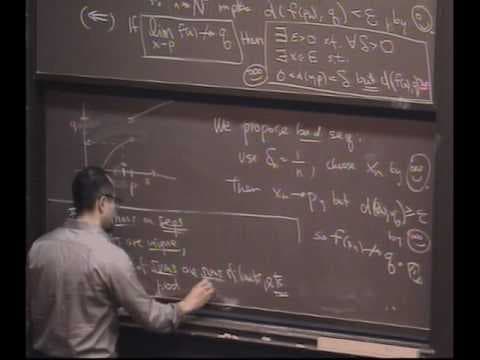
Lecture 20: Functions - Limits and Continuity (MATH 131)
This lecture formally defines limits of functions using the epsilon-delta criterion and introduces the concept of continuity, exploring its implications for function behavior on intervals.
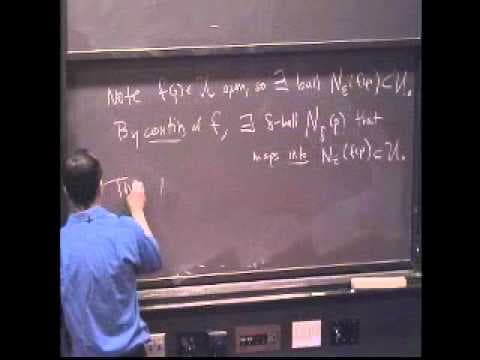
Lecture 21: Continuous Functions (MATH 131)
This lecture elaborates on properties of continuous functions, including the Intermediate Value Theorem and the Extreme Value Theorem, demonstrating their fundamental applications in real analysis.
Lecture 22: Uniform Continuity (MATH 131)
This session introduces uniform continuity, contrasting it with pointwise continuity and proving key theorems, such as continuous functions on compact sets being uniformly continuous.