
IAS Workshop: Quantum Aspects of Black Holes and Spacetime
Research workshop investigating black hole information, replica wormholes, generalized gravitational entropy, von Neumann algebras in quantum gravity, and holographic spacetime emergence.
Syllabus
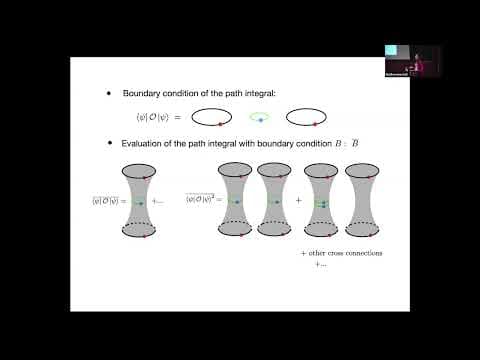
19Comments on the Hartle-Hawking State and Observers
This lecture examines the Hartle-Hawking state, focusing on dominant Euclidean sphere topology. It analyzes how including a classical observer resolves problems in holographic theories failing semi-classical physics.
Holographic Algebras at Null Infinity
This session delves into the structure and implications of holographic algebras as they manifest at null infinity. It explores their role in understanding quantum information in gravitational theories.
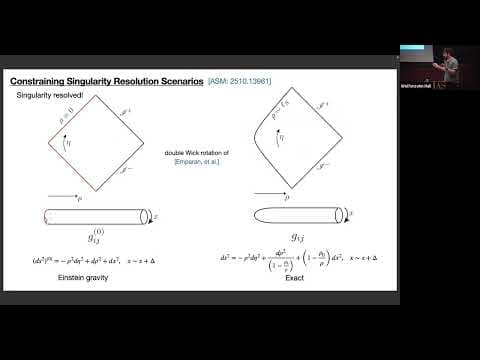
Exact Semiclassical Gravity and Partial Cauchy Slice Holography
This talk discusses an axiomatic framework for quantum gravity, rigorously establishing theorems with the quantum extremal surface prescription. It clarifies the regime of validity for G→0 while cG remains fixed.
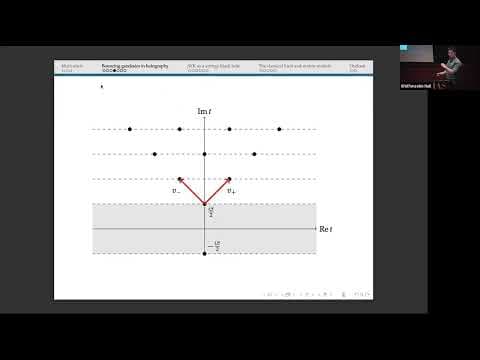
Bouncing off Stringy Singularities
This lecture investigates black hole singularities in AdS/CFT as divergences in two-point functions, smoothed out by stringy effects at finite 't Hooft coupling. It connects these phenomena to classical dynamical systems.
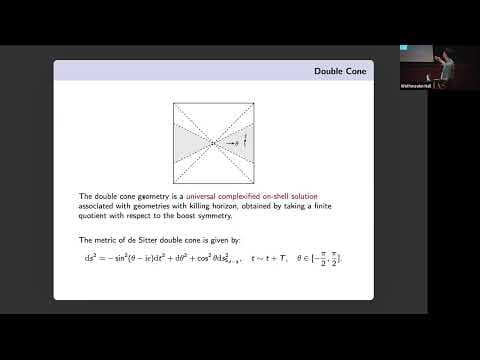
Comments on the de Sitter Double Cone
This presentation explores the de Sitter double cone geometry, demonstrating how static patch observers lead to a linear ramp consistent with random matrix behavior. The ramp arises from relative time shifts between clocks.
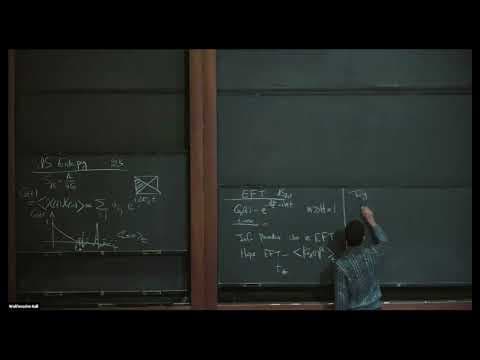
An Observer's Measure of De Sitter Entropy
This talk investigates the late-time behavior of two-point correlation functions in de Sitter space, presenting evidence from Jackiw-Teitelboim gravity for a topologically nontrivial saddle that contributes a constant to the correlator norm, interpreted as an average over microscopic theories.
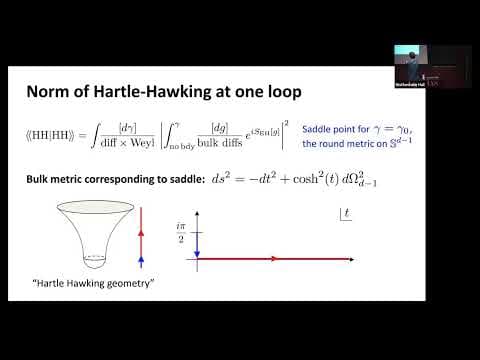
Quantum Mechanics of the Hartle-Hawking State
This lecture examines the Hartle-Hawking no-boundary state, exploring its relevance to de Sitter entropy puzzles and inflationary cosmology. It computes the norm of the state, focusing on spherical spatial slice contributions.
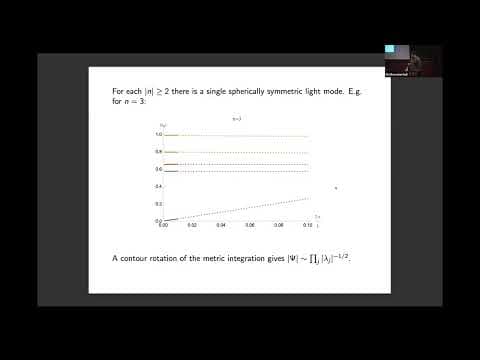
The Hartle-Hawking Wavefunction and de Sitter Black Holes
This lecture explores the Hartle-Hawking wavefunction in Schwarzschild-de Sitter spacetime, comparing its semiclassical norm to the Euclidean Nariai geometry action. It clarifies quantum corrections and the path integral phase.
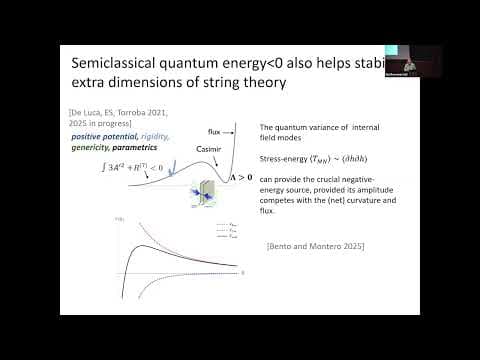
The Yes Boundaries Wavefunctions of the Universe and Late Time Cosmology
This talk discusses wavefunctions of the universe incorporating timelike boundaries, consistent with Lambda CDM cosmology. It summarizes constraints from CMB and BAO data and examines their holographic implications.
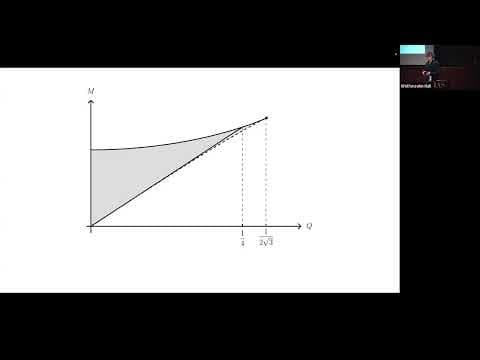
On the Phase of the de Sitter Density of States
This lecture investigates the complex phase of the de Sitter density of states, proposing its cancellation by including a charged black hole observer. It calculates the one-loop determinant within 2D dilaton gravity.
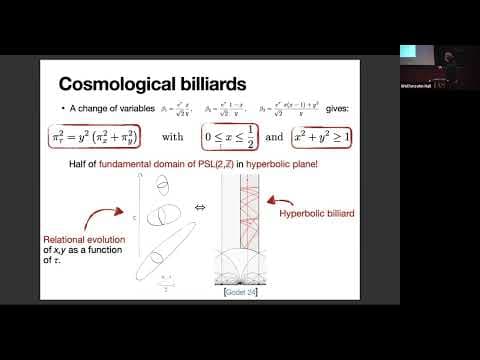
Quantum Cosmology in the BKL Regime and Dual Primon Gases
Sean Hartnoll re-examines the Belinski-Khalatnikov-Lifshitz (BKL) spacetime singularity dynamics through the lens of quantum chaos and holographic duality, proposing a dual 'primon gas' description connected to number theory.
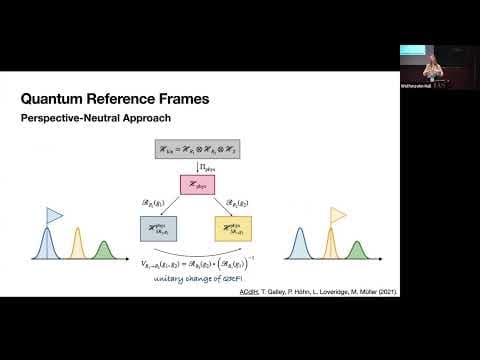
Relational Perspectives in Quantum Gravity: The Role of Quantum Reference Frames
This talk introduces quantum reference frames (QRFs) and their role in quantum gravity, demonstrating how they illuminate quantum effects in superposed spacetimes. It presents a perspective-neutral formulation and applications.
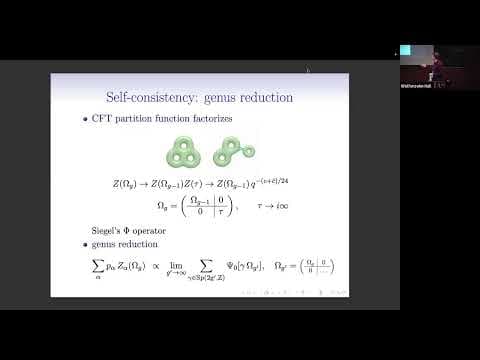
TQFT Gravity and Sum over Topologies
This lecture presents a topological gravity model defined by summing a 3D TQFT over bulk topologies, formulated for holographic duality. It explores explicit examples and their implications for pure 3D quantum gravity.
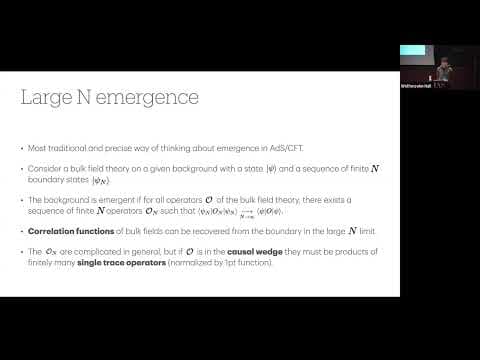
Failures of Spacetime Emergence
This talk argues that certain spacetime regions may fail to emerge from holographic theories, drawing conclusions from large N arguments and tensor network models. It comments on methods for restoring spacetime emergence.
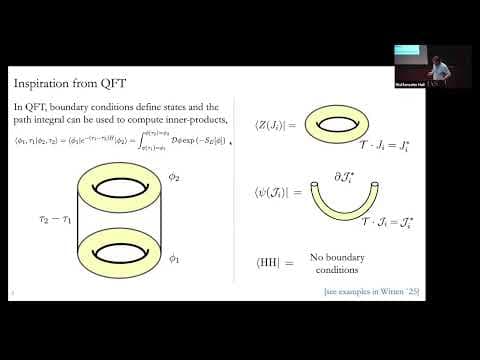
On the Hilbert Space of Quantum Gravity from the Gravitational Path Integral
This lecture reviews positivity criteria for the gravitational path integral to define a valid Hilbert space for open and closed universes. It describes cases where these highly constraining criteria are satisfied.
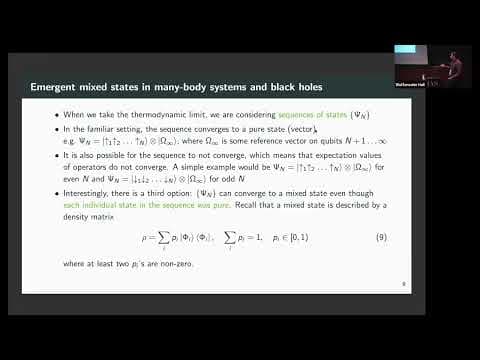
Emergent Mixed States for Baby Universes and Black Holes
This talk explores the fate of quantum states in the semiclassical limit of AdS/CFT, focusing on black holes and 'baby universes.' It discusses how states approach mixed states due to information loss and wormhole effects.
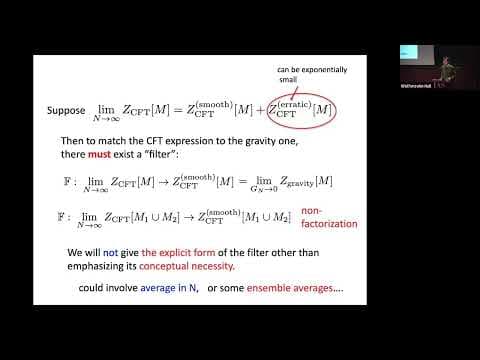
“Filtering'' CFTs at large N: Euclidean Wormholes, Closed Universes, and Black Hole Interiors
This lecture argues that Euclidean wormholes in AdS/CFT arise from erratic N-dependence in large-N CFTs, proposing a filtering procedure for gravitational duals. It examines both external and internal wormhole configurations.
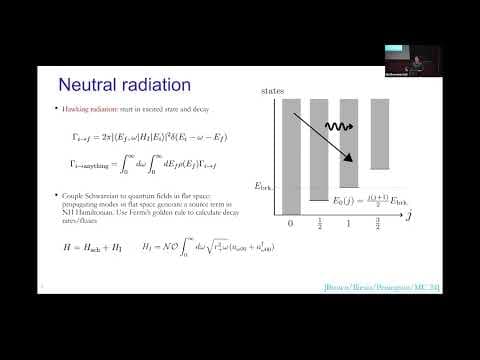
Near-Extremal Black Hole Evaporation
This talk investigates the evaporation processes of near-extremal black holes, exploring the quantum mechanical implications and information loss paradoxes within this regime of black hole physics.
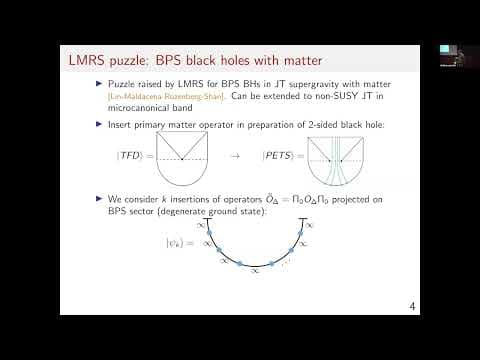
A Black Hole Airy Tail: Part 2
This second part addresses a puzzle in JT (super)gravity where naive bulk computations yield negative one-sided entropy for two-sided black holes. It demonstrates how semi-quenched entropy restores positivity.