
Quantum Field Theory
Prof. David TongDavid Tong's celebrated Perimeter Scholars International blackboard course covering classical fields, canonical quantization, interacting scalar theories, Wick's theorem, Feynman diagrams, Dirac spinors, and QED.
Syllabus
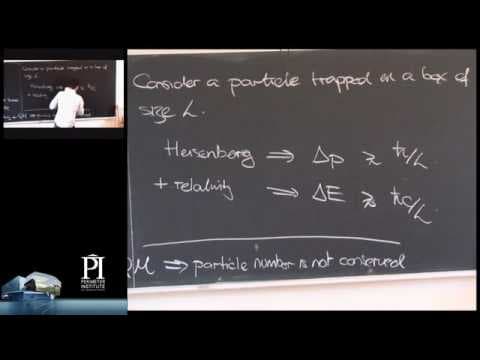
14Lecture 01 - Introductory remarks on quantum field theory and classical field theory
Introductory remarks on quantum field theory and classical field theory. Roughly covering pages 1-10 of the printed notes.
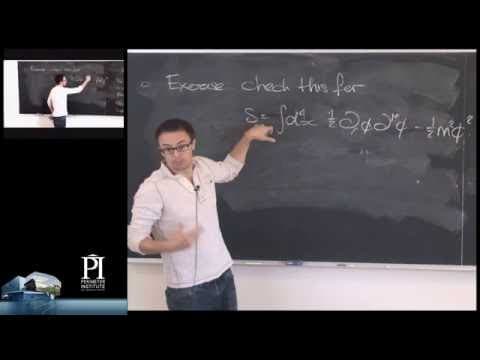
Lecture 02 - Noether's theorem and the energy momentum tensor
Noether's theorem and the energy momentum tensor. Pages 11-17 of the printed notes.
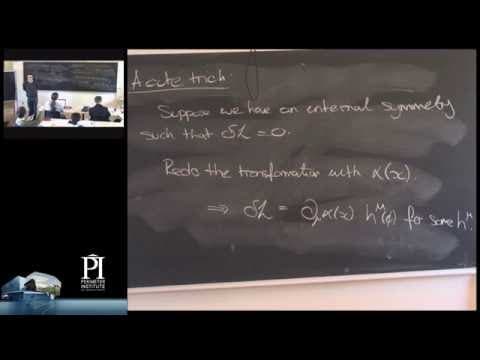
Lecture 03 - Canonical quantization for the free scalar field
This lecture introduces the canonical quantization procedure for the free scalar field, building upon classical field theory and laying foundational concepts for advanced quantum field theory.
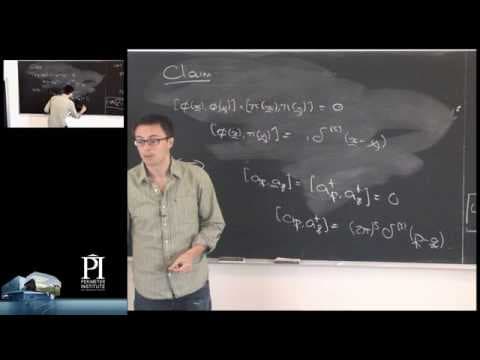
Lecture 04 - The vacuum. The interpretation of particles
More on canonical quantization, including normal ordering, the vacuum and the interpretation of particles. Pages 25-33.
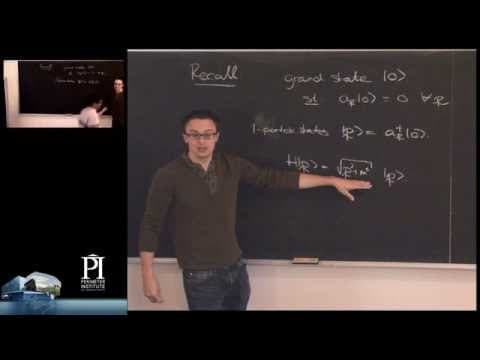
Lecture 05 - Heisenberg picture. Causality
Heisenberg picture. Causality. Yet more canonical quantization, including the Heisenberg picture and causality. Pages 34-38.
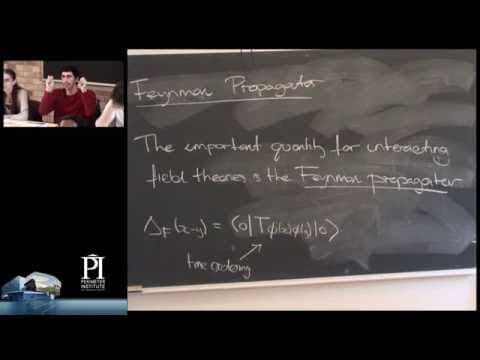
Lecture 06 - Propagators
This lecture from David Tong's Quantum Field Theory course at Perimeter Institute introduces the concept of propagators, detailing their derivation and role as Green's functions in describing particle interactions within quantum field theory, referencing specific sections of Tong's canonical lecture notes.
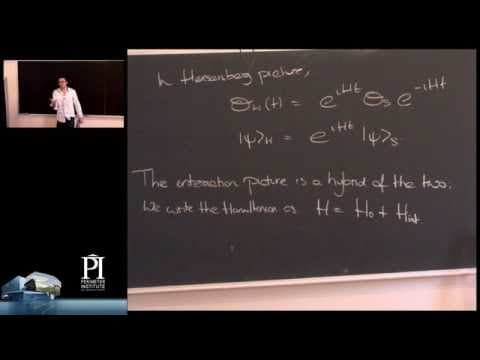
Lecture 07 - Interactions. Dyson's formula
Interactions. Dyson's formula and a first look at scattering. Pages 50-55.
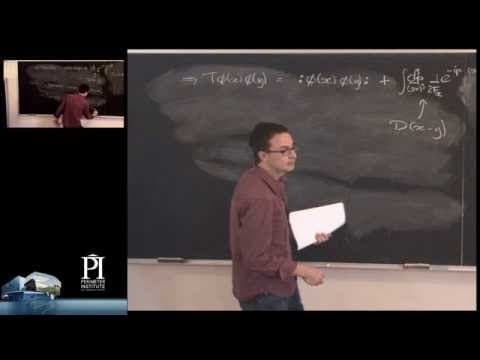
Lecture 08 - Wick's theorem, Feynman diagrams
Wick's theorem, Feynman diagrams and examples of scattering amplitudes. Pages 56-62.
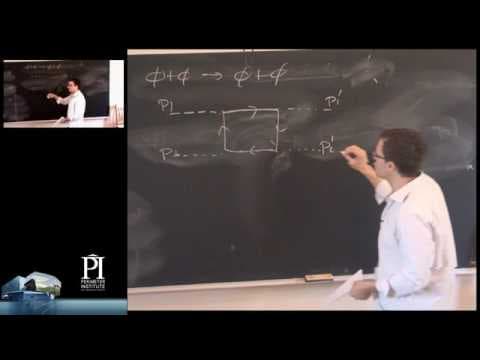
Lecture 09: Finishing off Scattering Amplitudes (PSI-QFT)
This lecture concludes the discussion on scattering amplitudes and delves into the intricate algebra of the Lorentz group, referencing pages 62-69 and 81-84 of the course notes.
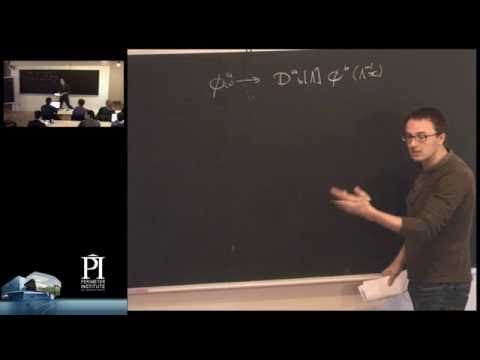
Lecture 10: The Dirac Equation (PSI-QFT)
This session introduces the spinor representation of the Lorentz group and rigorously derives the Dirac equation, covering material from pages 85-90.
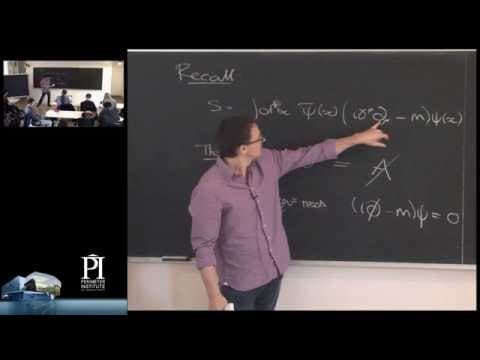
Lecture 11: Solving the Dirac Equation (PSI-QFT)
The lecture focuses on methods for solving the Dirac equation and offers an initial exploration of quantization and statistics, drawing from pages 90-108.
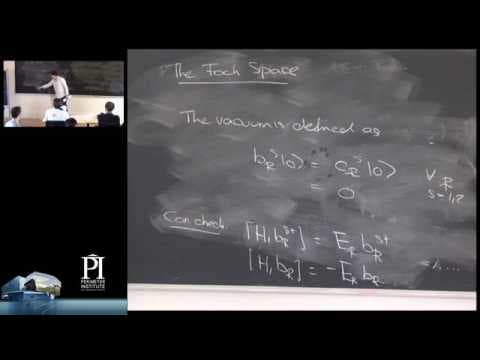
Lecture 12: Quantizing Fermions (PSI-QFT)
This lecture details the process of quantizing fermions and extends the treatment to scattering amplitudes in the fermionic context, based on pages 108-118.
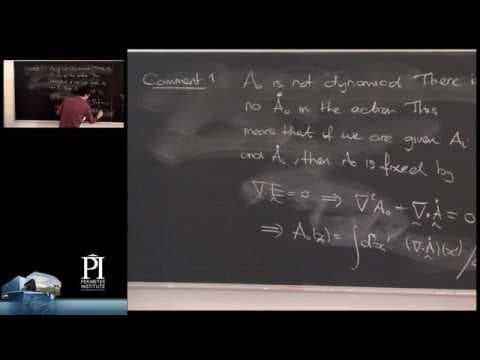
Lecture 13: Quantum Electrodynamics (PSI-QFT)
This session introduces Quantum Electrodynamics, explaining gauge fixing and the quantization of the electromagnetic field in Lorentz gauge, covering pages 124-134.
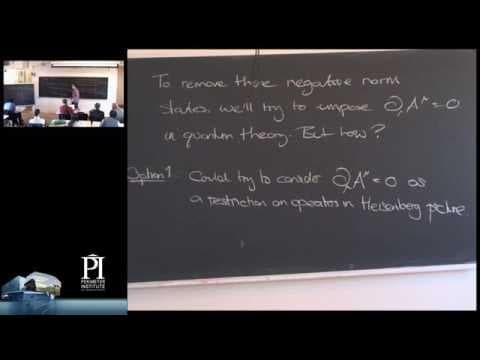
Lecture 14: Coupling Light and Matter (PSI-QFT)
This lecture explores the coupling of light and matter, introduces Feynman rules, and revisits scattering amplitudes within this framework, concluding the course content.