
Multivariable Calculus
Prof. Denis AurouxVector geometry, matrices, partial derivatives, Lagrange multipliers, multiple integrals, line and surface integrals, Green's theorem, Stokes' theorem, and the divergence theorem.
Syllabus
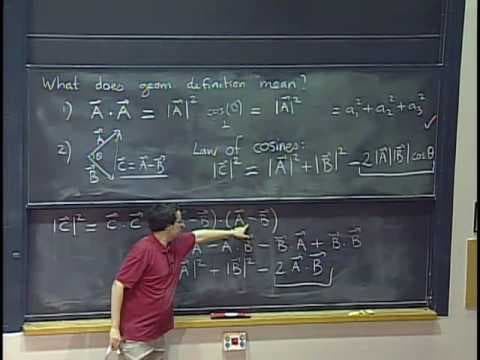
22Lec 1: Dot product | MIT 18.02 Multivariable Calculus, Fall 2007
This lecture from MIT's Multivariable Calculus course introduces the dot product, exploring its algebraic definition, geometric interpretation, and fundamental properties essential for understanding vector projections and angles in higher dimensions.
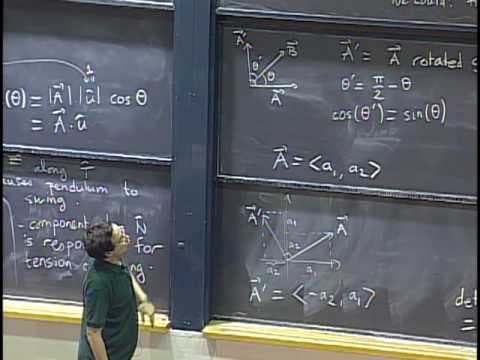
Lec 2: Determinants; cross product | MIT 18.02 Multivariable Calculus, Fall 2007
This lecture introduces the formal definition and properties of determinants, elucidating their geometric interpretation in terms of volume. It then rigorously defines the vector cross product and explores its fundamental algebraic and geometric characteristics within three-dimensional Euclidean space.
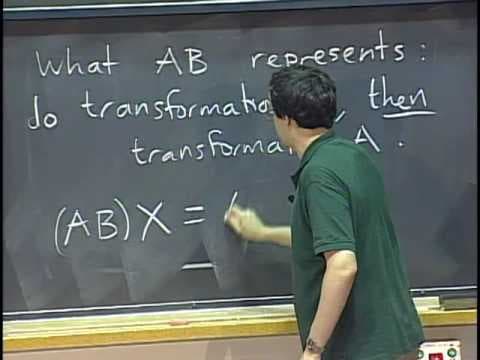
Lec 3: Matrices; inverse matrices | MIT 18.02 Multivariable Calculus, Fall 2007
This lecture introduces matrix arithmetic, including addition, scalar multiplication, and matrix multiplication. The session further develops the concept of the inverse matrix and methods for its computation, essential for solving systems of linear equations in multivariable contexts.
Lec 4: Square systems; equations of planes | MIT 18.02 Multivariable Calculus, Fall 2007
This lecture introduces the formalisms for square systems of linear equations and develops the canonical equations of planes in three-dimensional Euclidean space, building foundational concepts for multivariable calculus.
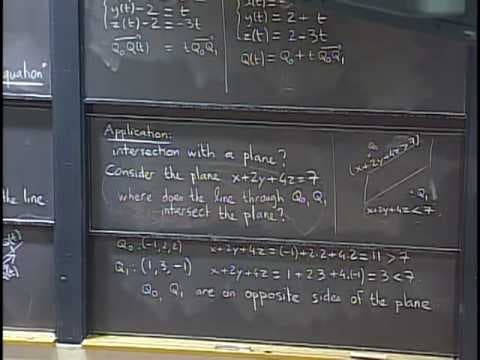
Lec 5: Parametric equations for lines and curves | MIT 18.02 Multivariable Calculus, Fall 2007
This lecture from MIT 18.02 introduces the formulation of lines and curves using parametric equations. It covers vector representations and their application in describing geometric paths in two and three dimensions.
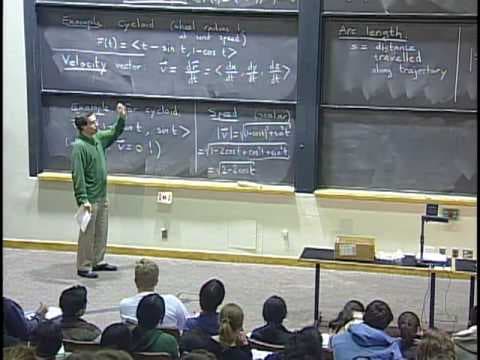
Lec 6: Velocity, acceleration; Kepler's second law | MIT 18.02 Multivariable Calculus, Fall 2007
This lecture introduces vector descriptions of velocity and acceleration in three dimensions, culminating in a rigorous derivation and geometric interpretation of Kepler's Second Law of Planetary Motion using calculus.
Lec 7: Review | MIT 18.02 Multivariable Calculus, Fall 2007
This session reviews key concepts in multivariable calculus, including vector fields, partial derivatives, double and triple integrals, and fundamental theorems such as Green's Theorem, preparing students for problem sets and exams.
Lecture 8: Level Curves; Partial Derivatives; Tangent Plane Approximation (18.02)
This lecture introduces the concept of level curves for visualizing multivariable functions, then details partial derivatives and their application in constructing tangent plane approximations.
Lecture 9: Max-Min Problems; Least Squares (18.02)
The session explores methods for solving maximum and minimum problems in multivariable calculus. It also covers the principle of least squares for data fitting and regression analysis.
Lecture 10: Second Derivative Test; Boundaries & Infinity (18.02)
This lecture focuses on the second derivative test for classifying critical points of multivariable functions, extending analysis to behaviors at boundaries and infinity.
Lecture 11: Differentials; Chain Rule (18.02)
The lecture elaborates on differentials for approximating function changes and thoroughly examines the multivariable chain rule, including its applications to implicit differentiation.
Lecture 12: Gradient; Directional Derivative; Tangent Plane (18.02)
This session introduces the gradient vector and its role in determining the direction of maximum increase. It further discusses directional derivatives and re-examines tangent planes.
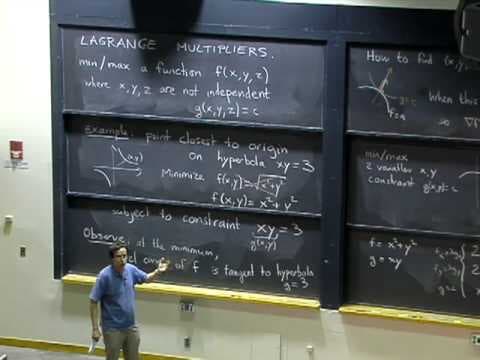
Lecture 13: Lagrange Multipliers (18.02)
The lecture provides a comprehensive treatment of the method of Lagrange multipliers for constrained optimization problems, illustrating its geometric and algebraic interpretations.
Lecture 14: Non-Independent Variables (18.02)
This lecture examines scenarios involving non-independent variables in multivariable calculus, focusing on the implications for differentiation and optimization when variables are related.
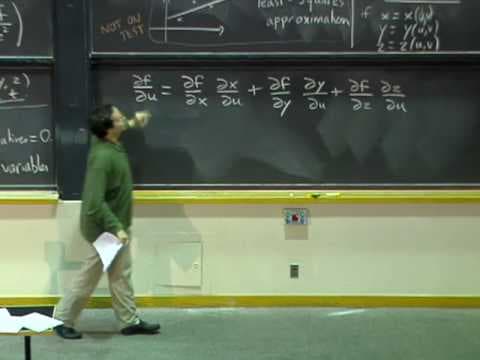
Lecture 15: Partial Differential Equations; Review (18.02)
This session offers an introduction to partial differential equations (PDEs), discussing basic concepts and methods for solving simple forms. It also includes a comprehensive review of previous topics.
Lecture 16: Double Integrals (18.02)
The lecture introduces double integrals, explaining their geometric interpretation for calculating volumes and their applications in computing areas over various regions.
Lecture 17: Double Integrals in Polar Coords; Applications (18.02)
This session demonstrates how to evaluate double integrals using polar coordinates, particularly beneficial for regions with circular symmetry, and explores their applications.
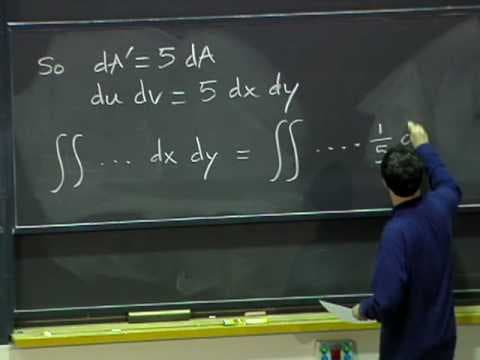
Lecture 18: Change of Variables (18.02)
This lecture delves into the technique of change of variables in multiple integrals, with a particular focus on the Jacobian determinant and its role in transforming coordinate systems.
Lecture 19: Vector Fields and Line Integrals in the Plane (18.02)
The lecture introduces vector fields and their visualization, then defines line integrals in the plane and discusses their computation over various paths.
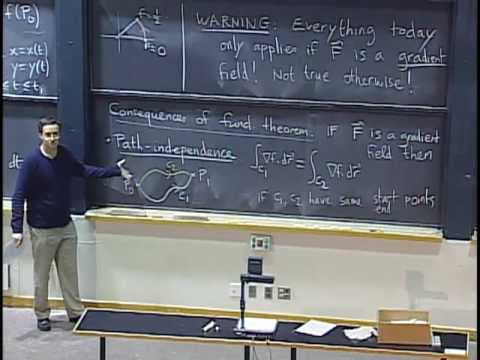
Lecture 20: Path Independence and Conservative Fields (18.02)
This session examines the concept of path independence for line integrals and introduces conservative vector fields, exploring their properties and identification criteria.
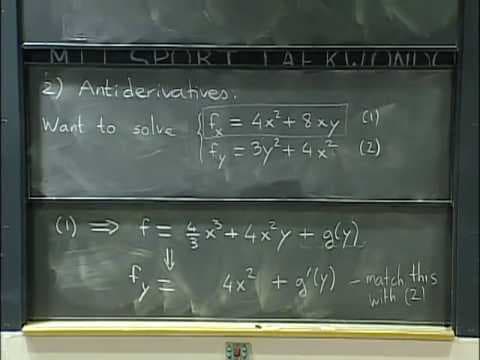
Lecture 21: Gradient Fields and Potential Functions (18.02)
This lecture explores the relationship between gradient fields and potential functions, demonstrating how to find a potential function for a given conservative vector field.
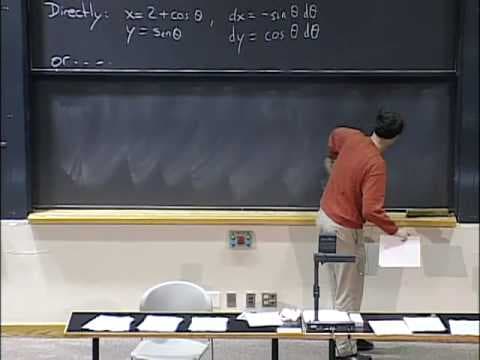
Lecture 22: Green's Theorem (18.02)
The lecture provides a detailed exposition of Green's Theorem, illustrating its application in relating line integrals around a simple closed curve to double integrals over the region it encloses.