Marine Chemistry and Global Biogeochemical Cycles
Quantitative study of chemical equilibria and biological cycling in the oceans, analyzing carbonate chemistry, trace metal biogeochemistry, isotopic tracers, and the global carbon cycle.
Faculty & visiting speakers
Complete university courses recorded at MIT.
Quantitative study of chemical equilibria and biological cycling in the oceans, analyzing carbonate chemistry, trace metal biogeochemistry, isotopic tracers, and the global carbon cycle.
Constrained utility maximization, demand elasticity, production functions, competitive equilibrium, welfare theorems, monopoly pricing, oligopoly, externalities, and asymmetric information.
Formal analysis of strategic interaction in economic environments, developing static and dynamic games of complete and incomplete information, signaling, bargaining, and auction theory.
Microeconomic analysis of government fiscal policy, examining market failures, externalities, public goods, social insurance design, optimal taxation, and empirical policy evaluation.
Nobel laureates Esther Duflo and Abhijit Banerjee analyze poverty traps, randomized controlled trials, nutrition, preventive health, education incentives, microcredit, insurance, and institutional governance.
Systems engineering case study of the Space Shuttle taught by NASA's former Space Shuttle program manager and astronauts: main engines, thermal protection tiles, avionics, aerodynamics, and Columbia/Challenger lessons.
Gilbert Strang bridges numerical linear algebra and modern machine learning: singular value decomposition, low-rank approximations, Eckart-Young theorem, randomized linear algebra, and stochastic gradient descent.
Gilbert Strang's gold-standard MIT undergraduate course building geometric and algebraic intuition for systems of equations, vector spaces, orthogonality, determinants, and eigenvalues.
Combinatorial and algebraic methods in applied mathematics, covering generating functions, probabilistic method, extremal graph theory, linear programming duality, and error-correcting codes.
Michael Sipser's definitive course on finite automata, context-free grammars, Turing machines, decidability, reducibility, time and space complexity, NP-completeness, and interactive proofs.
Linear regression, time-series econometrics, stochastic calculus, Itô's lemma, Black-Scholes option pricing, portfolio optimization, volatility modeling, and risk management.
Foundational MIT algorithms course covering asymptotic complexity, divide-and-conquer, hashing, balanced search trees, graph search, shortest paths, and dynamic programming.
Discrete mathematical foundations for theoretical computer science: proof techniques, well-ordering, number theory, RSA cryptography, graph theory, recurrences, generating functions, and discrete probability.
MIT's upper-level algorithms sequence advancing into divide-and-conquer FFT, amortized analysis, randomized algorithms, network flow, linear programming, NP-completeness, and approximation.
Systematic engineering of fast software: Bentley optimization rules, bit hacks, compiler vectorization, Cilk work-span parallelism, cache-oblivious algorithms, memory allocators, and lock-free synchronization.
Rigorous graduate treatment of modern deep learning foundations at MIT, covering optimization dynamics, representation learning, sequence modeling, generative architectures, and generalization theory.
MIT's flagship graduate distributed systems course examining MapReduce, RPC, Google File System, primary-backup replication, Raft consensus, ZooKeeper, and distributed transactions.
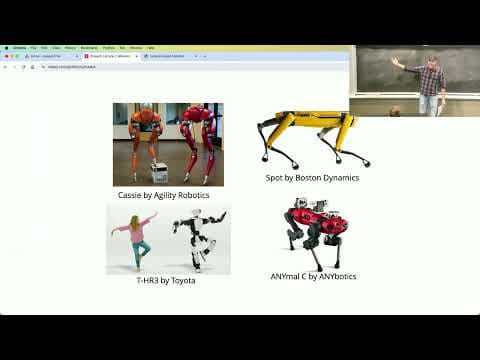
Nonlinear dynamics, phase-portrait geometry, dynamic programming, trajectory optimization, Lyapunov sum-of-squares verification, legged locomotion, and contact-rich manipulation.
Self-contained seminars, public lectures, and invited talks.
Harold Abelson's inaugural lecture for MIT's 6.001, "Structure and Interpretation of Computer Programs," introduces Lisp as a foundational tool for computational abstraction.
Professor Herb Gross introduces the core concepts of analytic geometry, laying the essential groundwork for the study of single variable calculus within the MIT curriculum.
From MIT OpenCourseWare, this lecture rigorously dissects the Chernobyl accident, analyzing the inherent design flaws of the RBMK reactor and the cascade of human errors exacerbated by Soviet institutional culture.
An in-depth MIT lecture on developing system dynamics models, focusing on predator-prey interactions, carrying capacity, and the structure of reinforcing and balancing feedback loops.
A foundational lecture from MIT's 6.034 course, delving into classic search algorithms including depth-first and hill-climbing techniques in artificial intelligence.
A core lecture from MIT's 6.302 course, providing a detailed analysis of operational amplifier compensation strategies for stable circuit design.
Auditory/visual transduction, psychophysical thresholds, and hardware-accelerated DNA analysis
MIT · ETH Zürich
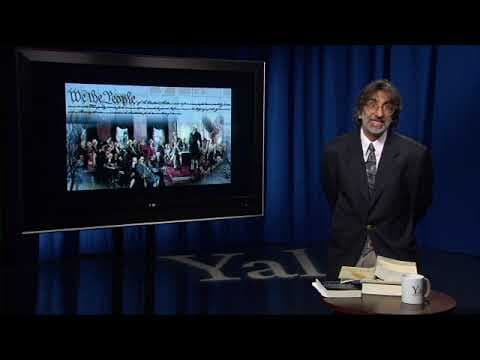
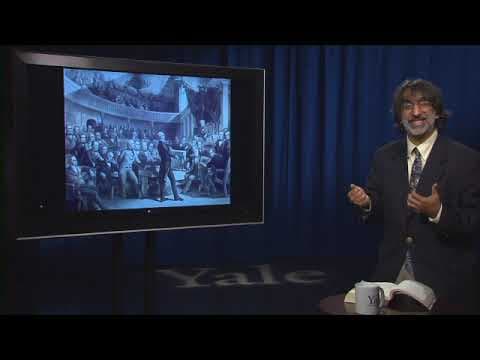

Written text, unwritten constitutional norms, game-theoretic dominance, and externalities
Yale University · MIT
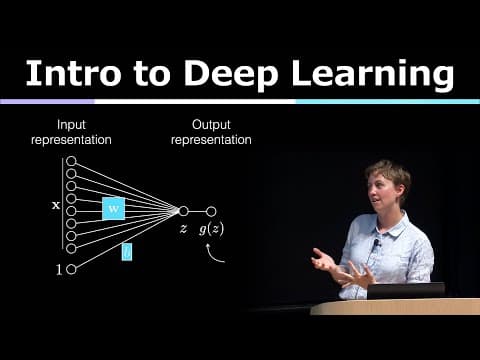
Neural approximation theorems, optimization dynamics, and relational query engines
MIT · Carnegie Mellon University
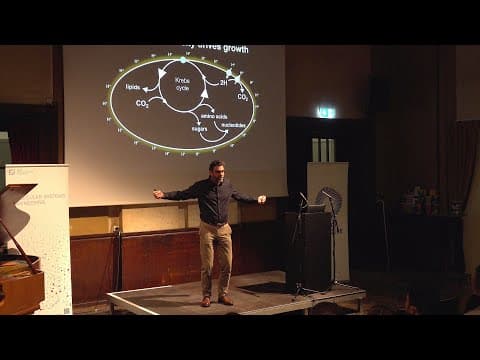
Quantum orbitals, proton gradients, bioelectric patterning, and paleogenomics
MIT · Yale University · Royal Institution +2
Browse every recorded lecture from MIT.