
Differential Equations
Prof. Arthur MattuckDirection fields, first-order and second-order linear ODEs, complex exponentials, resonance, Fourier series, Laplace transforms, Dirac delta impulses, and linear systems.
Syllabus
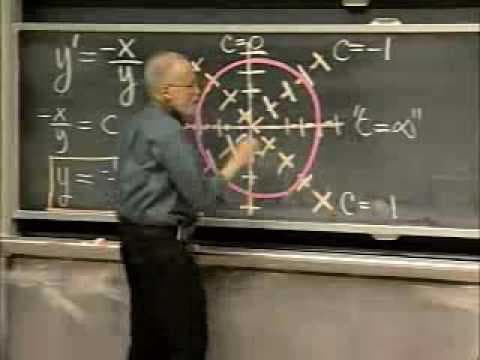
21Direction Fields and Integral Curves (MIT 18.03, Lecture 1)
This inaugural lecture introduces the geometrical interpretation of first-order ordinary differential equations, focusing on the construction and analysis of direction fields and their corresponding integral curves.

Euler's Numerical Method for y'=f(x,y) and its Generalizations (MIT 18.03, Lecture 2)
This lecture introduces Euler's numerical method for approximating solutions to first-order ordinary differential equations of the form y'=f(x,y), detailing its iterative procedure and discussing its fundamental role in computational differential equations.
First-order Linear ODEs: Steady-state and Transient Solutions (MIT 18.03, Lecture 3)
This lecture introduces methods for solving first-order linear ordinary differential equations, distinguishing between steady-state and transient solution components. It analyzes their behavior over time.
First-Order Substitution Methods: Bernoulli and Homogeneous ODEs (MIT 18.03, Lecture 4)
This lecture details first-order substitution methods for solving ordinary differential equations. It specifically addresses the Bernoulli equation and techniques for handling homogeneous ODEs.
First-order Autonomous ODEs: Qualitative Methods and Applications (MIT 18.03 Differential Equations, Lecture 5)
This lecture from MIT's 18.03 course introduces first-order autonomous ordinary differential equations, focusing on qualitative analysis techniques such as phase lines to understand solution behavior without explicit integration.
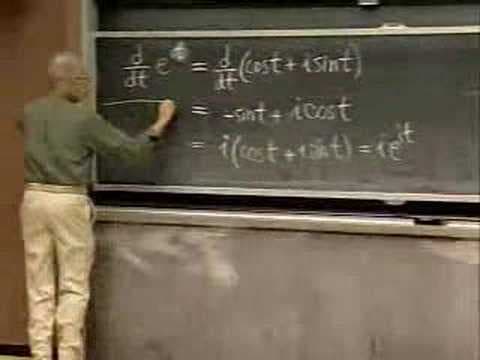
Complex Numbers and Complex Exponentials (MIT 18.03, Lecture 6)
This lecture from MIT's 18.03 Differential Equations course introduces the foundational concepts of complex numbers and their representation, culminating in Euler's formula and the properties of complex exponentials crucial for solving linear ODEs.
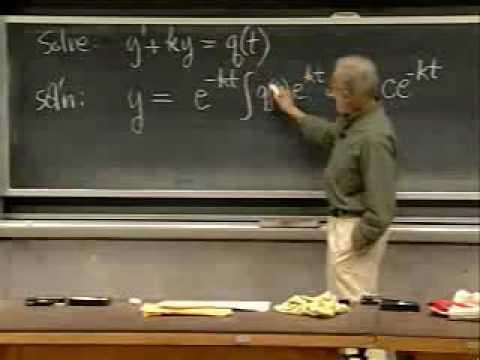
First-order Linear Differential Equations with Constant Coefficients (MIT 18.03, Lecture 7)
This lecture explores the behavior of solutions to first-order linear ordinary differential equations with constant coefficients, introducing complex exponential methods for systematic analysis.
Lecture 8: Applications to Temperature, Mixing, RC-Circuit, Decay, and Growth Models (18.03)
This lecture explores practical applications of differential equations, analyzing models for temperature dynamics, chemical mixing, RC-circuits, and exponential decay and growth.
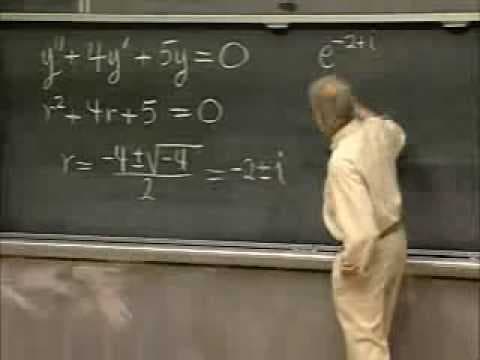
Lecture 9: Solving Second-order Linear ODE's with Constant Coefficients: The Three Cases (18.03)
This session details the methodology for solving second-order linear ordinary differential equations with constant coefficients, examining the three distinct cases based on characteristic roots.
Lecture 10: Complex Characteristic Roots; Undamped and Damped Oscillations (18.03)
The lecture extends the analysis of second-order ODEs to cases involving complex characteristic roots, illustrating the dynamics of undamped and damped oscillations.
Lecture 11: Theory of General Second-order Linear Homogeneous ODE's: Superposition, Uniqueness, Wronskians (18.03)
This lecture establishes the fundamental theory for general second-order linear homogeneous ordinary differential equations, covering the principles of superposition, uniqueness, and Wronskians.
Lecture 12: General Theory for Inhomogeneous ODE's; Stability Criteria for Constant-coefficient ODE's (18.03)
This session continues the general theory, focusing on inhomogeneous ordinary differential equations and outlining stability criteria specifically for constant-coefficient ODEs.
Lecture 13: Finding Particular Solutions to Inhomogeneous ODE's: Operator and Solution Formulas Involving Exponentials (18.03)
This lecture explores methods for determining particular solutions to inhomogeneous ordinary differential equations, emphasizing operator and solution formulas utilizing exponentials.
Lecture 14: Interpretation of the Exceptional Case: Resonance (18.03)
The lecture examines the exceptional case of resonance in differential equations, providing a detailed interpretation of this critical phenomenon and its implications.
Lecture 15: Introduction to Fourier Series; Basic Formulas for Period 2π (18.03)
This lecture introduces the foundational concepts of Fourier Series, detailing the basic formulas for functions with a period of 2π and their importance in signal analysis.
Lecture 16: More General Periods; Even and Odd Functions; Periodic Extension (18.03)
The session expands on Fourier Series, addressing more general periods, the properties of even and odd functions, and the technique of periodic extension.
Lecture 17: Finding Particular Solutions via Fourier Series; Resonant Terms; Hearing Musical Sounds (18.03)
This lecture demonstrates finding particular solutions using Fourier Series, discussing resonant terms and illustrating the application to the physics of musical sounds.
Lecture 19: Introduction to the Laplace Transform; Basic Formulas (18.03)
This lecture provides an introduction to the Laplace Transform, covering its definition and presenting the fundamental formulas essential for solving differential equations.
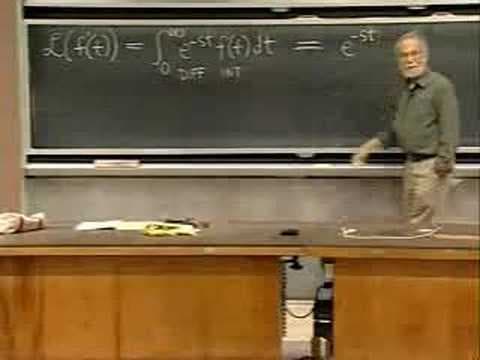
Lecture 20: Derivative Formulas; Using the Laplace Transform to Solve Linear ODE's (18.03)
The lecture elaborates on derivative formulas within the Laplace Transform framework, showcasing its application for solving linear ordinary differential equations effectively.
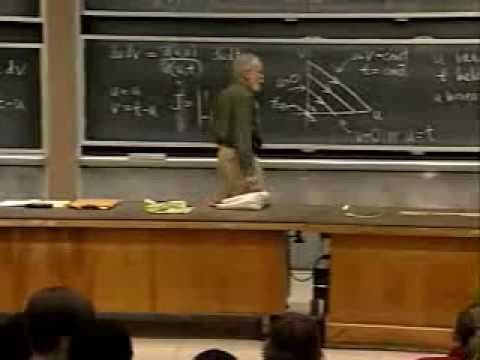
Lecture 21: Convolution Formula: Proof, Connection with Laplace Transform, Application to Physical Problems (18.03)
This session presents the convolution formula, detailing its proof and connection to the Laplace Transform, and demonstrates its utility in solving various physical problems.
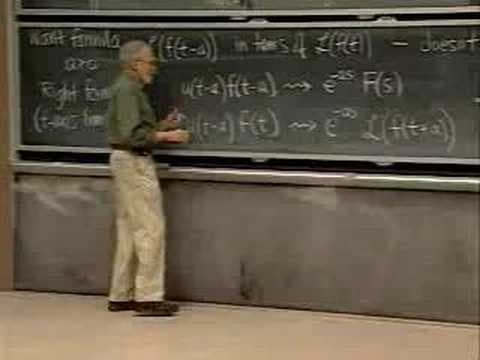
Lecture 22: Using Laplace Transform to Solve ODE's with Discontinuous Inputs (18.03)
The lecture focuses on leveraging the Laplace Transform to efficiently solve ordinary differential equations that involve discontinuous input functions, such as step or impulse functions.