
Linear Algebra
Prof. Gilbert StrangGilbert Strang's gold-standard MIT undergraduate course building geometric and algebraic intuition for systems of equations, vector spaces, orthogonality, determinants, and eigenvalues.
Syllabus
21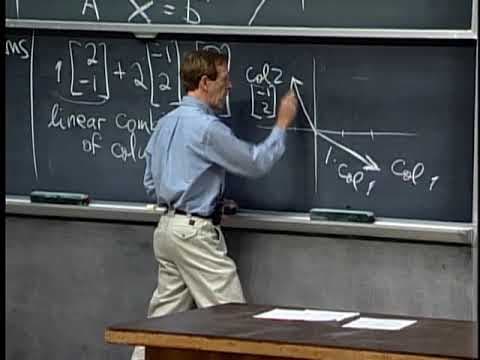
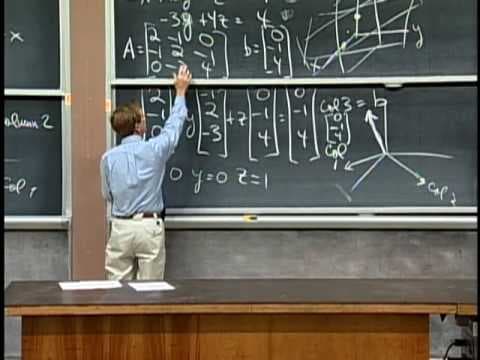
Lecture 1: The Geometry of Linear Equations (18.06)
This lecture explores the fundamental geometric interpretations of linear equations, delving into row pictures and column pictures to visualize solution sets and vector spaces in two and three dimensions.
Elimination with Matrices
Turns Gaussian elimination from tedious bookkeeping into matrix algebra by deriving elimination and row-exchange matrices from first principles.
Matrix Multiplication and Inverse Matrices
The rank-1 outer-product view of matrix multiplication taught at 16:00 is essential preparation for SVD, PCA, and low-rank adaptation (LoRA) in ML.
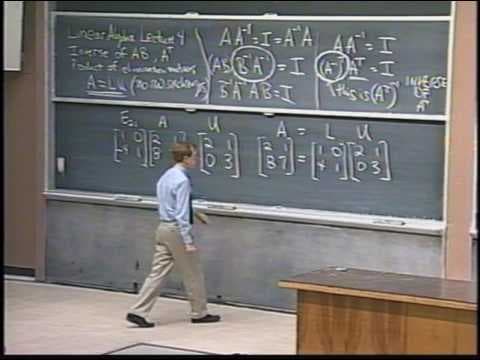
MIT 18.06 Lecture 4: Factorization into A = LU
Shows why inverse elementary matrices assemble without cross-terms into lower-triangular L, yielding A = LU and quantifying the exact (1/3)n³ operation count of Gaussian elimination.
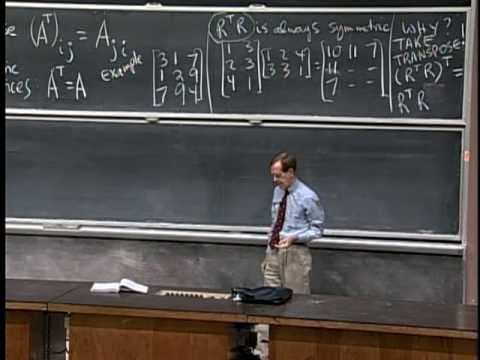
MIT 18.06 Lecture 5: Transposes, Permutations & Vector Spaces R^n
Marks the transition from row operations to genuine vector-space geometry: symmetric matrices RᵀR, P⁻¹ = Pᵀ for permutation matrices, subspaces of ℝⁿ, and closure under linear combinations.
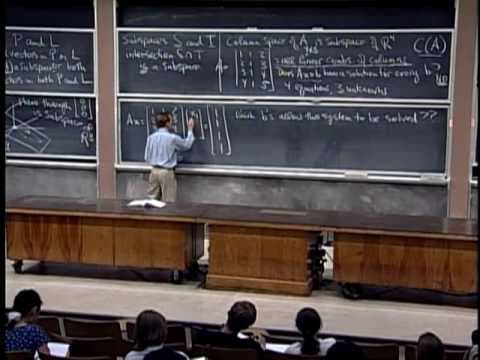
MIT 18.06 Lecture 6: Column Space and Nullspace
Introduces the first two of Strang's Four Fundamental Subspaces—connecting solvability of Ax = b to C(A) and uniqueness of solutions to N(A).
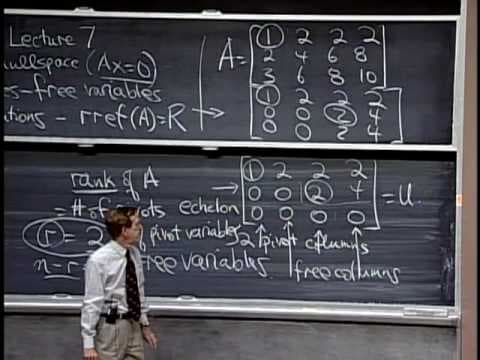
MIT 18.06 Lecture 7: Solving Ax = 0 — Pivot Variables, Free Variables & Rank
Systematic algorithm for computing a basis of the nullspace N(A) from echelon form, proving why dim N(A) = n - r free variables.
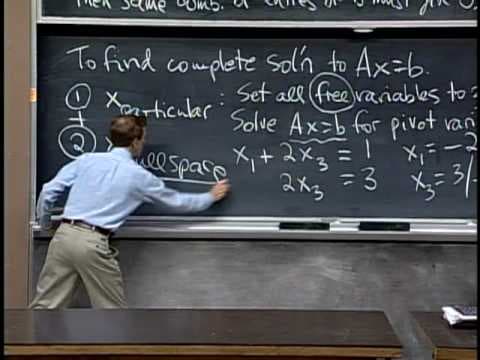
MIT 18.06 Lecture 8: Solving Ax = b — Complete Solutions & Full Rank Cases
Unifies linear systems completely: x_complete = x_particular + x_nullspace, classifying full column rank, full row rank,full invertible rank, and rank-deficient matrices.
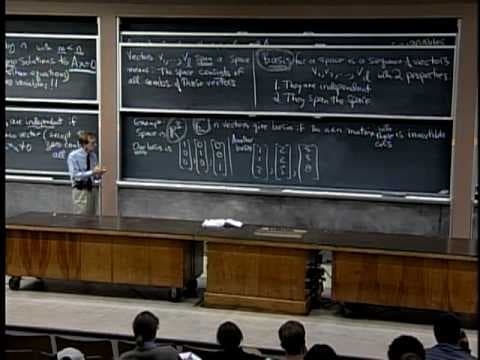
Lecture 9: Independence, Basis, and Dimension (18.06)
This session rigorously defines linear independence, spanning sets, and basis vectors, culminating in the formal definition of dimension for vector spaces and subspaces.
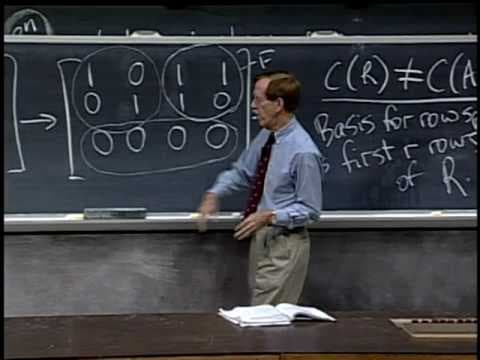
Lecture 10: The Four Fundamental Subspaces (18.06)
The lecture introduces the crucial concepts of the column space, null space, row space, and left null space of a matrix, elucidating their interrelationships and orthogonal properties.
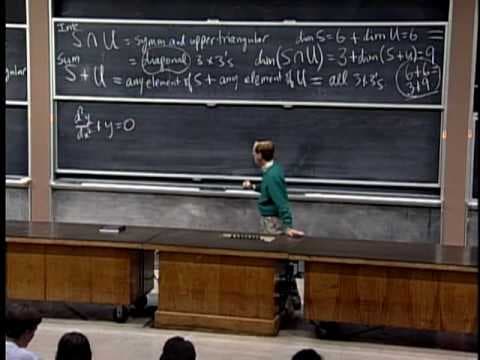
Lecture 11: Matrix Spaces; Rank 1; Small World Graphs (18.06)
This lecture examines different types of matrix spaces, with a focus on rank-1 matrices and their construction. It also introduces the concept of small-world graphs as an application.
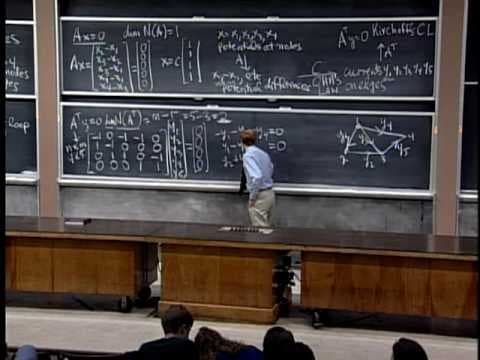
Lecture 12: Graphs, Networks, Incidence Matrices (18.06)
This session explores the connection between linear algebra and graph theory, demonstrating how incidence matrices represent graphs and their properties in network analysis.
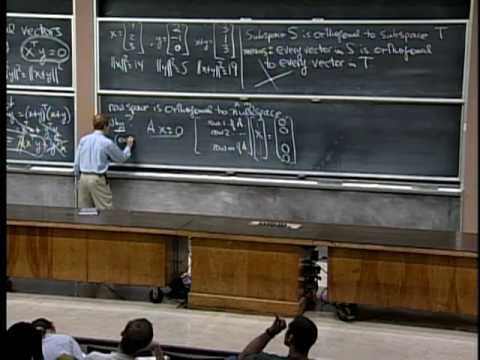
Lecture 14: Orthogonal Vectors and Subspaces (18.06)
This lecture introduces the concept of orthogonal vectors and subspaces, establishing the conditions for orthogonality and its significance in vector space decomposition.
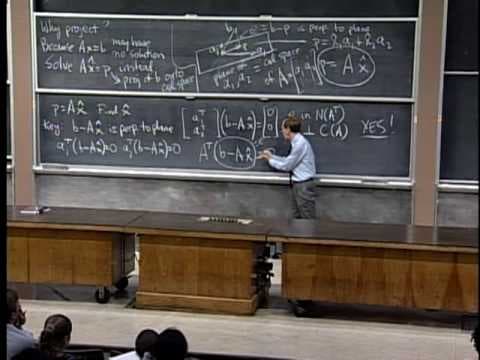
Lecture 15: Projections onto Subspaces (18.06)
The session details the process of projecting a vector onto a subspace, deriving the projection formula and its geometric interpretation in finding the closest point.
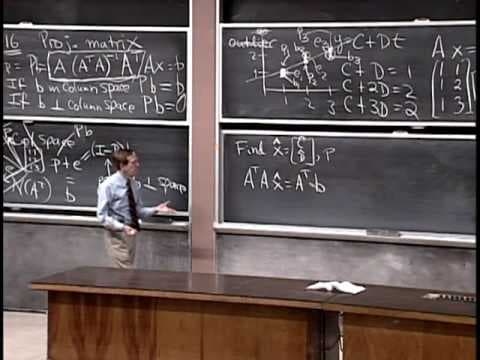
Lecture 16: Projection Matrices and Least Squares (18.06)
This lecture explores the construction and properties of projection matrices, demonstrating their application in solving overdetermined systems via the method of least squares.

Lecture 17: Orthogonal Matrices and Gram-Schmidt (18.06)
This session introduces orthogonal matrices and their properties, followed by a detailed explanation of the Gram-Schmidt orthonormalization process for constructing orthonormal bases.
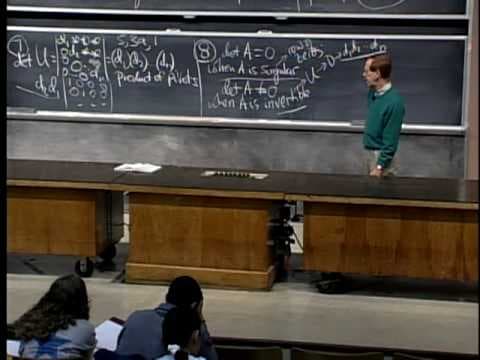
Lecture 18: Properties of Determinants (18.06)
This lecture systematically covers the axiomatic properties of determinants, including their behavior under row operations, transposition, and scalar multiplication.
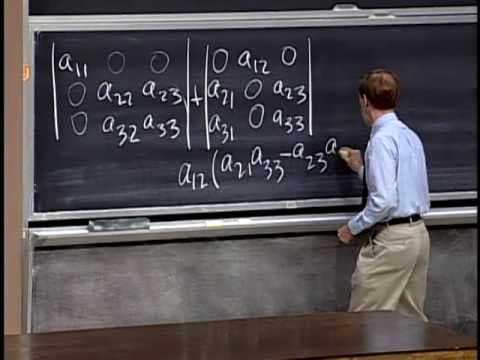
Lecture 19: Determinant Formulas and Cofactors (18.06)
This session derives explicit formulas for determinants using permutations and introduces the cofactor expansion method for calculating determinants of arbitrary size matrices.
Lecture 20: Cramer's Rule, Inverse Matrix, and Volume (18.06)
This lecture presents Cramer's Rule for solving linear systems, connects the adjoint matrix to the inverse, and illustrates the geometric interpretation of determinants as volume.
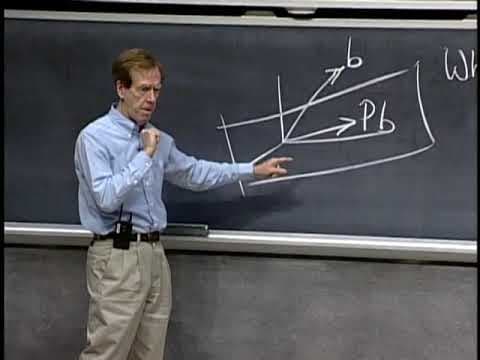
Lecture 21: Eigenvalues and Eigenvectors (18.06)
This foundational lecture introduces the concepts of eigenvalues and eigenvectors, demonstrating their significance in understanding matrix transformations and system dynamics.
The Geometry of Linear Equations
Widely cited across Hacker News and math forums as the single clearest opening lecture in undergraduate mathematics: reframes systems of equations as linear combinations of column vectors within 15 minutes.