
Real Analysis
Prof. Casey RodriguezRigorous proof-based analysis of the real numbers, completeness, metric compactness, continuity, uniform convergence, differentiation, and the Riemann integral.
Syllabus
22Lecture 1: Sets, Set Operations and Mathematical Induction
This introductory lecture from MIT's Real Analysis course establishes foundational concepts in set theory and introduces formal proof writing, with an emphasis on the principle of mathematical induction for proving properties across natural numbers.
Lecture 2: Cantor's Theory of Cardinality (Size)
This lecture introduces Georg Cantor's foundational theory of set cardinality, defining injections, surjections, and bijections to formally compare the "size" of infinite sets. It rigorously demonstrates the countability of the rational numbers.
Lecture 3: Cantor's Remarkable Theorem and the Rationals' Lack of the Least Upper Bound Property
This lecture extends Cantor's foundational work on cardinality, progressing to ordered sets and the definition of the real numbers. It rigorously demonstrates the incompleteness of the rational numbers via their failure to satisfy the least upper bound property.
Lecture 4: The Characterization of the Real Numbers
This lecture introduces the foundational axiomatic properties of fields and ordered fields, culminating in the complete characterization of the real numbers via the completeness axiom, a cornerstone of real analysis.
Lecture 5: The Archimedian Property, Density of the Rationals, and Absolute Value
This lecture introduces the Archimedean property for real numbers, demonstrates the density of the rationals within the reals, and rigorously defines the absolute value function and its derived properties.
Lecture 6: The Uncountabality of the Real Numbers
This lecture proves the uncountability of the real numbers using Cantor's diagonalization argument, establishing that the irrational numbers significantly outnumber the rationals. It also introduces the triangle inequality, sequences, and limits of real numbers, foundational concepts in analysis.
Lecture 7: Convergent Sequences of Real Numbers
This lecture introduces the formal definition of convergent sequences in real analysis, focusing on the properties of monotone sequences and the utility of subsequences in proving convergence or divergence.
Lecture 8: The Squeeze Theorem and Operations Involving Convergent Sequences
This lecture explicates the Squeeze Theorem for convergent sequences and demonstrates its application to various algebraic operations, including quotients, absolute values, and square roots.
Lecture 9: Limsup, Liminf, and the Bolzano-Weierstrass Theorem (18.100A)
This lecture introduces limit inferiors and limit superiors, then employs these concepts to rigorously prove the Bolzano-Weierstrass theorem, demonstrating that every bounded sequence possesses a convergent subsequence.
Lecture 10: The Completeness of the Real Numbers and Basic Properties of Infinite Series (18.100A)
The session defines Cauchy sequences and establishes the completeness of the real numbers, proving every Cauchy sequence converges. It then transitions to infinite series, starting with geometric series.
Lecture 11: Absolute Convergence and the Comparison Test for Series (18.100A)
This lecture delves into the convergence of infinite series, defining absolute convergence and proving the comparison test. Properties of p-series are also established.
Lecture 12: The Ratio, Root, and Alternating Series Tests (18.100A)
This session introduces and proves three crucial tests for determining the convergence of infinite series: the ratio test, the root test, and the alternating series test.
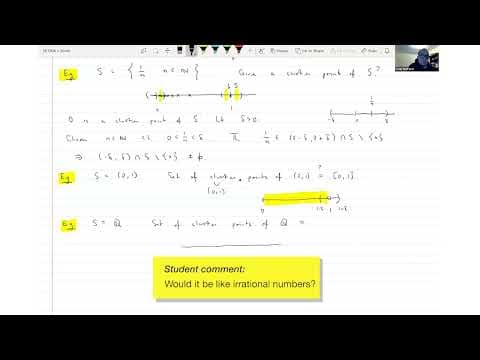
Lecture 13: Limits of Functions (18.100A)
This lecture initiates the study of limits of functions, introducing concepts such as cluster points and one-sided limits, which are foundational for understanding continuity.
Lecture 14: Limits of Functions in Terms of Sequences and Continuity (18.100A)
This lecture explores the fundamental connection between limits of functions and limits of sequences, establishing how continuity provides a crucial link for proving results in single-variable calculus.
Lecture 15: The Continuity of Sine and Cosine and the Many Discontinuities of Dirichlet's Function (18.100A)
This lecture demonstrates the continuity of sine and cosine functions and explores algebraic properties of continuous functions. It also defines the Dirichlet function, highlighting its extensive discontinuities.
Lecture 16: The Min/Max Theorem and Bolzano's Intermediate Value Theorem (18.100A)
This lecture rigorously proves two cornerstone theorems of calculus: the Min/Max Theorem (Extreme Value Theorem) and Bolzano's Intermediate Value Theorem, examining the necessity of their hypotheses.
Lecture 17: Uniform Continuity and the Definition of the Derivative (18.100A)
This lecture concludes the study of continuous functions by introducing uniform continuity, demonstrating its equivalence to continuity on closed and bounded intervals. It then establishes the formal definition of the derivative.
Lecture 18: Weierstrass's Example of a Continuous and Nowhere Differentiable Function (18.100A)
This lecture addresses whether continuity implies differentiability, constructing Weierstrass's famous continuous but nowhere differentiable function using the oscillatory properties of sine and cosine.
Lecture 19: Differentiation Rules, Rolle's Theorem, and the Mean Value Theorem (18.100A)
This lecture provides rigorous proofs for fundamental differentiation rules, including the product, quotient, and chain rules. It also establishes Rolle's Theorem and the Mean Value Theorem, exploring their applications.
Lecture 20: Taylor's Theorem and the Definition of Riemann Sums (18.100A)
This lecture covers Taylor's Theorem, derived as a direct consequence of repeated applications of the Mean Value Theorem. It also initiates the study of the Riemann integral, defining partitions and Riemann sums.
Lecture 21: The Riemann Integral of a Continuous Function (18.100A)
This lecture continues the study of the Riemann integral, demonstrating the convergence of Riemann sums for continuous functions on bounded intervals. It also begins exploring the essential properties of the Riemann integral.
Lecture 22: Fundamental Theorem of Calculus, Integration by Parts, and Change of Variable Formula (18.100A)
This lecture proves key properties of the Riemann integral, including the triangle inequality, integration by parts, and the change of variable formula. It also establishes the Fundamental Theorem of Calculus.