
Quantum Physics I
Prof. Allan AdamsAllan Adams's celebrated MIT Spring 2013 lecture sequence introducing quantum superposition, Bell's inequalities, wavefunctions, Hermitian operators, uncertainty relations, and the Schrödinger equation.
Syllabus
22MIT 8.04 Lecture 1: Introduction to Quantum Superposition
Famous MIT OCW opening lecture (9M+ views): Allan Adams builds chained Mach-Zehnder electron color/hardness boxes on the chalkboard until every classical hidden-variable explanation collapses.
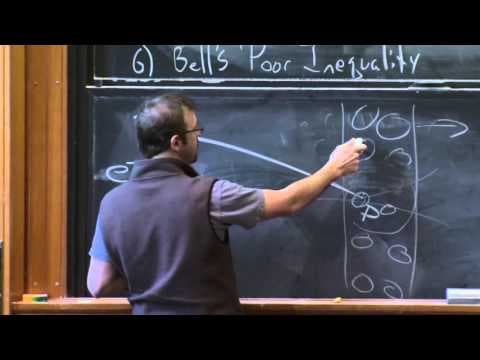
MIT 8.04 Lecture 2: Experimental Facts of Life — Photoelectric Effect, Double Slit & Bell
Surveys the empirical shocks that forced quantum mechanics into existence: Planck-Einstein quanta, Davisson-Germer electron diffraction, atomic spectra, and EPR/Bell nonlocality.
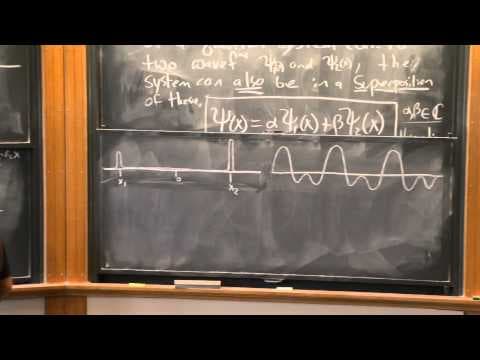
MIT 8.04 Lecture 3: The Wave Function, Born's Rule & Fourier Wave Packets
Translates physical superposition into complex-valued L² wavefunctions ψ(x), Born probability density |ψ(x)|², de Broglie momentum waves, and Fourier transform duality.
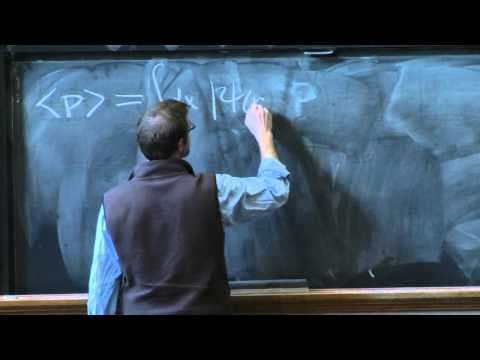
MIT 8.04 Lecture 4: Expectation Values, Momentum Operator & Heisenberg Uncertainty
Shows why momentum in position space must be the differential operator -iℏ ∂/∂x and how non-commutativity [x̂, p̂] = iℏ enforces Δx·Δp ≥ ℏ/2.
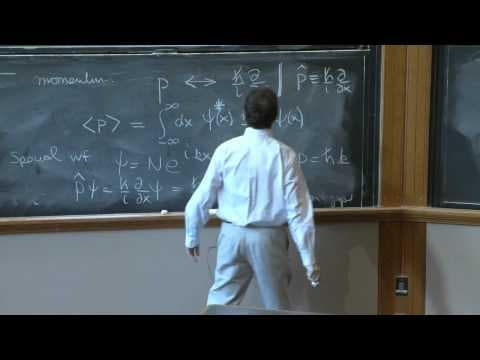
MIT 8.04 Lecture 5: Linear Operators, Eigenfunctions & The Schrödinger Equation
Connects observable measurements to eigenvalues of Hermitian operators and derives the energy operator Ĥ = p̂²/2m + V(x).
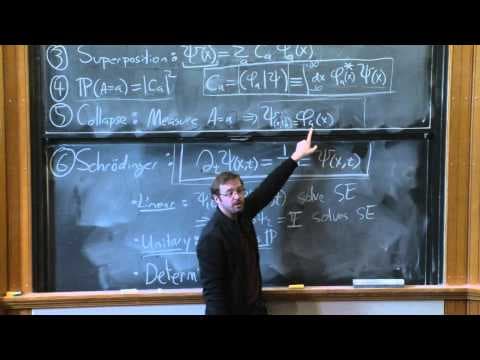
MIT 8.04 Lecture 6: Unitary Time Evolution, Stationary States & Infinite Square Well
Demonstrates how energy eigenstates evolve by pure phase factors e^(-iEt/ℏ) while superpositions slosh interference terms back and forth in space.
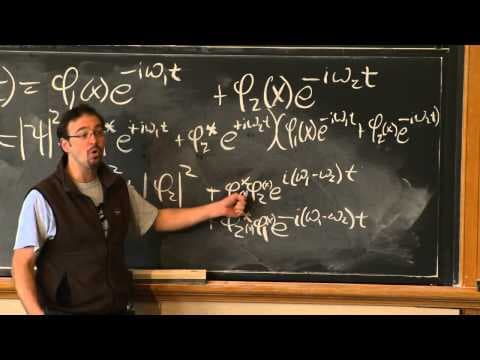
Lecture 7: More on Energy Eigenstates
Professor Allan Adams elucidates the application of energy eigenfunctions for solving time evolution problems in quantum mechanics. The lecture details the properties and characteristics of energy eigenfunctions and their superpositions.
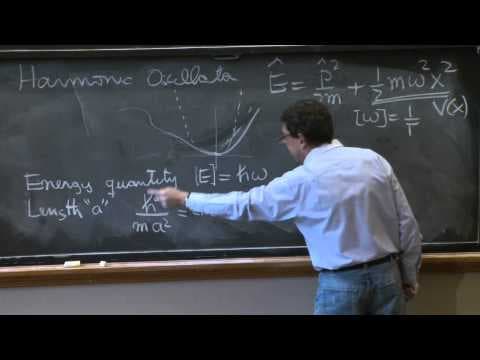
Lecture 8: Quantum Harmonic Oscillator
In this lecture, Prof. Zwiebach covers the quantum mechanics of harmonic oscillators. He begins with qualitative discussion on bound state solutions and then moves on to the quantitative treatment of harmonic oscillators.
Lecture 9: Operator Methods for the Harmonic Oscillator (8.04)
This lecture explores an alternative framework for solving the quantum harmonic oscillator problem by employing creation and annihilation operators. The algebraic approach simplifies complex calculations.
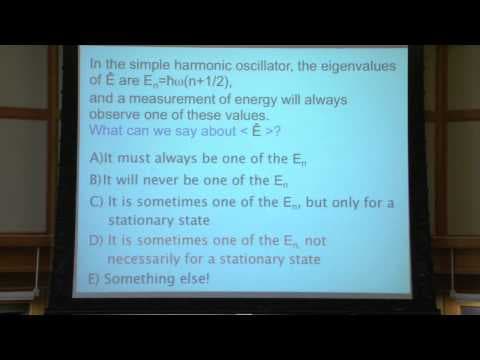
Lecture 10: Clicker Bonanza and Dirac Notation (8.04)
This session provides a comprehensive review of foundational quantum mechanics concepts through a series of multiple-choice questions. It then introduces the powerful and concise Dirac notation for quantum states and operators.
Lecture 11: Dispersion of the Gaussian and the Finite Well (8.04)
This lecture delves into the qualitative characteristics of quantum mechanical bound states, examining the dispersion of Gaussian wave packets. It thoroughly solves the finite potential well problem, a crucial model for bound states.
Lecture 12: The Dirac Well and Scattering off the Finite Step (8.04)
The lecture examines the time evolution of Gaussian wave packets, both in free space and as they interact with potential steps. It specifically covers the properties and solutions for the Dirac delta potential well.
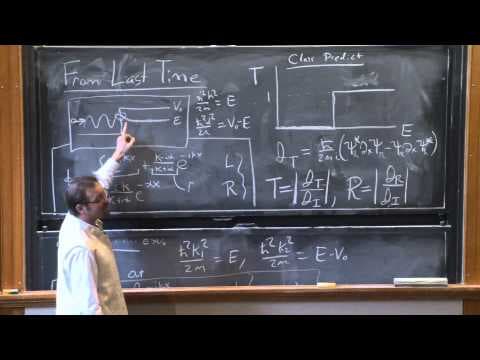
Lecture 13: More on Scattering (8.04)
This lecture introduces the concept of coherent states before expanding on one-dimensional scattering problems. It systematically analyzes particle interactions with both potential steps and potential barriers.
Lecture 14: Resonance and the S-Matrix (8.04)
This lecture investigates the resonance phenomena associated with potential barriers and wells. It progresses from simple plane wave cases to the more complex analysis involving wave packets, introducing the S-matrix formalism.
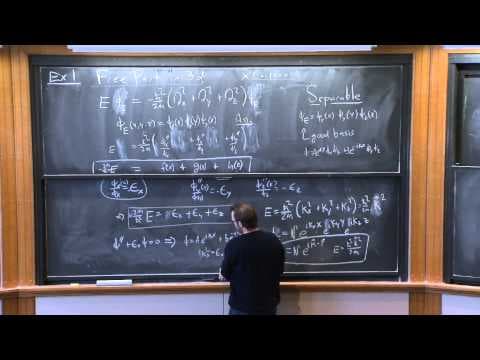
Lecture 15: Eigenstates of the Angular Momentum Part 1 (8.04)
This lecture explores energy degeneracy in three-dimensional quantum systems and its fundamental link to rotational symmetry. It meticulously derives angular momentum operators and their crucial commutation relations.
Lecture 16: Eigenstates of the Angular Momentum Part 2 (8.04)
Continuing the discussion on quantum angular momentum, this lecture elucidates the structure of angular momentum eigenvalues and introduces the corresponding eigenfunctions. Spherical harmonics are implicitly covered.
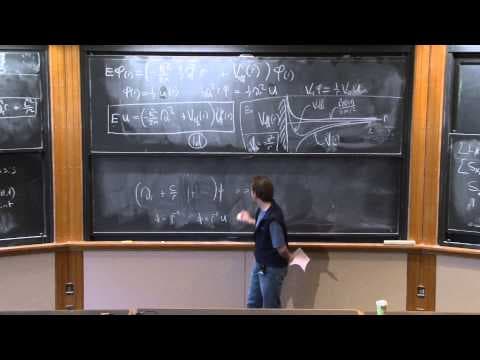
Lecture 17: More on Central Potentials (8.04)
This lecture provides a general discussion on the properties of central potentials in 3D, followed by solving the central potential problem. It presents a detailed quantum mechanical model of hydrogen atoms, highlighting key features.
Lecture 18: "Hydrogen" and its Discontents (8.04)
Building on the hydrogen atom model, this lecture introduces advanced concepts such as Runge-Lenz symmetry and relativistic corrections. It further covers the Zeeman effect and the fundamental Pauli exclusion principle.
Lecture 19: Identical Particles (8.04)
This lecture concludes the analysis of hydrogen atom magnetic moments before introducing the quantum mechanical formalism for systems containing multiple identical particles. It lays the groundwork for understanding particle indistinguishability and its implications in quantum statistics.
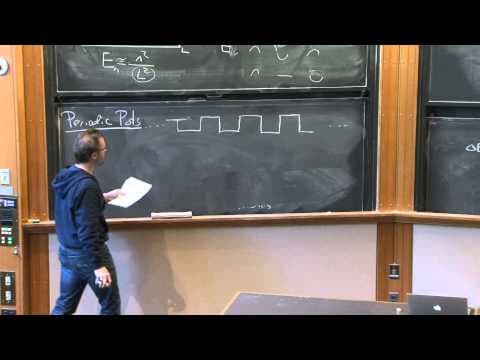
Lecture 20: Periodic Lattices Part 1 (8.04)
This lecture initiates the study of quantum mechanics in periodic potentials, analyzing energy structures and wave functions. It meticulously derives the energy band structure for a one-dimensional periodic delta potential.
Lecture 21: Periodic Lattices Part 2 (8.04)
Building upon previous results for periodic potentials, this lecture further explores energy band structures and delves into the physics of solids. It covers the implications of periodicity for electronic properties.
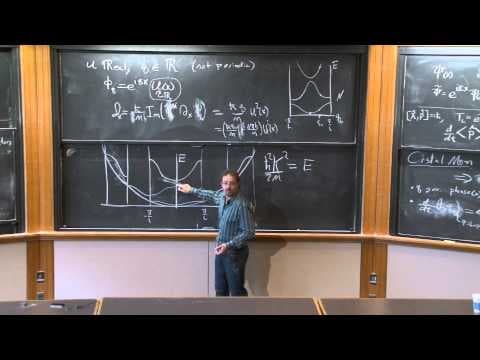
Lecture 22: Metals, Insulators, and Semiconductors (8.04)
This lecture applies band theory to explain the electronic properties classifying metals, insulators, and semiconductors. The latter part includes a historical overview of quantum entanglement, presented by guest lecturer Tom Levenson.