
Quantum Physics II
Prof. Barton ZwiebachDirac bra-ket formalism, spin-1/2 precession, unitary time evolution, coherent states, orbital and spin angular momentum addition, tensor products, and entanglement.
Syllabus
221. Wave Mechanics
This lecture introduces the fundamental principles of quantum wave mechanics, deriving the time-dependent and time-independent Schrödinger equations, and exploring their application to stationary solutions for quantum systems. It establishes the mathematical framework for understanding particle behavior at the quantum level.
2. Wave Mechanics (continued)
This lecture delves into the properties of energy eigenstates in one-dimensional quantum systems, exploring the nature of their spectra and introducing the variational principle for energy estimation.
3. Wave Mechanics (continued) and Stern-Gerlach Experiment
This lecture extends wave mechanics, delving into the quantum operators for position and momentum. It rigorously analyzes the Stern-Gerlach experiment as empirical evidence for spin angular momentum quantization.
4. Spin One-half, Bras, Kets, and Operators
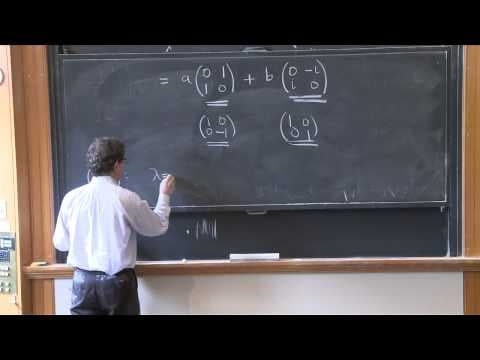
This lecture formally introduces spin-1/2 states within the framework of Dirac notation, elucidating the properties and applications of Pauli matrices and their role in representing quantum operators for spin in arbitrary directions.
5. Linear Algebra: Vector Spaces and Operators
In this lecture, the professor talked about vector spaces and dimensionality.
6. Linear Algebra: Vector Spaces and Operators (continued)
This lecture continues the formal development of linear algebra within quantum mechanics, focusing on the properties of vector spaces and the action of linear operators, including their matrix representations.
7. Linear Algebra: Vector Spaces and Operators (continued)
This lecture extends the analysis of complex vector spaces, rigorously defining inner products and examining the eigenvalues and eigenvectors of Hermitian operators, foundational concepts in quantum mechanics.
8. Linear Algebra: Vector Spaces and Operators (continued)
This lecture continues the formal development of linear algebra for quantum mechanics, detailing linear functionals, adjoint operators, and the properties of Hermitian and unitary operators within the context of Hilbert spaces.
Lecture 9: Dirac's Bra and Ket Notation (8.05)
This lecture introduces Dirac's bra-ket notation, transitioning from inner products to projection operators. It examines adjoint, Hermitian, and unitary operators, and the uncertainty of Hermitian operators.
Lecture 10: Uncertainty Principle and Compatible Observables (8.05)
The lecture explores the uncertainty of Hermitian operators and elaborates on the generalized uncertainty principle. Key concepts include the energy-time uncertainty relation and compatible observables.
Lecture 11: Uncertainty Principle and Compatible Observables (continued) (8.05)
Continuing the discussion on fundamental quantum concepts, this lecture deepens the analysis of the uncertainty principle. It further explores the implications of compatible observables in quantum systems.
Lecture 12: Quantum Dynamics (8.05)
This lecture introduces quantum dynamics, focusing on the harmonic oscillator and unitary time evolution. It rigorously derives the time-dependent Schrödinger equation from first principles.
Lecture 13: Quantum Dynamics (continued) | Heisenberg Picture (8.05)
Continuing the study of quantum dynamics, this session extends the Schrödinger equation. It introduces and develops the Heisenberg picture, contrasting it with the Schrödinger picture.
Lecture 14: Quantum Dynamics (continued) (8.05)
This lecture delves into the translation operator and introduces coherent states, examining their definitions and basic properties. It covers time evolution, uncertainties, and coherent states in the energy basis.
Lecture 15: Quantum Dynamics (continued) (8.05)
Focusing on advanced quantum states, this lecture explores squeezed vacuum states and their properties. It then generalizes to describe more complex squeezed states and their implications in quantum optics.
Lecture 16: Quantum Dynamics (continued) and Two State Systems (8.05)
This lecture introduces photon states and provides an introduction to two-state systems. It discusses spin precession in a magnetic field and views general two-state systems as spin systems.
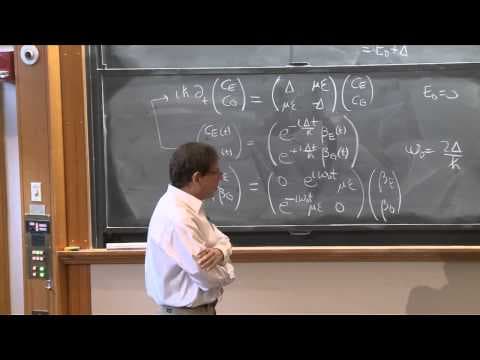
Lecture 17: Two State Systems (continued) (8.05)
Expanding on two-state systems, this lecture analyzes the ammonia molecule in an electric field as a practical example. It also introduces the principles of nuclear magnetic resonance (NMR).
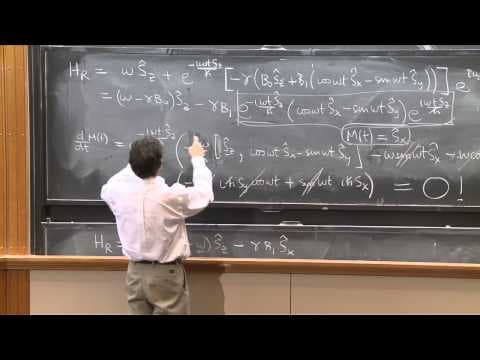
Lecture 18: Two State Systems (continued), Multiparticle States and Tensor Products (8.05)
This lecture continues with nuclear magnetic resonance applications and introduces multiparticle states. It rigorously defines and applies the tensor product for constructing composite quantum systems.
Lecture 19: Multiparticle States and Tensor Products (continued) (8.05)
Building on tensor products, this lecture introduces entangled states and the Bell basis states. It covers the foundational concepts of quantum teleportation and its theoretical framework.
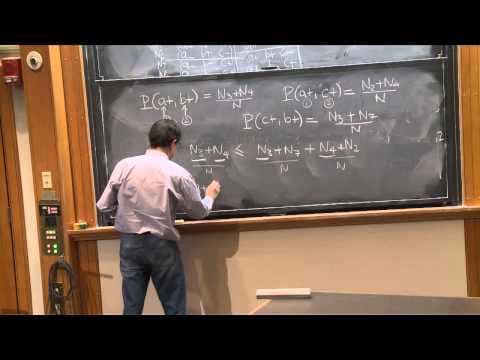
Lecture 20: Multiparticle States and Tensor Products (continued) and Angular Momentum (8.05)
This lecture critically examines EPR paradox and Bell inequalities, providing a theoretical foundation. It then transitions to orbital angular momentum and its role in central potentials.
Lecture 21: Angular Momentum (continued) (8.05)
This lecture focuses on the algebraic theory of angular momentum, developing its commutator relations and eigenvalues. It includes detailed comments on the properties and applications of spherical harmonics.
Lecture 22: Angular Momentum (continued) (8.05)
This lecture analyzes the radial equation for various systems, including the free particle and the infinite spherical well. It rigorously derives and interprets their energy eigenvalues and wave functions.