
The Early Universe
Alan GuthCosmological inflation pioneer Alan Guth develops Friedmann-Robertson-Walker dynamics, cosmic microwave background physics, big-bang nucleosynthesis, dark energy, and inflationary cosmology.
Syllabus
22Inflationary Cosmology: Is Our Universe Part of a Multiverse? Part I
Professor Alan Guth talks about the Big Bang, cosmic inflation, evidence for inflation, Cosmic Microwave Background (CMB), dark energy, and whether or not our universe is part of a multiverse.
Inflationary Cosmology: Is Our Universe Part of a Multiverse, Part II
Professor Alan Guth presents the theoretical foundations and observational evidence for cosmic inflation, exploring its implications for a multiverse and the role of anthropic arguments in cosmological selection. This lecture addresses the landscape problem and the nature of dark energy.
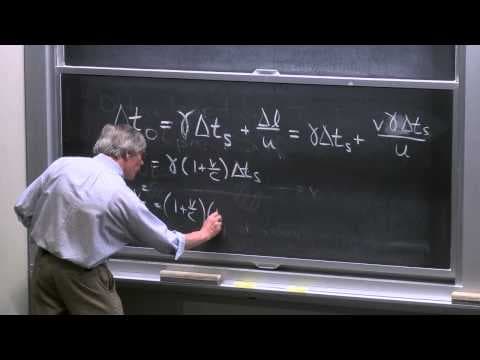
The Doppler Effect and Special Relativity
In this lecture, the professor discussed the doppler effect, time dilation, Lorentz-Fitzgerald contraction and relativity of simultaneity.
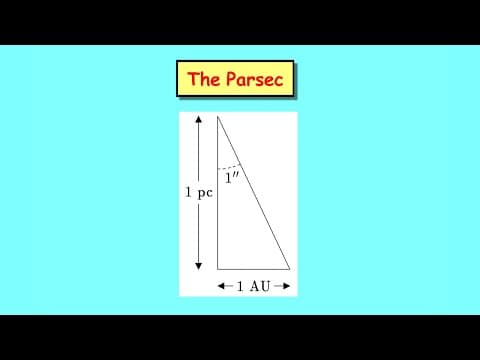
The Kinematics of the Homogeneous Expanding Universe
This lecture, part of MIT's 8.286 'The Early Universe' course, rigorously develops the kinematics of an expanding, homogeneous universe. It details Hubble's Law and explores the subtle distinctions between isotropy and homogeneity in cosmological models.
Cosmological Redshift and the Dynamics of Homogeneous Expansion, Part I
In this lecture, the professor quickly reviewed the homogeneous expanding universe, then discussed cosmological redshift and the dynamics of homogeneous expansion.
The Dynamics of Homogeneous Expansion, Part II
In this lecture, the professor talked about cosmological redshift and the dynamics of homogeneous expansion.
The Dynamics of Homogeneous Expansion, Part III
This lecture, from MIT's 'The Early Universe' course, delves into the dynamics of homogeneous expansion within cosmological models, summarizing the underlying mathematical framework and key conservation laws, likely including aspects of the Friedmann equations.
The Dynamics of Homogeneous Expansion, Part IV
In this lecture, the professor continued to talk about the dynamics of homogeneous expansion; summarized mathematical model and equations, conventions, types of solutions and evolution of a flat universe.
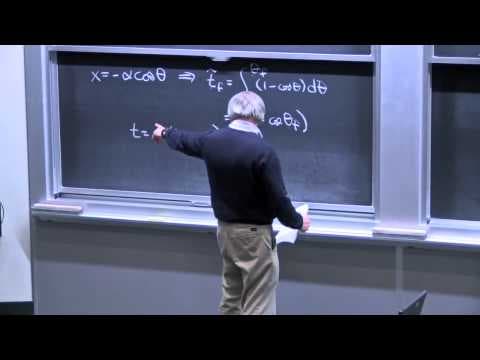
The Dynamics of Homogeneous Expansion, Part V
This lecture concludes the dynamics of homogeneous expansion, summarizing the age of a flat matter-dominated universe, the Big Bang singularity, and closed universe evolution.
Introduction to Non-Euclidean Spaces
This session reviews homogeneous expansion dynamics before introducing the fundamental concepts of non-Euclidean spaces, crucial for cosmological models.
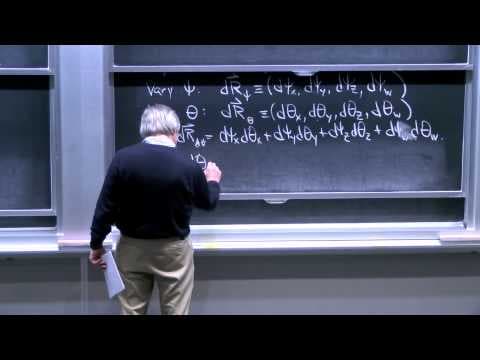
Non-Euclidean Spaces: Closed Universes
The lecture explores Euclid's Postulates and their limitations, delving into non-Euclidean geometry and the concept of a sphere in four Euclidean dimensions, relevant to closed universes.
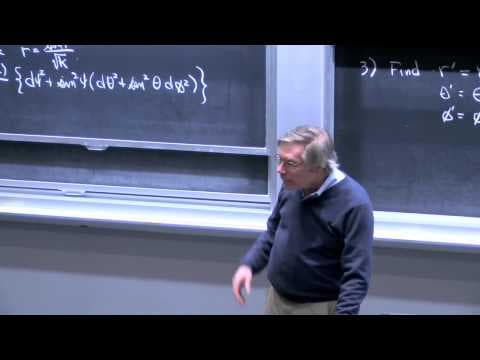
Non-Euclidean Spaces: Open Universes and the Spacetime Metric
This session examines the implications of general relativity for a closed three-dimensional space, then introduces open universe models and the critical concept of the spacetime metric.
Non-Euclidean Spaces: Spacetime Metric and Geodesic Equation
The lecture contrasts open and closed universe metrics, detailing the properties of the spacetime metric and setting the stage for the geodesic equation in curved spacetimes.
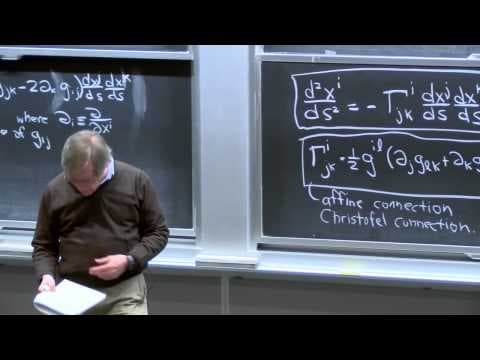
The Geodesic Equation
This lecture reviews the Robertson-Walker metric and rigorously derives the geodesic equation, a fundamental tool for understanding particle motion in curved spacetime.
Black-Body Radiation and the Early History of the Universe, Part I
This session reviews the spacetime geodesic equation, introduces the Schwarzschild metric, discusses radial geodesics, and solves the radial infall equation.
Black-Body Radiation and the Early History of the Universe, Part II
This lecture covers relativistic energy and four-momentum, the mass of radiation, and modifications to the Friedmann equations to account for radiation in an expanding universe.
Black-Body Radiation and the Early History of the Universe, Part III
This session continues the discussion on black-body radiation, examining the dynamics of a flat radiation-dominated universe and its implications for cosmic history.
Cosmic Microwave Background Spectrum and the Cosmological Constant, Part I
Building on black-body radiation, this lecture introduces the Cosmic Microwave Background (CMB) spectrum and begins exploring the role and implications of the cosmological constant.
The Cosmological Constant, Part II
This lecture examines the gravitational effects of pressure, then delves into the age of the universe in relation to the cosmological constant and its impact on cosmic evolution.
Supernovae Ia and Vacuum Energy Density
This session introduces Type Ia supernovae as cosmic distance indicators, summarizes the age of the universe via radiation flux and redshift, and details vacuum energy density.
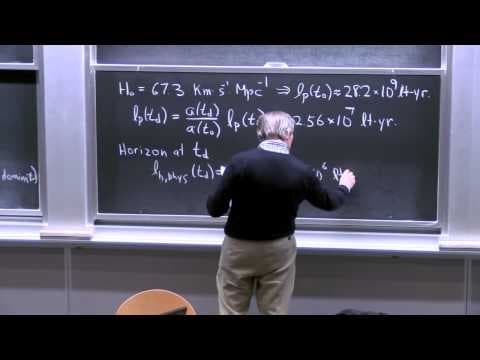
Problems of the Conventional (Non-inflationary) Hot Big Bang Model
After reviewing supernovae Ia and vacuum energy density, this lecture articulates the significant conceptual problems inherent in the conventional hot Big Bang model, setting up for inflation.
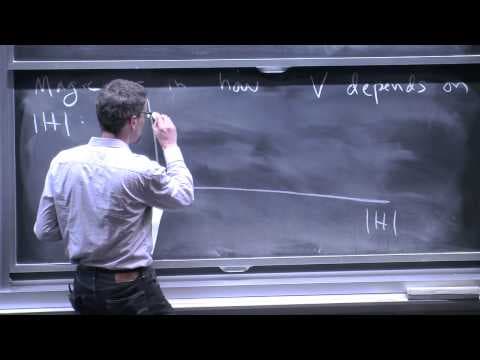
The Higgs Field and the Cosmological Magnetic Monopole Problem
Professor Hughes reviews gauge theory symmetries within the Standard Model, then examines the Higgs field and its connection to the cosmological magnetic monopole problem.