
Introduction to Cryptography
Prof. Christof PaarStream ciphers, DES, AES and finite-field arithmetic, block cipher modes, RSA, Diffie-Hellman key exchange, elliptic curve cryptography, hash functions, and digital signatures.
Syllabus
22Lecture 1: Introduction to Cryptography by Christof Paar
This introductory lecture establishes foundational concepts in cryptography, surveying the historical evolution of secure communication techniques and defining key terms such as cryptosystems, adversaries, and security goals.
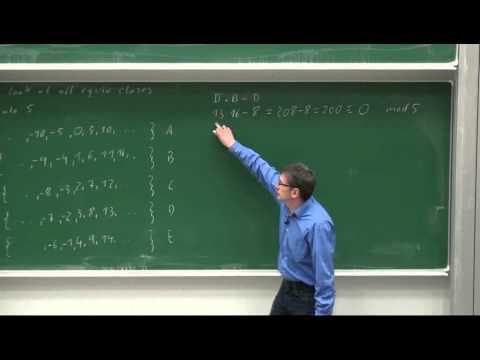
Lecture 2: Modular Arithmetic and Historical Ciphers by Christof Paar
This lecture introduces the foundational principles of modular arithmetic, essential for modern cryptography, and applies these concepts to analyze the mechanics and cryptanalysis of classical substitution ciphers such as the Caesar and Vigenère ciphers.
Lecture 3: Stream Ciphers, Random Numbers and the One Time Pad by Christof Paar
This lecture formally introduces stream cipher architectures, examines the requirements for true random number generators, and analyzes the information-theoretic security of the One-Time Pad cipher.
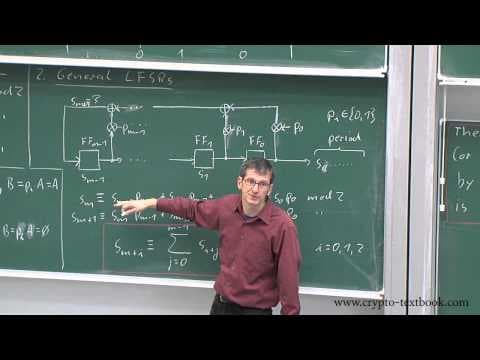
Lecture 4: Stream Ciphers and Linear Feedback Shift Registers by Christof Paar
This lecture introduces the fundamental principles of stream ciphers, detailing their operational modes and security properties. It provides a comprehensive analysis of Linear Feedback Shift Registers (LFSRs) as a core component in stream cipher design, exploring their mathematical underpinnings and practical applications.
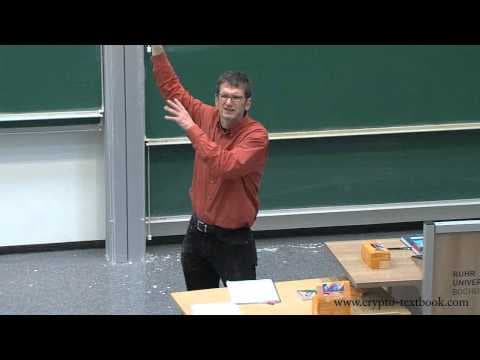
Lecture 5: Data Encryption Standard (DES): Encryption by Christof Paar
This lecture provides a rigorous analysis of the Data Encryption Standard (DES), detailing its Feistel network structure, key schedule, and S-box operations. It examines the cryptographic principles underlying this historical symmetric-key block cipher.
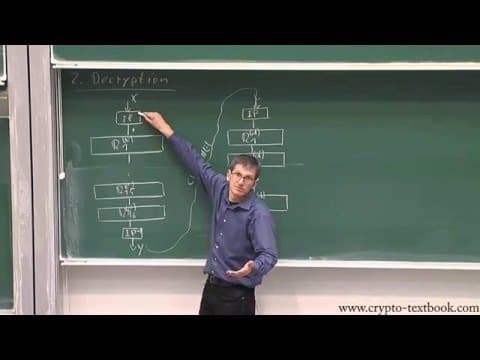
Lecture 6: Data Encryption Standard (DES): Key Schedule and Decryption by Christof Paar
This lecture delves into the internal mechanics of the Data Encryption Standard (DES), detailing the key schedule generation process and the precise steps involved in DES decryption. It rigorously unpacks the bit-level permutations and substitutions that define the cipher's operation.
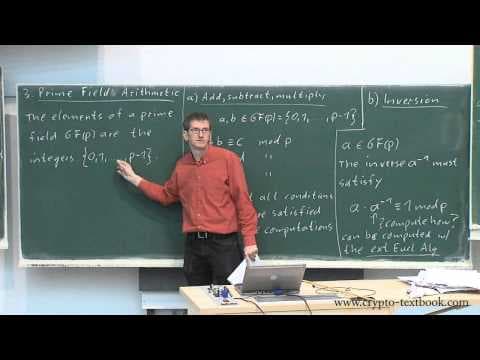
Lecture 7: Introduction to Galois Fields for the AES by Christof Paar
This lecture introduces the foundational algebraic structures of Galois Fields (finite fields) with direct application to the Advanced Encryption Standard (AES) algorithm. It systematically covers the construction and arithmetic of GF(2^8) essential for understanding AES operations.
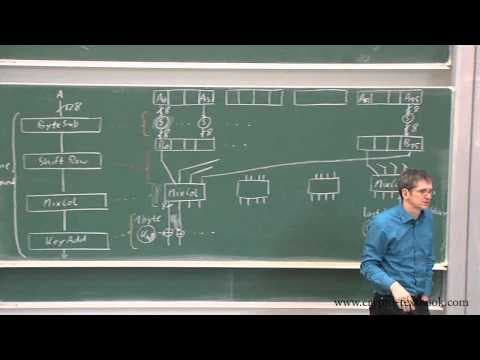
Lecture 8: Advanced Encryption Standard (AES) by Christof Paar
This lecture provides a detailed examination of the Advanced Encryption Standard (AES), outlining its internal structure, including the SubBytes, ShiftRows, MixColumns, and AddRoundKey transformations. It analyzes the mathematical underpinnings and design principles that ensure its security and efficiency.
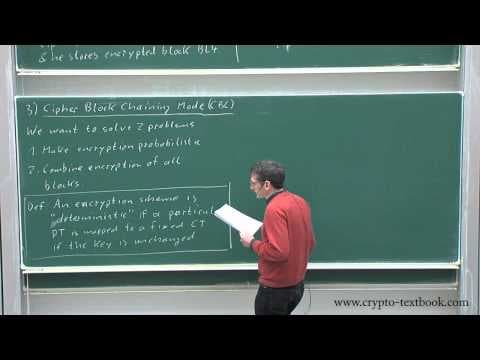
Lecture 9: Modes of Operation for Block Ciphers (CRYPTO-101)
This lecture dissects various block cipher modes of operation, including ECB, CBC, OFB, CFB, and CTR, analyzing their cryptographic properties and practical applications for secure data transmission.
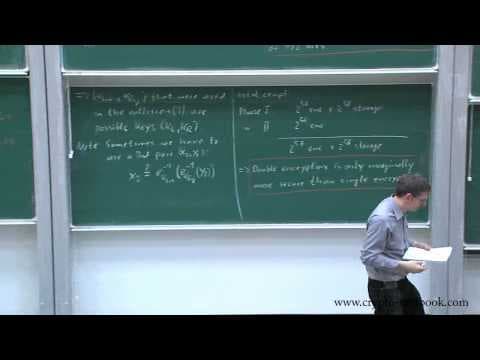
Lecture 10: Multiple Encryption and Brute-Force Attacks (CRYPTO-101)
This lecture investigates the theoretical foundations of multiple encryption schemes, focusing on triple DES (3DES) and its security against various brute-force and meet-in-the-middle attacks.
Lecture 11: Number Theory for PKC: Euclidean Algorithm, Euler's Phi Function & Euler's Theorem (CRYPTO-101)
This lecture establishes the essential number theoretic background for public-key cryptography, explaining the Euclidean Algorithm, Euler's Phi Function, and Euler's Theorem with proofs and applications.
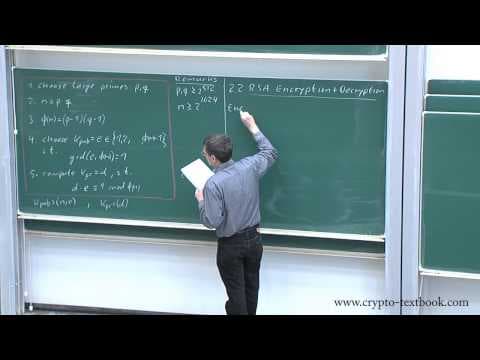
Lecture 12: The RSA Cryptosystem and Efficient Exponentiation (CRYPTO-101)
This lecture introduces the widely used RSA cryptosystem, detailing its key generation, encryption, and decryption processes, alongside methods for efficient modular exponentiation.
Lecture 13: Diffie-Hellman Key Exchange and the Discrete Log Problem (CRYPTO-101)
This lecture presents the foundational Diffie-Hellman key exchange protocol, examining its security based on the computational difficulty of the Discrete Logarithm Problem.
Lecture 14: The Generalized Discrete Log Problem and the Security of Diffie-Hellman (CRYPTO-101)
This lecture extends the discussion of the Discrete Logarithm Problem to generalized groups and rigorously analyzes the security considerations and vulnerabilities of the Diffie-Hellman key exchange protocol.
Lecture 15: Elgamal Encryption Scheme (CRYPTO-101)
This lecture comprehensively covers the Elgamal encryption scheme, detailing its probabilistic encryption property and its reliance on the computational Diffie-Hellman assumption.
Lecture 16: Introduction to Elliptic Curves (CRYPTO-101)
This lecture provides an accessible introduction to elliptic curves, defining their algebraic properties and group operations crucial for modern cryptographic applications.
Lecture 17: Elliptic Curve Cryptography (ECC) (CRYPTO-101)
This lecture delves into the principles of Elliptic Curve Cryptography (ECC), explaining its key generation, encryption, and digital signature algorithms, and its efficiency compared to RSA.
Lecture 18: Digital Signatures and Security Services (CRYPTO-101)
This lecture introduces the concept of digital signatures, elucidating their role in providing authenticity, integrity, and non-repudiation in cryptographic security services.
Lecture 19: Elgamal Digital Signature (CRYPTO-101)
This lecture thoroughly explains the Elgamal Digital Signature scheme, detailing its signing and verification processes and its security properties based on the discrete logarithm problem.
Lecture 20: Hash Functions (CRYPTO-101)
This lecture provides a comprehensive overview of cryptographic hash functions, defining their essential properties such as collision resistance and preimage resistance, and exploring their applications.
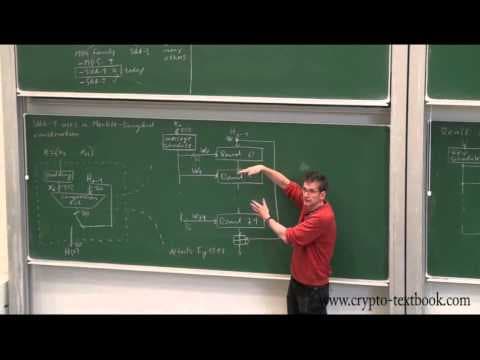
Lecture 21: SHA-1 Hash Function (CRYPTO-101)
This lecture presents a detailed architectural and operational analysis of the SHA-1 cryptographic hash function, including its message padding, compression function, and security vulnerabilities.
Lecture 22: SHA-3 Hash Function (CRYPTO-101)
This lecture meticulously examines the SHA-3 hash function, explaining its Keccak sponge construction, inner workings, and enhanced security features as a successor to SHA-1 and SHA-2.