Theory of Computation
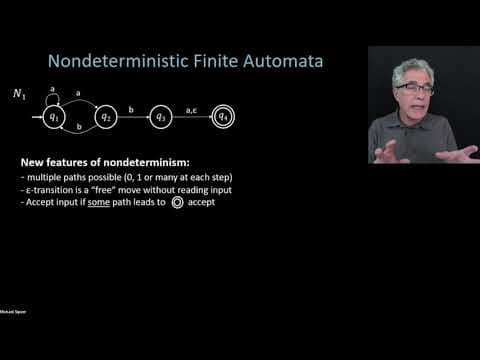
Michael Sipser's definitive course on finite automata, context-free grammars, Turing machines, decidability, reducibility, time and space complexity, NP-completeness, and interactive proofs.
Algorithms, data structures, computational complexity, cryptography, formal verification, logic, and type theory.
Complete university lecture courses in algorithms & theory.
Michael Sipser's definitive course on finite automata, context-free grammars, Turing machines, decidability, reducibility, time and space complexity, NP-completeness, and interactive proofs.
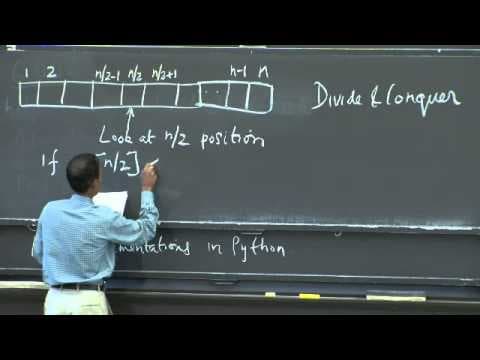
Foundational MIT algorithms course covering asymptotic complexity, divide-and-conquer, hashing, balanced search trees, graph search, shortest paths, and dynamic programming.
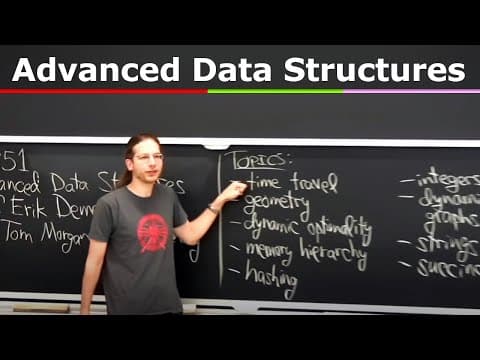
Persistent data structures, retroactive structures, geometric range queries, dynamic optimality, splay trees, van Emde Boas trees, fusion trees, cache-oblivious structures, and succinct representations.
Stream ciphers, DES, AES and finite-field arithmetic, block cipher modes, RSA, Diffie-Hellman key exchange, elliptic curve cryptography, hash functions, and digital signatures.
Essential mathematical machinery for theoretical computer science research: asymptotic tail bounds, spectral graph theory, expanders, linear and semidefinite programming duality, and Fourier analysis.
Discrete mathematical foundations for theoretical computer science: proof techniques, well-ordering, number theory, RSA cryptography, graph theory, recurrences, generating functions, and discrete probability.
Two complementary theory & algos talks paired around a central intellectual tension.
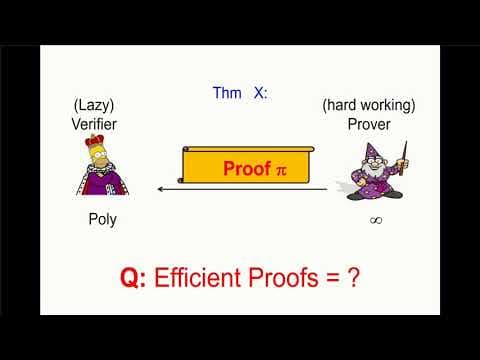
What makes mathematical witnesses easy to verify yet hard to find—and how interactive randomness lets you prove a theorem without revealing why it is true.
Self-contained lectures, Nobel addresses, and research colloquia you can watch in one sitting.
A foundational lecture from MIT's 6.034 course, delving into classic search algorithms including depth-first and hill-climbing techniques in artificial intelligence.
Donald Knuth's 24th annual Christmas lecture, detailing the elegant 'Dancing Links' algorithm and its surprising effectiveness for solving exact covering problems across diverse applications.
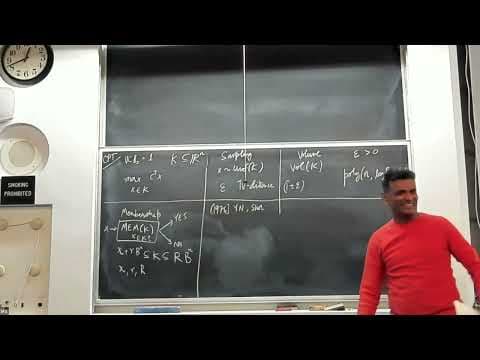
Examine the computational complexity of linear optimization over convex bodies, presenting nearly quadratic lower bounds for randomized algorithms in the membership oracle model.
An MIT OpenCourseWare session offering detailed technical critiques of student system dynamics models, emphasizing formulation, unit consistency, and strategies for model refinement.
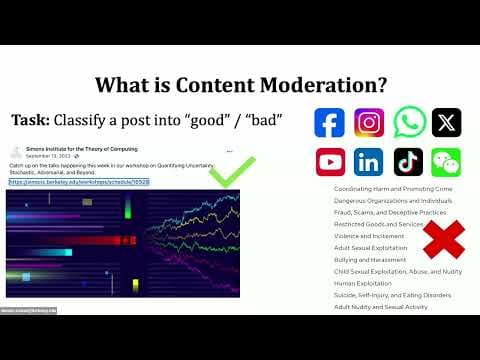
Thodoris Lykouris (MIT) presents a novel approach to scheduling content review, addressing time-evolving uncertainty in social media moderation pipelines.
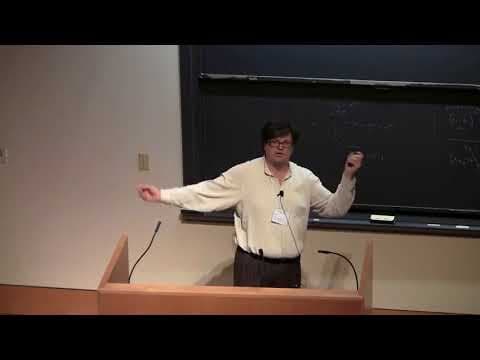
Yann LeCun examines the fundamental challenges of learning theory in the context of representation learning, presented at the Conference on Learning Theory (COLT) in 2013.



Harmonic analysis on the hypercube, linearity testing, social choice, and quantum circuits
Carnegie Mellon University
Automata, cryptographic hardness, interactive proofs, and privacy guarantees
MIT · Ruhr University Bochum · Harvard University +1
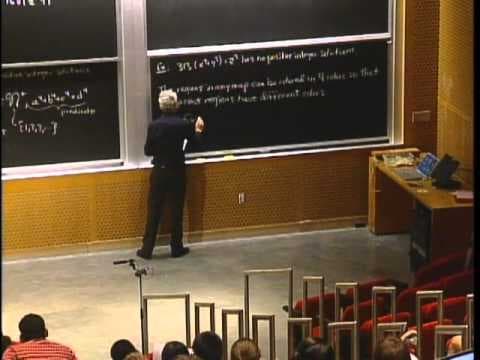
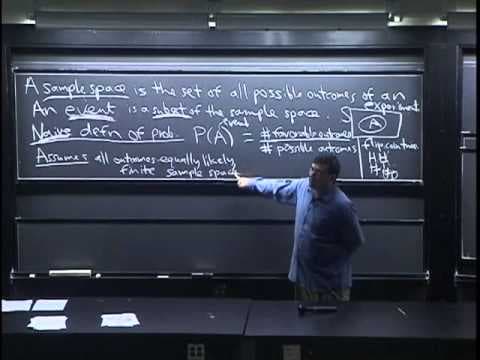
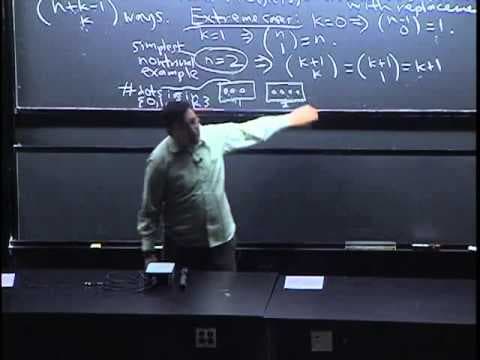
Discrete proof invariants, stochastic conditioning, pseudorandomness, and P vs. NP
MIT · Harvard University · UCLA +2