
Santa Fe Institute: Foundations of Complex Systems
Santa Fe Institute FacultyInterdisciplinary lectures exploring emergence, scaling laws, algorithmic information, network dynamics, biological computation, and collective intelligence across physical and social systems.
Syllabus
21Neurotechnology and the Recovering Brain
John Krakauer examines the latent capacity for recovery in the damaged nervous system, exploring therapeutic avenues such as immersive environments, exer-gaming, physiological stimulation, and psychedelics to unmask and express experience-dependent neuroplasticity.
Why Your Brain Hates Losing
This lecture by MacArthur Fellow Colin Camerer explores the neural and psychological underpinnings of loss aversion, integrating insights from behavioral economics with methods from neuroscience to analyze decision-making anomalies.
The Beautiful Engineering of Us: From Neurons to Collective Minds
Thalia Wheatley investigates how human intelligence manifests as a collective phenomenon, analyzing conversation as a mechanism for coupling minds. The lecture synthesizes insights from neuroscience, psychology, and network science to explain how social interactions synchronize brains and shape mental health.

Crossroads Democracy — A Panel Discussion
This panel, hosted by the Santa Fe Institute, examines the historical trajectory and contemporary challenges of democratic governance. Scholars analyze democracy's evolution, economic underpinnings, psychological factors, and political dynamics through the lens of complex systems science.
Transmission Versus Truth: What Will It Take to Make an Al as Smart as a 4-Year-Old?
Alison Gopnik examines the concept of general intelligence, proposing that human cognitive development, encompassing exploration in childhood, exploitation in adulthood, and cultural transmission in elderhood, offers a crucial framework for designing diverse AI capacities. The discussion highlights the trade-offs inherent in different developmental stages and their implications for AI architectures.
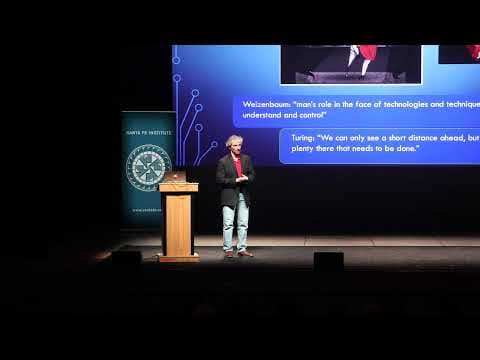
Machining the Ghost: Ideating in the Age of AI
This seminar by Dan Rockmore explores the philosophical and practical implications of generative AI systems on human ideation and the long-term trajectory of cognitive augmentation. It contextualizes current large language models within the historical evolution of computational tools.
Whom Do We Trust? How AI Is (Re)Shaping Our Interactions Today (SFI-CX)
This lecture explores the evolving landscape of trust in human-AI interactions. It analyzes the societal implications of AI's increasing role in daily life and its impact on human communication dynamics.
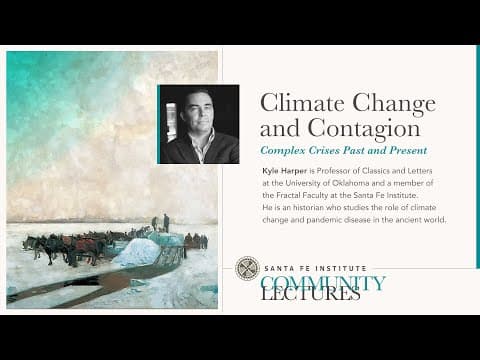
Climate Change and Contagion: Complex Crises Past and Present (SFI-CX)
This talk utilizes paleoclimatology and historical analysis to examine how past climate shifts influenced civilizations. It draws parallels between historical complex crises and current challenges like climate change and pandemics, framed through a complex systems lens.
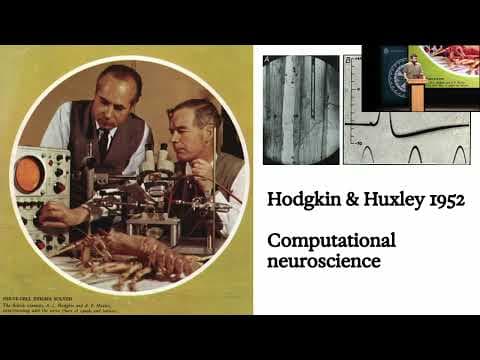
Computing, Life, and Intelligence (SFI-CX)
This lecture explores the foundations of theoretical biology and computer science as laid by Turing and von Neumann. It presents new research on 'digital life' evolving through symbiogenesis rather than Darwinian mutation and selection.
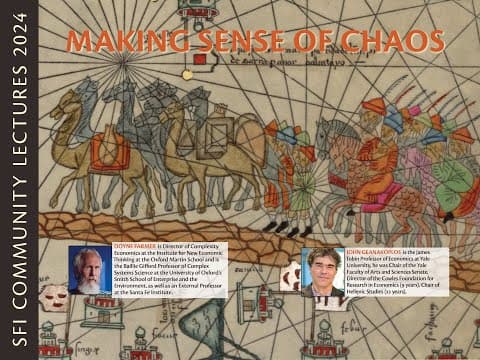
Making Sense of Chaos: A Better Economics for a Better World (SFI-CX)
This session introduces complexity economics, a new science utilizing big data and computational models to understand the global economy. It addresses the failures of standard economic predictions in an age of accelerating technology and global interconnection.
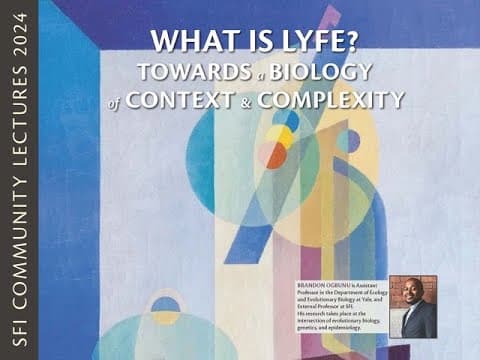
What is Lyfe? Towards a Biology of Context & Complexity (SFI-CX)
This lecture critiques the reductionist approach of genomics and proposes a new framework for biology, termed 'Lyfe'. It emphasizes a multidimensional understanding of biological systems that incorporates context and complexity beyond sequence data.
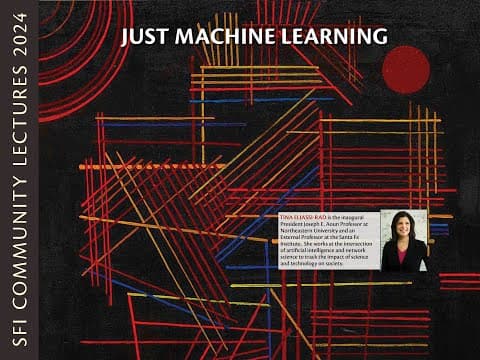
Just Machine Learning (SFI-CX)
This lecture investigates the societal implications of algorithmically infused societies, focusing on generative AI. It addresses issues like epistemic instability, the challenge of oversight, and accountability for rapidly evolving AI technologies.
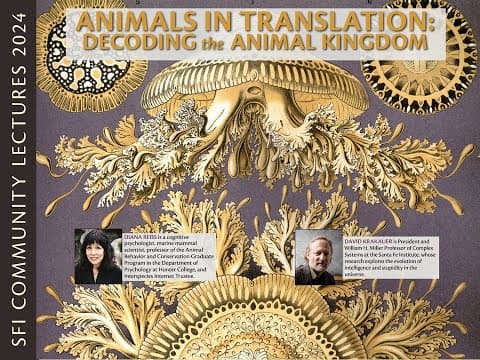
Animals in Translation: A Conversation (SFI-CX)
This conversation discusses the 'Animals in Translation' workshop, aiming to establish criteria for decoding animal communication systems. It explores contributions from diverse fields towards exobiology and interspecies communication.
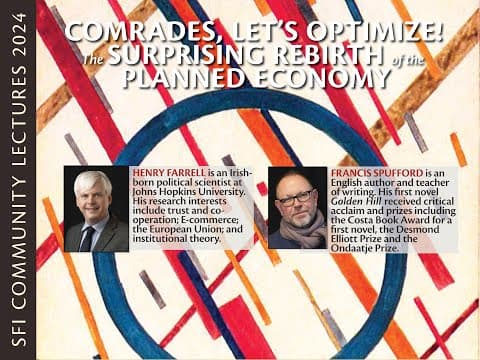
Comrades, Let's Optimize! The Surprising Rebirth of the Planned Economy (SFI-CX)
This discussion revisits debates on planned economies, contrasting Soviet planning with modern corporate optimization strategies like Amazon's. It explores how Silicon Valley's algorithmic approach to economics reopens questions about markets and centralized planning.
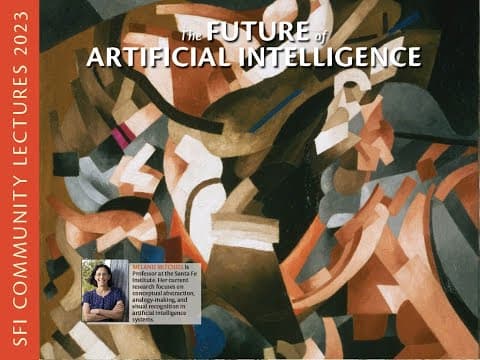
The Future of Artificial Intelligence (SFI-CX)
Melanie Mitchell examines the foundational mechanisms of contemporary AI, critically evaluating its current capabilities and the ethical, societal implications of its projected future trajectory. The discussion emphasizes the disparity between current AI's pattern recognition strengths and human-level cognitive understanding.
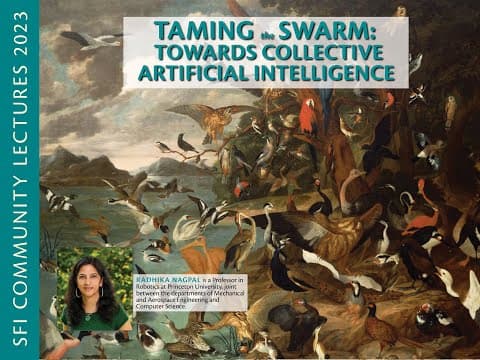
Taming the Swarm: Towards Collective Artificial Intelligence (SFI-CX)
This talk draws inspiration from biological swarms to explore principles of collective artificial intelligence. It illustrates how local interactions can lead to complex collective behaviors in artificial systems and robotics.
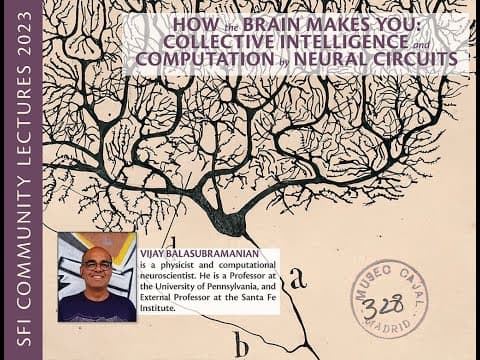
How the Brain Makes You: Collective Intelligence and Computation by Neural Circuits (SFI-CX)
This lecture examines how the collective computational function of billions of neurons gives rise to consciousness and intelligence. It explores the intricate interplay of neural circuits in creating perception, action, memory, and imagination.
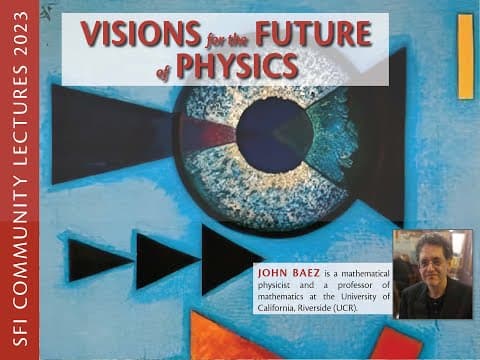
The Future of Physics (SFI-CX)
This SFI Community Lecture discusses the shift in physics from fundamental laws to designing novel forms of matter. It highlights the imperative for physics to address the challenges of the Anthropocene, including climate and biosphere impacts.
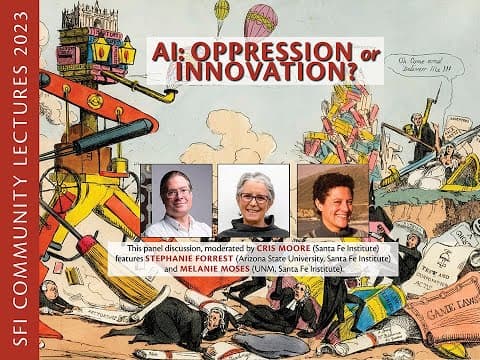
AI: Oppression or Innovation? (SFI-CX)
This panel delves into whether AI amplifies societal biases or promotes innovation across various domains. It discusses the human role in shaping AI systems and the democratic processes needed to govern their creation and application.
Harnessing Social Capital to Enhance Collective Welfare (SFI-CX)
This panel discusses the nature, origins, and implications of social and income inequality through the lens of collective computation. It explores how understanding these dynamics might lead to improvements in collective and individual welfare.
Lecture 2: The Story of Sync (SFI-CX)
Steven Strogatz traces the historical and mathematical development of synchronization theory, from Huygens' pendulum observations to modern applications in coupled oscillators and network dynamics, culminating in the Kuramoto model and recent advancements in understanding collective behavior.