
Frontiers and Controversies in Astrophysics
Exoplanet detection, orbital mechanics, stellar collapse and black holes, general relativistic tests, Hubble expansion, dark matter, and accelerating cosmic expansion.
Syllabus
22Introduction
This introductory lecture outlines the scope of Yale's ASTR 160, covering exoplanets, black holes, and cosmology. It reviews historical astronomical models, including Kepler's laws of planetary motion and their Newtonian modification.
Planetary Orbits
This lecture from Yale's ASTR 160 introduces methods for detecting exoplanets and addresses the fundamental challenges of astronomical measurement, including the rigorous application of physical units and significant digits in calculating celestial distances and masses.
Our Solar System and the Pluto Problem
This lecture reviews Newton's Third Law in the context of exoplanet detection, surveys the structure of the inner and outer Solar System, and analyzes the IAU's planetary classification debate, specifically addressing Pluto's reclassification.
Discovering Exoplanets: Hot Jupiters
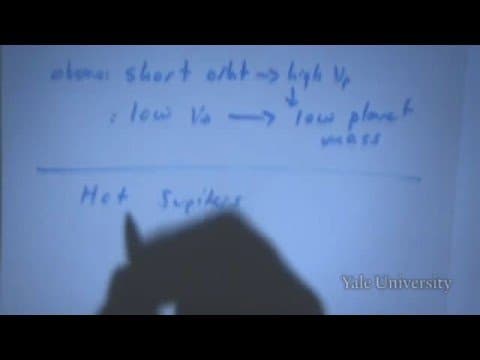
This lecture examines the theory of planetary formation, the application of momentum equations for detecting exoplanets via stellar wobble, and the use of the Doppler shift to characterize objects like 51 Pegasi b and the class of 'Hot Jupiters'.
Planetary Transits
This lecture examines the scientific and cultural implications of Pluto's reclassification, then delves into the methods for detecting exoplanets via stellar velocity curves and Doppler shifts, with a focus on 'Hot Jupiters' and the challenges of distinguishing them from binary star systems or pulsating stars.
Microlensing, Astrometry and Other Methods
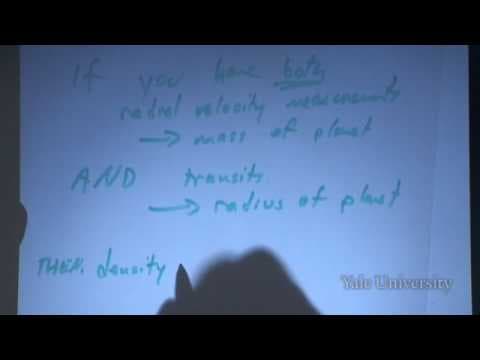
This lecture examines key exoplanet detection methods, focusing on the principles of planetary transits and gravitational microlensing. It also explores the concept of planetary migration and its implications for solar system formation and dynamics, addressing observational complexities regarding 'Hot Jupiters'.
Direct Imaging of Exoplanets
This lecture outlines methods for exoplanet identification, focusing on transit photometry to derive planetary radii, Doppler spectroscopy for stellar mass, and astrometry for precise positional assessment. It concludes with an overview of missions like Kepler, SIM, and TPF for advanced detection.
Introduction to Black Holes
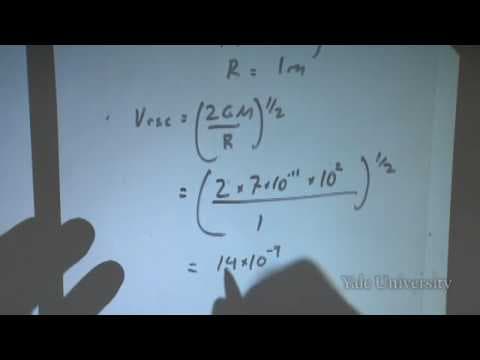
This lecture introduces the fundamental definition and detection methods for black holes, emphasizing the necessity of Einstein's Theory of Relativity over Newtonian physics. It derives escape and circular velocity concepts and traces the historical understanding of black holes within stellar evolution.
Special and General Relativity
This session explores the event horizon concept of black holes and the mathematical framework for its calculation. It addresses the reconciliation of Newton's laws of motion with Special Relativity and Newton's law of gravity with General Relativity.
Tests of Relativity
This lecture develops post-Newtonian approximations from Newtonian terms, examining how concepts like mass and velocity differ across these frameworks. It discusses the observed space-time changes near light speed and potential superluminal travel, using muons as an illustrative example.
Special and General Relativity (cont.)
This lecture overviews the historical context for Einstein's theories, including the clock synchronization problem and his foundational 1905 papers. It demonstrates how General Relativity encompasses Newton's laws of gravity, illustrating space-time curvature with mass.
Stellar Mass Black Holes
This session introduces coordinate systems in space-time for describing events in Special Relativity. It provides a mathematical explanation for the reversal of space and time inside the Schwarzschild radius and offers astronomical evidence for General Relativity, including the discovery of Neptune.
Stellar Mass Black Holes (cont.)
This lecture details four post-Newtonian gravitational effects: perihelion precession, deflection of light, gravitational redshift, and gravitational waves. It describes how these phenomena manifest due to varying gravitational forces and the bending of space-time around massive objects.
Pulsars
This lecture reviews the four post-Newtonian effects of General Relativity and introduces gravitational lensing as predicted by Einstein's theory. It illustrates the formation of gravitational lenses with astronomical examples and discusses observational challenges.
Supermassive Black Holes
This lecture explores supermassive black holes, their existence in galactic centers, and observational methods. It delves into strong-field relativity and testing black hole predictions through X-ray binary star systems to estimate compact object masses.
Hubble's Law and the Big Bang
This lecture traces the development of cosmology, highlighting the impact of dark energy and dark matter. It presents Hubble's redshift diagram as the basis for Hubble's Constant and Big Bang cosmology, detailing parallax and standard candle methods for cosmic distance measurement.
Hubble's Law and the Big Bang (cont.)
This session reviews magnitudes and explores implications of Hubble's Law and Diagram for the Big Bang theory. It addresses controversial questions regarding the universe's age, development, and boundaries, including the hypothetical 'Big Crunch' end scenario.
Hubble's Law and the Big Bang (cont.)
This lecture presents alternative explanations for cosmic expansion beyond the Big Bang theory, including the concept of an initial singularity. It details the Steady State theory, which posits continuous creation of matter and energy to maintain cosmic density.
Omega and the End of the Universe
This session explores the role of gravity in cosmic expansion, explaining why the expansion rate cannot be constant. It details methods for calculating the universe's actual density and proposes hypotheses for dark matter, including WIMPs and MACHOs.
Dark Matter
This lecture explores the cosmological scale factor, the empirical evidence for dark matter, and the discovery of dark energy's repulsive force. It concludes with a discussion of Einstein's initial conception and later rejection of the cosmological constant.
Dark Energy and the Accelerating Universe and the Big Rip
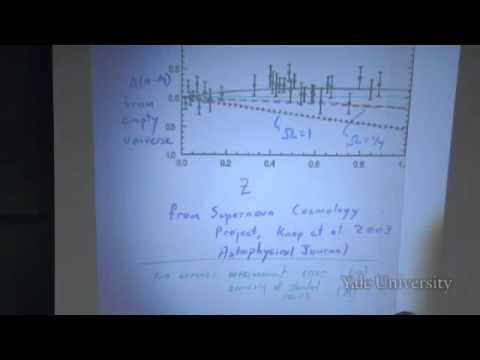
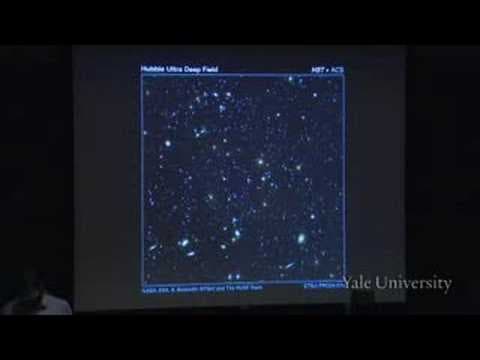
This lecture reviews dark matter and illustrates different universe models. It discusses supernovae data from the Supernova Cosmology Project, revisits dark energy's discovery, and presents the 'Big Rip' as a catastrophic hypothesis for the universe's ultimate fate.
Supernovae
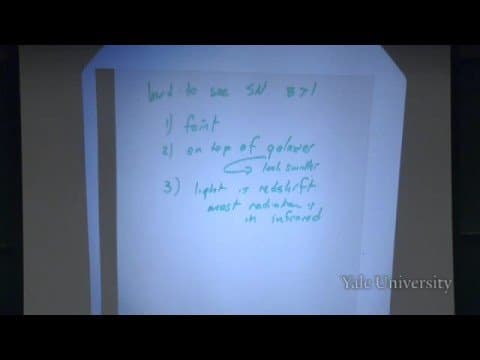
This lecture reviews cosmic expansion evidence from galaxies and supernovae, analyzing the balance of dark energy and dark matter and the universe's acceleration/deceleration shift. It addresses concerns about high-redshift supernovae brightness and outlines projects like JDEM for detection.