
Fundamentals of Physics I
Ramamurti Shankar derives Newtonian mechanics, conservation laws, rotational dynamics, special relativity, waves, and thermodynamics from first principles on the blackboard.
Syllabus
22Course Introduction and Newtonian Mechanics
Professor Shankar introduces the core concepts of Newtonian mechanics, distinguishing between kinematics and dynamics. The lecture reviews fundamental calculus applications to derive and interpret equations of motion for particles in one dimension, focusing on constant acceleration scenarios.
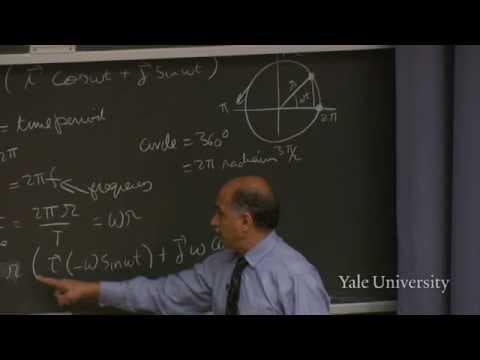
Vectors in Multiple Dimensions
Professor Shankar introduces vectors in two and three dimensions, covering properties like magnitude, direction, null vectors, and unit vectors. The lecture then applies vector differentiation to analyze velocity and projectile motion.
Newton's Laws of Motion
This lecture systematically introduces Newton's three laws of motion, defining inertial frames, detailing the relationship between force and acceleration (F=ma), and explaining action-reaction pairs. Concepts of various forces and weightlessness are also examined.
Newton's Laws (cont.) and Inclined Planes
This lecture extends the application of Newton's three laws to systems involving kinetic and static friction, inclined planes, and pulley dynamics. It concludes with an analysis of forces in uniform circular motion scenarios.
Work-Energy Theorem and Law of Conservation of Energy
This lecture elaborates on the Work-Energy Theorem and the Law of Conservation of Energy, analyzing kinetic and potential energy transformations. It includes an examination of friction's impact on energy conservation and a review of relevant calculus concepts.
Law of Conservation of Energy in Higher Dimensions
This lecture extends the Law of Conservation of Energy to higher dimensions, introducing work in 2D, defining conservative and non-conservative forces, and applying the cross derivative test for potential energy equations.
Kepler's Laws
This lecture presents Kepler's three laws of planetary motion and systematically derives the inverse-square law of gravitational force. It further develops the equations for orbital period and velocity, and examines the conservation of energy in distant gravitational fields.
Dynamics of Multiple-Body System and Law of
Professor Shankar elucidates the dynamics of multi-body systems, deriving the center of mass and applying the Law of Conservation of Momentum to phenomena such as the rocket equation and various types of collisions, including perfectly elastic and inelastic cases.
Rotations, Part I: Dynamics of Rigid Bodies
This lecture introduces rigid body rotation in two dimensions, defining angular velocity, momentum, acceleration, and torque. The Parallel Axis Theorem is also expounded.
Rotations, Part II: Parallel Axis Theorem
This session thoroughly explains the Parallel Axis Theorem, demonstrating its application to moments of inertia for rigid bodies like a disk, alongside examining angular momentum and velocity.
Torque
This lecture explores the analogue to Newton's law, "tau = I alpha," focusing on static equilibrium scenarios where net torque is zero. The concept is demonstrated using a seesaw and multiple-object systems.
Introduction to Relativity
This lecture introduces the historical context and fundamental problems of relativity, analyzing events from multiple observer perspectives. It covers Maxwell's theory and the Galilean and Lorentz transformations.
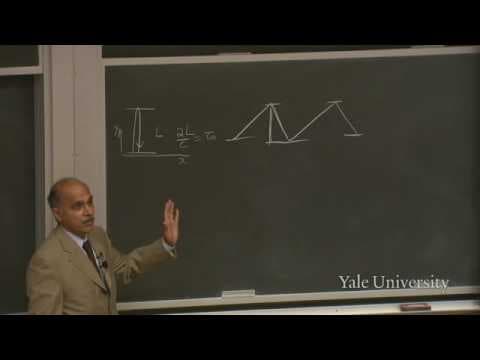
Lorentz Transformation
This lecture provides a detailed analysis of Lorentz transformations, demonstrating how length, time, and simultaneity are relative concepts. It also addresses the Twin Paradox.
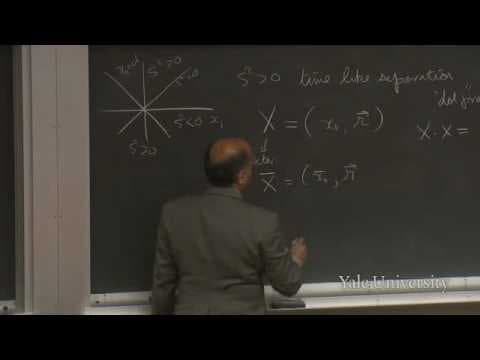
Introduction to the Four-Vector
This session introduces the concept of the four-vector, unifying space-time coordinates into an entity whose components transform under Lorentz transformations. It explains the invariant space-time interval and the energy-momentum four-vector.
Four-Vector in Relativity
Continuing the discussion on four-vectors, this lecture focuses on the energy-momentum of a particle. It elaborates on the invariance of the energy-momentum four-vector due to invariant rest mass under coordinate transformations.
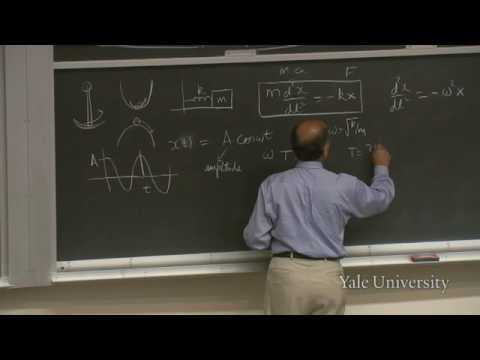
The Taylor Series and Other Mathematical Concepts
This lecture introduces the Taylor series and its properties through various examples. It also details complex numbers in polar form and concludes with an examination of simple harmonic motion fundamentals.
Simple Harmonic Motion
This lecture focuses on simple harmonic motion, defining amplitude, frequency, and period through examples like a mass-spring system. Several oscillation problems are solved to illustrate various cases.
Simple Harmonic Motion (cont.) and Introduction to Waves
Continuing with harmonic motions, this lecture solves oscillation problems and introduces the nature and behavior of waves. It defines and explains both longitudinal and transverse waves.
Waves
This lecture delves deeper into wave properties, including velocity, energy, intensity, and frequency, through diverse examples. It then focuses on wave superposition, defining constructive and destructive interference.
Fluid Dynamics and Statics and Bernoulli's Equation
This lecture covers fluid dynamics and statics, discussing density and pressure, and demonstrating Archimedes' Principle. The session culminates with an introduction to Bernoulli's Equation.
Thermodynamics
This introductory thermodynamics lecture clarifies the concept of temperature, explains Zeroth's law, and defines absolute zero and the triple point of water. It also covers heat, convection, and conduction.
The Boltzmann Constant and First Law of Thermodynamics
This lecture continues thermodynamics, detailing heat generation and measurement, introducing the Boltzmann Constant, and defining temperature microscopically. It concludes with the presentation of the First Law of Thermodynamics.