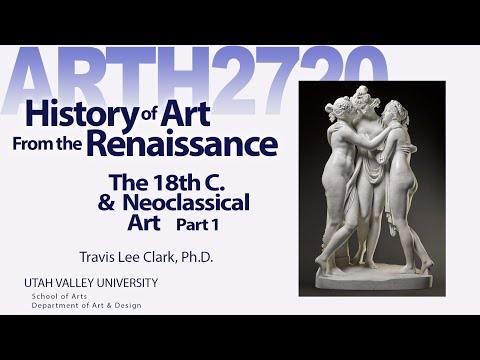
Opening 18th Century Art and Neoclassicism, Part 1 (ARTH2720)
18th Century Art and Neoclassicism, Part 1 (ARTH2720)
- Length
- 1 h 16 min
- Level
- Undergraduate
- Recorded
- Utah Valley University2020
Opening 18th Century Art and Neoclassicism, Part 1 (ARTH2720)
Chapter 1 of 10: Before the lecture
Traces the rise of Neoclassicism as an intellectual and artistic antidote to the Rococo style.
Neoclassicism in 18th-century painting and sculpture grows out of the Thirty Years' War, the Enlightenment and a reaction against the Rococo. Clark starts with Jacques Callot's etching The Hanging and the Peace of Westphalia, then moves through Descartes, Locke, Voltaire and Newton's Principia Mathematica. English portraitists such as Gainsborough, Hogarth and Reynolds show a lingering Rococo before Angelica Kauffman's Cornelia, Mother of the Gracchi marks the turn to classical subjects. Canova's Psyche Revived by Cupid's Kiss receives close attention for its lines, negative space and marble surfaces. The session closes with classical iconography applied to George Washington and assumes a basic grounding in European history.
Neoclassicism in 18th-century painting and sculpture grows out of the Thirty Years' War, the Enlightenment and a reaction against the Rococo. Clark starts with Jacques Callot's etching The Hanging and the Peace of Westphalia, then moves through Descartes, Locke, Voltaire and Newton's Principia Mathematica. English portraitists such as Gainsborough, Hogarth and Reynolds show a lingering Rococo before Angelica Kauffman's Cornelia, Mother of the Gracchi marks the turn to classical subjects. Canova's Psyche Revived by Cupid's Kiss receives close attention for its lines, negative space and marble surfaces. The session closes with classical iconography applied to George Washington and assumes a basic grounding in European history.
Treaty of Osnabrück and Treaty of Münster
Philosophiae Naturalis Principia Mathematica
Tennis Court Oath
Signing of the Declaration of Independence
John Trumbull, Signing of the Declaration of Independence
The History of Art in Antiquity

This lecture
Lecture 8 of 23 of History of Art From the Renaissance.
Choose a node to see how it connects to this lecture. What comes before is on the leftat the top. What comes after is on the rightat the bottom. The ring is what it teaches. People and places are above. Other lectures and books are below.
Press a chosen node again to open it.
Your comment is kept while you sign up.Sign in


