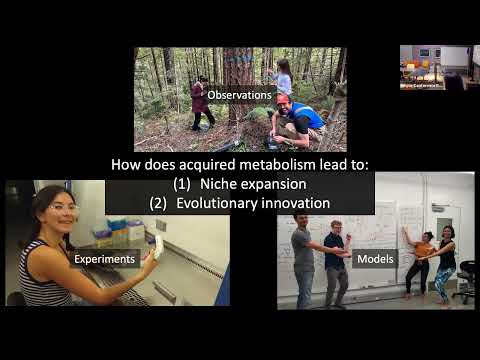
Acquired Metabolism and Evolutionary Innovation

Examining how species acquire metabolism from others, creating opportunities for niche expansion and evolutionary diversification, with examples from marine microbes and tree-fungal mutualisms.
Holly Moeller, University of California, Santa Barbara
While biologists typically think of an organism's metabolism as hard-wired in its DNA, in reality a vast array of species gain access to additional forms of metabolism from other species. This acquired metabolism can be obtained through interactions ranging from mutualism to predation, creating opportunities for niche expansion and, ultimately, evolutionary diversification. I'll focus on two examples of acquired metabolism chloroplast-stealing marine microbes and tree-fungal mutualisms to illustrate how these metabolic exchanges create and maintain diversity on our planet. We'll explore these systems using a combination of field observations (and collections), laboratory experiments, and, especially, mathematical models, demonstrating how the synergy between these approaches can give us insight into the mechanisms underlying acquired metabolism.