Opening Ahern's Biochemistry #18 Carbohydrates & Signaling
Ahern's Biochemistry #18 Carbohydrates & Signaling
- Length
- 49 min
- Level
- Undergraduate
- Recorded
- Oregon State University2014
Opening Ahern's Biochemistry #18 Carbohydrates & Signaling
Chapter 1 of 8: Before the lecture
Traces how epinephrine activates G proteins and cyclic AMP to mobilize energy stores in cells.
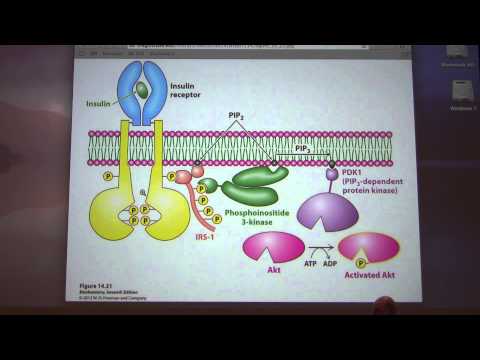
Cell surface carbohydrates and hormone signaling pathways regulate cellular function. The lecture details protein glycosylation in the endoplasmic reticulum and Golgi apparatus. It covers dolichol phosphate flipping, N-linkages, and O-linkages. Blood antigens and neuraminidase inhibition by antiviral drugs during viral infections are examined. The second half explores signal transduction, focusing on epinephrine binding to seven transmembrane receptors and activating G proteins to produce cyclic AMP. Phosphodiesterase breaks down cyclic AMP; caffeine inhibits this enzyme to raise blood glucose.
Cell surface carbohydrates and hormone signaling pathways regulate cellular function. The lecture details protein glycosylation in the endoplasmic reticulum and Golgi apparatus. It covers dolichol phosphate flipping, N-linkages, and O-linkages. Blood antigens and neuraminidase inhibition by antiviral drugs during viral infections are examined. The second half explores signal transduction, focusing on epinephrine binding to seven transmembrane receptors and activating G proteins to produce cyclic AMP. Phosphodiesterase breaks down cyclic AMP; caffeine inhibits this enzyme to raise blood glucose.
Biochemistry
Biochemistry, Seventh Edition
J. Biol. Chem. 273:1839-1842, 1998
This lecture
Lecture 17 of 28 of Kevin Ahern's BB 450 Biochemistry Fall 2014.
Choose a node to see how it connects to this lecture. What comes before is on the leftat the top. What comes after is on the rightat the bottom. The ring is what it teaches. People and places are above. Other lectures and books are below.
Press a chosen node again to open it.
Your comment is kept while you sign up.Sign in