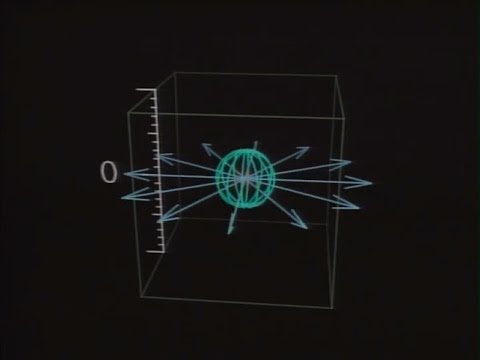
Opening Atoms to Quarks: Electron Waves and the Periodic Table (The Mechanical Universe, Episode 51)
Atoms to Quarks: Electron Waves and the Periodic Table (The Mechanical Universe, Episode 51)
- Length
- 29 min
- Level
- Introductory
- Recorded
- Caltech2016
Opening Atoms to Quarks: Electron Waves and the Periodic Table (The Mechanical Universe, Episode 51)
Chapter 1 of 6: Before the lecture
Fills electron orbitals from hydrogen to argon using quantum numbers and spin, then sorts hadrons into quarks.
The periodic table of the elements follows from the wave behaviour of electrons, as Goodstein shows in this episode of Caltech's The Mechanical Universe. He starts from Bohr's orbits and de Broglie's standing waves, then turns to Schrödinger's matter waves spread through three-dimensional space. The quantum numbers , and set the energy, angular momentum and orientation of each hydrogen orbital. Adding electron spin and the Pauli exclusion principle, Goodstein fills shells element by element from hydrogen to argon, recovering Mendeleev's repeating chemical properties. He then treats the particle zoo of accelerators the same way, building protons and neutrons from up, down and strange quarks. The treatment is introductory and assumes Bohr's model and basic angular momentum.
The periodic table of the elements follows from the wave behaviour of electrons, as Goodstein shows in this episode of Caltech's The Mechanical Universe. He starts from Bohr's orbits and de Broglie's standing waves, then turns to Schrödinger's matter waves spread through three-dimensional space. The quantum numbers , and set the energy, angular momentum and orientation of each hydrogen orbital. Adding electron spin and the Pauli exclusion principle, Goodstein fills shells element by element from hydrogen to argon, recovering Mendeleev's repeating chemical properties. He then treats the particle zoo of accelerators the same way, building protons and neutrons from up, down and strange quarks. The treatment is introductory and assumes Bohr's model and basic angular momentum.
The Principles of Chemistry

This lecture
Lecture 50 of 51 of The Mechanical Universe.
Choose a node to see how it connects to this lecture. What comes before is on the leftat the top. What comes after is on the rightat the bottom. The ring is what it teaches. People and places are above. Other lectures and books are below.
Press a chosen node again to open it.
Your comment is kept while you sign up.Sign in


