
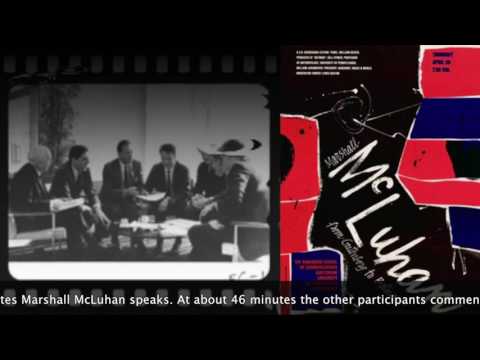
Opening Film and New Media (Museum of Modern Art, 1966)
Film and New Media (Museum of Modern Art, 1966)
- Length
- 1 h 17 min
- Level
- Graduate
- Recorded
- Johns Hopkins University2016
Opening Film and New Media (Museum of Modern Art, 1966)
Chapter 1 of 12: Before the lecture
Marshall McLuhan examines the media ecology of film and television through the lens of sensory involvement and pattern recognition. The lecture contrasts the high-definition detachment of cinematic viewing with the low-definition environmental immersion produced by television scanning. Examples range from James Joyce's Finnegans Wake and Georges Seurat's pointillist paintings to detective fiction and newspaper layouts. The discussion traces how electronic media shift human perception away from linear narrative and phonetic literacy toward total sensory participation.
Your comment is kept while you sign up.Sign in
McLuhan reads Seurat's pointillism as television painted in advance, set against film's high-definition distance.
Marshall McLuhan examines the media ecology of film and television through the lens of sensory involvement and pattern recognition. The lecture contrasts the high-definition detachment of cinematic viewing with the low-definition environmental immersion produced by television scanning. Examples range from James Joyce's Finnegans Wake and Georges Seurat's pointillist paintings to detective fiction and newspaper layouts. The discussion traces how electronic media shift human perception away from linear narrative and phonetic literacy toward total sensory participation.
The Mechanical Bride
The Gutenberg Galaxy
Understanding Media
Finnegans Wake
Ulysses
Robinson Crusoe
Saving the Appearances
Hamlet
Paradise Lost
This lecture
Lecture 4 of 7 of Marshall McLuhan Lecture Recordings.
Choose a node to see how it connects to this lecture. What comes before is on the leftat the top. What comes after is on the rightat the bottom. The ring is what it teaches. People and places are above. Other lectures and books are below.
Press a chosen node again to open it.


