Opening Omics and RBC Storage: Toward Personalized Transfusion Medicine
Omics and RBC Storage: Toward Personalized Transfusion Medicine
- Length
- 56 min
- Level
- Graduate
- Recorded
- University of Washington2022
Opening Omics and RBC Storage: Toward Personalized Transfusion Medicine
Chapter 1 of 9: Before the lecture
Argues from omics data on large donor cohorts that donor genetics and metabolic age outweigh red cell storage time.
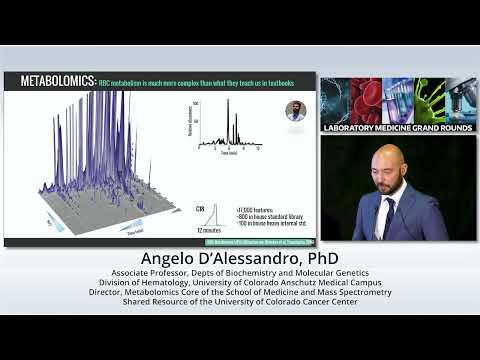
Red blood cell storage lesions are progressive metabolic and oxidative changes that alter the quality of transfused blood. D'Alessandro, speaking at the University of Washington Laboratory Medicine Grand Rounds, starts from the red cell as a model of oxidant stress without nuclei or organelles. Mass spectrometry proteomics and metabolomics then map high-altitude hypoxia responses and the storage lesion: ATP and 2,3-DPG depletion, lactate buildup and protein oxidation. Population cohorts show donor genetics, sex, smoking, medications and caffeine shaping storage quality, and metabolic age diverging from chronological age. The session assumes red cell glycolysis and mass spectrometry basics, and closes with questions on clinical transfusion outcomes.
Red blood cell storage lesions are progressive metabolic and oxidative changes that alter the quality of transfused blood. D'Alessandro, speaking at the University of Washington Laboratory Medicine Grand Rounds, starts from the red cell as a model of oxidant stress without nuclei or organelles. Mass spectrometry proteomics and metabolomics then map high-altitude hypoxia responses and the storage lesion: ATP and 2,3-DPG depletion, lactate buildup and protein oxidation. Population cohorts show donor genetics, sex, smoking, medications and caffeine shaping storage quality, and metabolic age diverging from chronological age. The session assumes red cell glycolysis and mass spectrometry basics, and closes with questions on clinical transfusion outcomes.
Technology Network and Springer Nature
Retrospective study by Dr. Colleen Gorman Cox
Hamonex

This lecture
Talk 4 of 14 of Laboratory Medicine Grand Rounds.
Choose a node to see how it connects to this lecture. What comes before is on the leftat the top. What comes after is on the rightat the bottom. The ring is what it teaches. People and places are above. Other lectures and books are below.
Press a chosen node again to open it.
Your comment is kept while you sign up.Sign in


