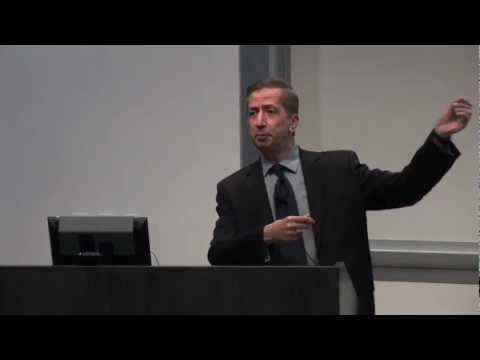
Opening Patient-Centered Pathology Reporting for Cancer Care
Patient-Centered Pathology Reporting for Cancer Care
- Length
- 52 min
- Level
- Graduate
- Recorded
- University of Washington2021
Opening Patient-Centered Pathology Reporting for Cancer Care
Chapter 1 of 9: Before the lecture
Gore builds simplified pathology reports with patients and pathologists, then tests what patients retain.
Patient-centered pathology reports rewrite dense cancer diagnoses into documents that newly diagnosed patients can read. Gore starts from the chronic care model, user-centered design and national data on low health literacy. He then traces how stakeholder interviews, expert panels and patient feedback shaped reports for prostate and bladder cancer. American Cancer Society funding extended the work to breast and colorectal cancers, and pilot trials showed patients favor the reports and gain short-term knowledge accuracy. Retention and the RE-AIM implementation framework expose gaps, and the talk closes with a pathology translator app using optical character recognition and natural language processing.
Patient-centered pathology reports rewrite dense cancer diagnoses into documents that newly diagnosed patients can read. Gore starts from the chronic care model, user-centered design and national data on low health literacy. He then traces how stakeholder interviews, expert panels and patient feedback shaped reports for prostate and bladder cancer. American Cancer Society funding extended the work to breast and colorectal cancers, and pilot trials showed patients favor the reports and gain short-term knowledge accuracy. Retention and the RE-AIM implementation framework expose gaps, and the talk closes with a pathology translator app using optical character recognition and natural language processing.
JAMA 2002
Health Information Technology for Economic and Clinical Health (HITECH) Act
21st Century Cures Act
Human Pathol 2014
Adult Literacy in America
Urol Oncol 2014

This lecture
Talk 13 of 14 of Laboratory Medicine Grand Rounds.
Choose a node to see how it connects to this lecture. What comes before is on the leftat the top. What comes after is on the rightat the bottom. The ring is what it teaches. People and places are above. Other lectures and books are below.
Press a chosen node again to open it.
Your comment is kept while you sign up.Sign in
Urologic Oncology 2014 study
Rand Health Insurance experiment
J Urol 2016 study
Mossonin et al. J Urol 2016
Nayak et al. GU ASCO 2018
Prostate Cancer and Prostatic Diseases 2018 study
Austin E, et al. Patient Educ Couns 2020
Austin E, et al. BMC Health Care Inform 2020
Javid S, et al. ASCO 2020
ASCO 2020
AMIA 2021
Affordable Care Act