Opening Postclassic Maya and Toltec: Styles, Sites, and Comparisons
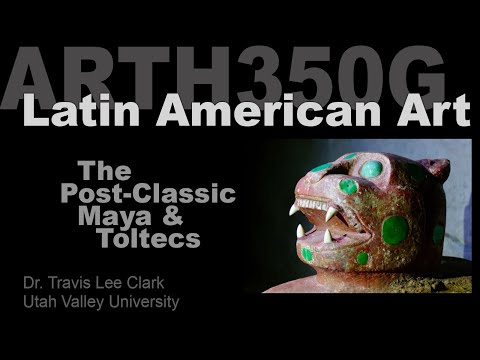
Postclassic Maya and Toltec: Styles, Sites, and Comparisons
- Length
- 1 h 20 min
- Level
- Undergraduate
- Recorded
- Utah Valley University2021 · Standalone Lecture
Opening Postclassic Maya and Toltec: Styles, Sites, and Comparisons
Chapter 1 of 10: Transitions in the post-classic Maya
Reads the Witz monster-mouth doorways of Hochob and Chicanna, then sets Chichen Itza beside Toltec Tula.
Postclassic Maya architecture in the Yucatan moves from naturalistic relief carving toward geometric mosaic stonework and fewer dated inscriptions. Clark starts with the Puuc style at Uxmal, reading the Pyramid of the Magician, the Nunnery and the Governor's Palace, then the mosaic masks of Sayil, Kabah and Labna. Chenes and Rio Bec buildings follow, from the earth-monster entrances at Hochob and Chicanna to nonfunctional sham pyramids. Chichen Itza's serpent columns, Chac Mool altars, skull racks and great ball court are compared with the basalt Atlantean warriors of Tula. Tulum, El Tajin and Mitla close the survey, and the material assumes basic familiarity with Classic Maya chronology.
Postclassic Maya architecture in the Yucatan moves from naturalistic relief carving toward geometric mosaic stonework and fewer dated inscriptions. Clark starts with the Puuc style at Uxmal, reading the Pyramid of the Magician, the Nunnery and the Governor's Palace, then the mosaic masks of Sayil, Kabah and Labna. Chenes and Rio Bec buildings follow, from the earth-monster entrances at Hochob and Chicanna to nonfunctional sham pyramids. Chichen Itza's serpent columns, Chac Mool altars, skull racks and great ball court are compared with the basalt Atlantean warriors of Tula. Tulum, El Tajin and Mitla close the survey, and the material assumes basic familiarity with Classic Maya chronology.

Your comment is kept while you sign up.Sign in