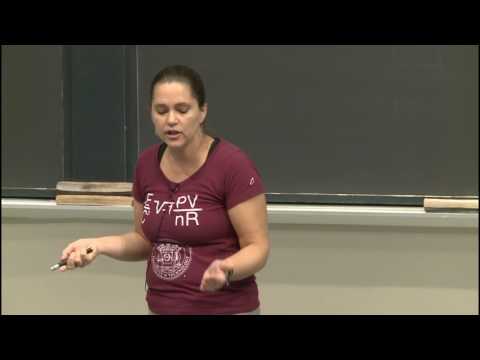
Opening Temperature and the Gas Law (The Mechanical Universe, Episode 45)
Temperature and the Gas Law (The Mechanical Universe, Episode 45)
- Length
- 29 min
- Level
- Introductory
- Recorded
- Caltech2016
Opening Temperature and the Gas Law (The Mechanical Universe, Episode 45)
Chapter 1 of 5: Before the lecture
The ideal gas law, , ties pressure, volume, particle count and absolute temperature together in a single relation. Goodstein starts from heat as the random motion of atoms and molecules. Applying Newton's laws, he treats gas pressure as the momentum change of countless molecules striking a container's walls. The history runs through Robert Boyle's inverse relation between pressure and volume, Jacques Charles's linear expansion of gases, and the ballooning of Gay-Lussac and the Montgolfier brothers. Extending Charles's line downward points to absolute zero, given final form by Lord Kelvin, and the episode closes with Daniel Fahrenheit's fixed points.

Your comment is kept while you sign up.Sign in
Goodstein derives gas pressure from molecules striking a wall, then extrapolates Charles's law to absolute zero.
The ideal gas law, , ties pressure, volume, particle count and absolute temperature together in a single relation. Goodstein starts from heat as the random motion of atoms and molecules. Applying Newton's laws, he treats gas pressure as the momentum change of countless molecules striking a container's walls. The history runs through Robert Boyle's inverse relation between pressure and volume, Jacques Charles's linear expansion of gases, and the ballooning of Gay-Lussac and the Montgolfier brothers. Extending Charles's line downward points to absolute zero, given final form by Lord Kelvin, and the episode closes with Daniel Fahrenheit's fixed points.
This lecture
Lecture 44 of 51 of The Mechanical Universe.
Choose a node to see how it connects to this lecture. What comes before is on the leftat the top. What comes after is on the rightat the bottom. The ring is what it teaches. People and places are above. Other lectures and books are below.
Press a chosen node again to open it.