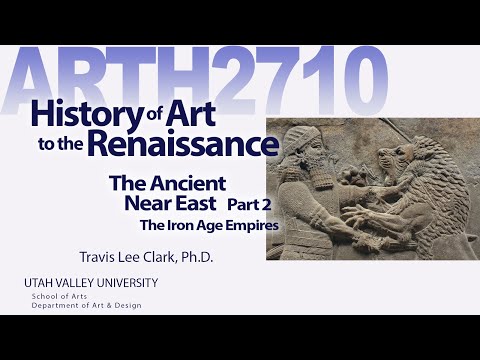
Opening The Ancient Near East Part 2: Iron Age Empires (ARTH2710, Lecture 7)
The Ancient Near East Part 2: Iron Age Empires (ARTH2710, Lecture 7)
- Length
- 1 h 34 min
- Level
- Undergraduate
- Recorded
- Utah Valley University2020
Opening The Ancient Near East Part 2: Iron Age Empires (ARTH2710, Lecture 7)
Chapter 1 of 12: Late Bronze Age trade networks
Reads Assyrian palace reliefs as psychological warfare and matches Solomon's temple cherubim to lamassu.
Iron Age Near Eastern art grew out of the Bronze Age collapse, when the Sea Peoples and broken tin routes pushed societies from bronze toward iron. Clark starts with Late Bronze Age sea trade and the Ulu Burun shipwreck, then sets Tutankhamun's daggers beside the Vered Jericho Sword. Neo-Assyrian palace reliefs follow, read as continuous narrative and psychological warfare showing deportations and royal dominance. The Ishtar Gate's glazed blue bricks and the hypostyle halls and tribute reliefs of Persepolis present the Neo-Babylonian and Achaemenid empires. The last part compares Megiddo ivory plaques and the biblical cherubim of Solomon's temple with Near Eastern sphinxes, lamassu and palm reliefs.
Iron Age Near Eastern art grew out of the Bronze Age collapse, when the Sea Peoples and broken tin routes pushed societies from bronze toward iron. Clark starts with Late Bronze Age sea trade and the Ulu Burun shipwreck, then sets Tutankhamun's daggers beside the Vered Jericho Sword. Neo-Assyrian palace reliefs follow, read as continuous narrative and psychological warfare showing deportations and royal dominance. The Ishtar Gate's glazed blue bricks and the hypostyle halls and tribute reliefs of Persepolis present the Neo-Babylonian and Achaemenid empires. The last part compares Megiddo ivory plaques and the biblical cherubim of Solomon's temple with Near Eastern sphinxes, lamassu and palm reliefs.
The Iliad
The Bible
Old Testament (Kings and Chronicles)
Book of Ezra and Nehemiah
Walser Eidot plate I
This lecture
Lecture 7 of 24 of History of Art to the Renaissance.
Choose a node to see how it connects to this lecture. What comes before is on the leftat the top. What comes after is on the rightat the bottom. The ring is what it teaches. People and places are above.
Press a chosen node again to open it.
Your comment is kept while you sign up.Sign in