
Introduction to Artificial Intelligence
Prof. Pieter AbbeelUninformed and A* heuristic search, constraint satisfaction, adversarial minimax/expectimax games, Markov decision processes, reinforcement learning, Bayes nets, and particle filtering.
Syllabus
22COMPSCI 188 - 2018-08-23 - Introduction to Artificial Intelligence
This inaugural lecture for UC Berkeley's CS 188 introduces core concepts of artificial intelligence, differentiating between approaches that model human thought versus rational action. It provides a historical overview of AI and surveys key application areas such as natural language processing, computer vision, and game playing.
COMPSCI 188 - 2018-08-28 - Uninformed Search
This lecture introduces foundational uninformed search algorithms for AI planning, including Breadth-First Search, Depth-First Search, Uniform-Cost Search, and Iterative Deepening Search, detailing their mechanics and comparative performance characteristics.
COMPSCI 188 - 2018-08-30 - A* Search and Heuristics
This lecture introduces informed search algorithms, detailing the principles of heuristic functions, greedy best-first search, and the A* algorithm. It rigorously covers the properties of A* optimality and completeness, examining the conditions of heuristic admissibility and consistency.
COMPSCI 188 - 2018-09-04 - Constraint Satisfaction Problems (CSPs) Part 1/2
This lecture introduces formal definitions of Constraint Satisfaction Problems (CSPs), exploring their representation via constraint graphs and fundamental solution techniques including backtracking search, forward checking, and the AC3 arc consistency algorithm.
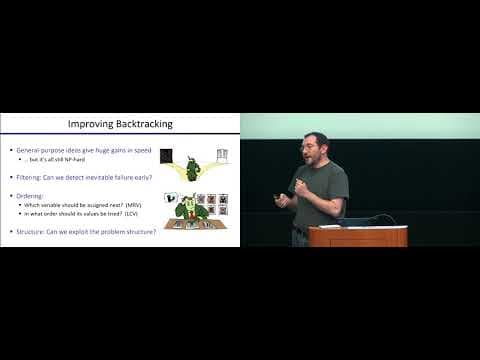
COMPSCI 188 - 2018-09-06 - Constraint Satisfaction Problems (CSPs) Part 2/2
This lecture extends the analysis of Constraint Satisfaction Problems (CSPs), detailing k-consistency, algorithms for tree-structured CSPs, and the application of cutset conditioning. It also introduces local search methods such as hill climbing for solving CSPs.
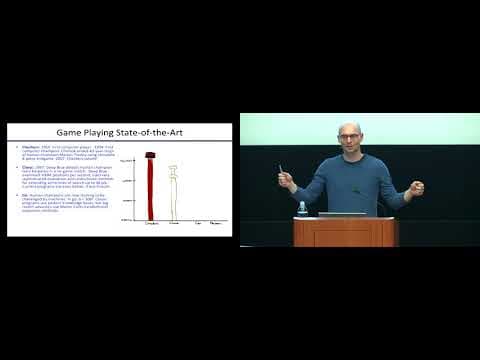
COMPSCI 188 - 2018-09-11 - Search with Other Agents: Minimax
This lecture introduces formal game theory concepts, detailing the Minimax algorithm for optimal decision-making in zero-sum games. It thoroughly covers Alpha-Beta Pruning as an optimization technique for Minimax search trees, alongside discussions of depth-limited search and heuristic evaluation functions.
COMPSCI 188 - 2018-09-13 - Search with Other Agents: Expectimax, Utilities
This lecture introduces the Expectimax algorithm for decision-making in stochastic games, contrasting it with Minimax. It covers modeling probabilities, the role of utility functions in rational agents, and implications for human decision-making.
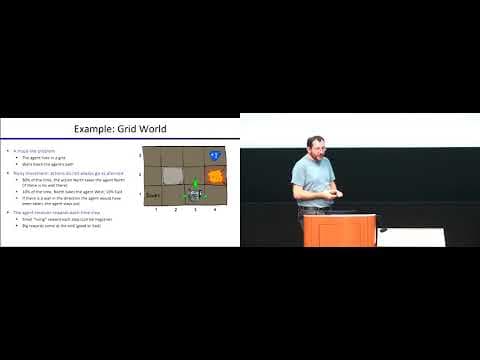
Markov Decision Processes (MDPs) Part 1/2 (CS 188)
This lecture introduces the formal definition of Markov Decision Processes (MDPs), exploring optimal policies, value iteration, and concepts of utilities and discounting in sequential decision-making.
Markov Decision Processes (MDPs) Part 2/2 (CS 188)
The lecture delves into the Bellman Equations and their role in value iteration convergence, contrasting it with policy evaluation and policy iteration algorithms for solving MDPs.
Reinforcement Learning Part 1/2 (CS 188)
This session introduces fundamental concepts of Reinforcement Learning, differentiating between model-based and model-free approaches, and detailing passive RL techniques like Direct Evaluation and Temporal Difference Learning.
Reinforcement Learning Part 2/2 (CS 188)
This lecture explores advanced Reinforcement Learning topics including the exploration-exploitation dilemma with Epsilon Greedy policies, approximate Q-learning using feature-based representations, and an introduction to policy search.
Probability (CS 188)
The lecture covers foundational probability concepts, including random variables, joint and marginal distributions, conditional probability, the product rule, the chain rule, and Bayes' Rule for probabilistic inference.
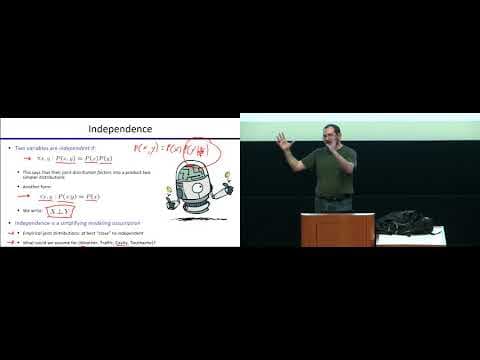
Bayes' Nets: Representation (CS 188)
This lecture introduces Bayesian Networks, defining their structure and notation. It covers concepts of independence and conditional independence, demonstrating how these simplify probabilistic models.
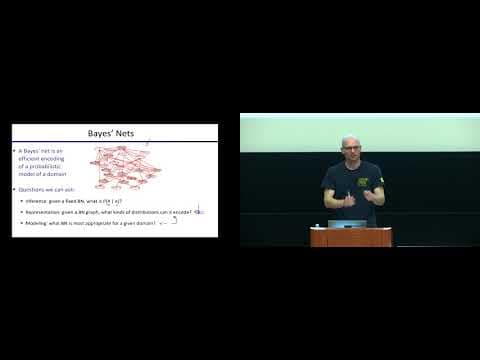
Bayes' Nets: Independence (D-Separation) (CS 188)
The session focuses on determining independence in Bayesian Networks using D-separation, examining causal chain, common cause, and common effect triples to understand structural implications.
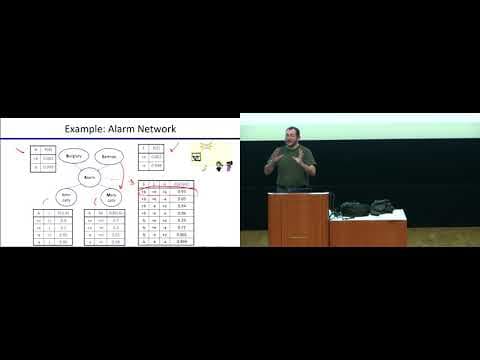
Bayes' Nets: Inference (Variable Elimination) (CS 188)
This lecture details inference in Bayesian Networks using Variable Elimination, comparing its efficiency with enumeration, and explaining the operations of joining and eliminating factors.
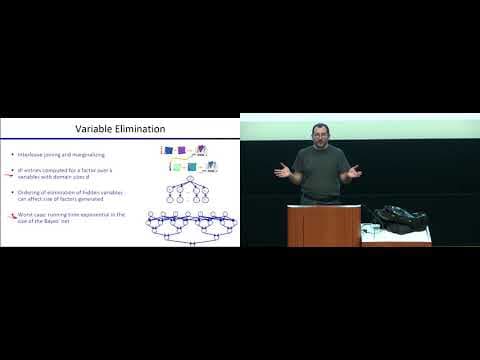
Bayes' Nets: Sampling (CS 188)
The lecture explores various sampling methods for approximate inference in Bayesian Networks, including prior sampling, rejection sampling, likelihood weighting, and Gibbs sampling.
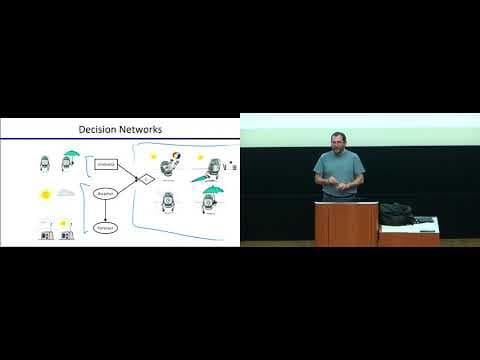
Decision Networks and Value of Perfect Information (VPI) (CS 188)
This session introduces Decision Networks for optimal action selection under uncertainty, elaborating on the Value of Perfect Information (VPI) and its properties, including its relation to conditional independence.
Hidden Markov Models (CS 188)
This lecture introduces Hidden Markov Models (HMMs), building from Markov chains and defining their independence assumptions. It covers stationary distributions and their applications.
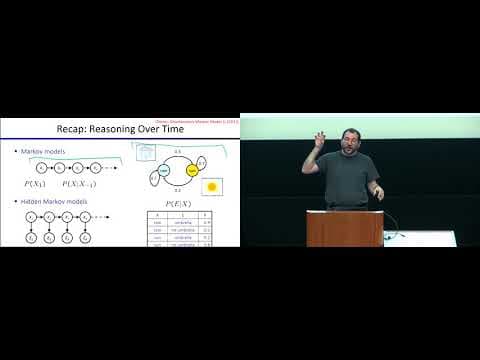
Particle Filtering (CS 188)
The lecture focuses on Particle Filtering, a sequential Monte Carlo method for state estimation in dynamic systems. It illustrates its application through time elapse and observation updates.
Machine Learning: Naive Bayes (CS 188)
This lecture introduces Machine Learning concepts through Naive Bayes classification. It covers computing probabilities from data, handling unseen events with Laplace smoothing, and evaluating generalization and overfitting.
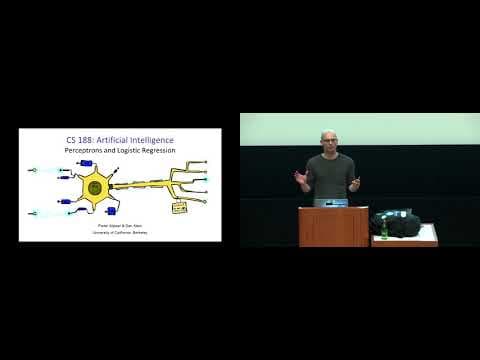
Machine Learning: Perceptrons and Logistic Regression (CS 188)
This session delves into linear classifiers, specifically perceptrons and logistic regression. It explains weight updates for training, multiclass extensions, and the properties and limitations of these models.
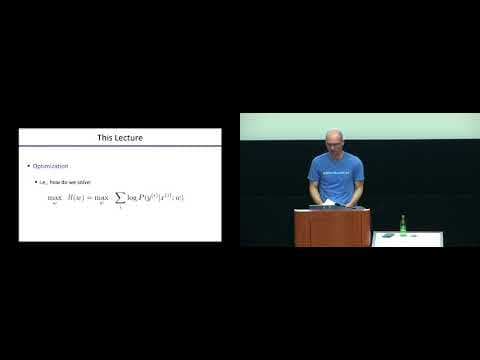
Machine Learning: Optimization and Neural Networks (CS 188)
The lecture covers optimization techniques like Hill Climbing and Gradient Ascent, essential for training machine learning models. It introduces Neural Network structure, activation functions, and training methodologies.