
Deep Reinforcement Learning
Prof. Sergey LevineImitation learning, policy gradients, actor-critic algorithms, value-function Q-learning, model-based RL, offline reinforcement learning, exploration, and inverse RL.
Syllabus
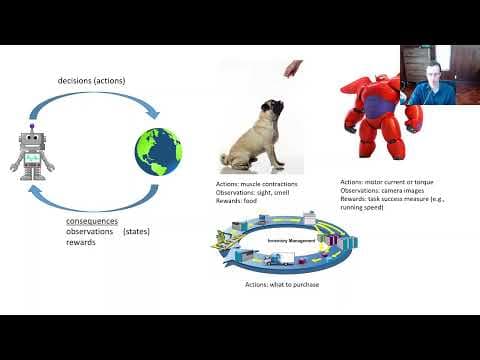
11CS 285: Lecture 1, Introduction. Part 2
This segment of CS 285 introduces foundational concepts in deep reinforcement learning, outlining the problem statement, key components of an RL system, and the interplay between deep neural networks and control.
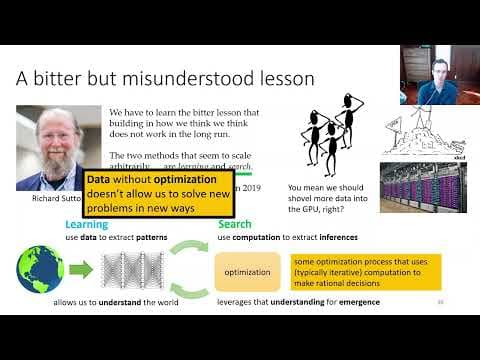
CS 285: Lecture 1, Introduction. Part 3
This lecture segment introduces foundational concepts in deep reinforcement learning, laying the groundwork for understanding policy gradient methods and value-based approaches to sequential decision-making.
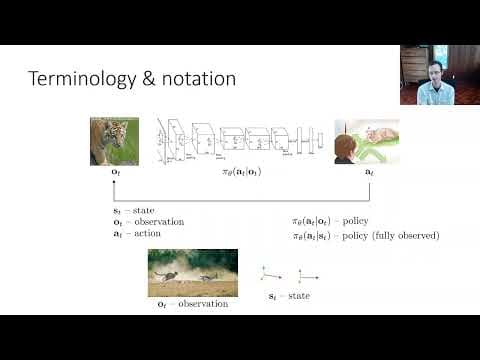
CS 285: Lecture 2, Imitation Learning. Part 1
This lecture introduces the foundational concepts of imitation learning in the context of deep reinforcement learning, detailing methods like behavioral cloning and their underlying theoretical assumptions. It sets the stage for understanding how agents can learn directly from expert demonstrations.
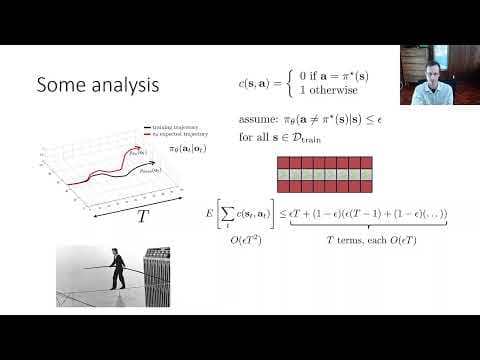
CS 285: Lecture 2, Imitation Learning. Part 2
This lecture segment from UC Berkeley's CS 285 course details advanced topics in imitation learning, specifically addressing covariate shift and applying techniques like DAgger for robust policy learning from expert demonstrations.
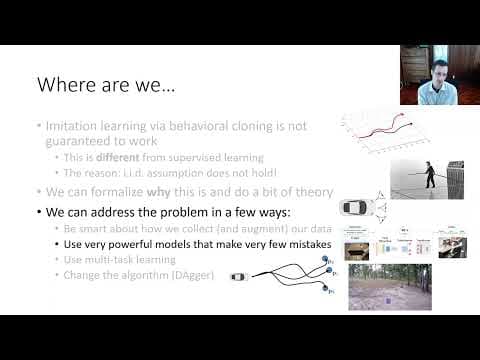
CS 285: Lecture 2, Imitation Learning. Part 3
This lecture segment systematically presents advanced imitation learning algorithms, delving into theoretical foundations of generative adversarial imitation learning (GAIL) and its practical implications for robust policy learning.
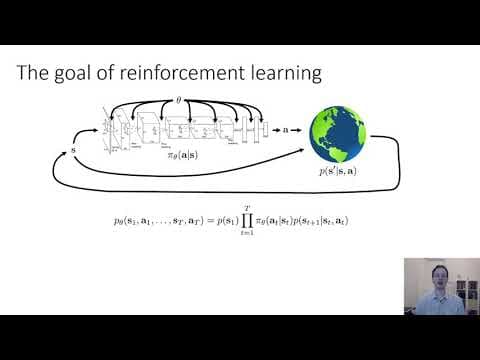
CS 285: Lecture 4, Part 1
This lecture segment from UC Berkeley's CS 285 introduces foundational concepts in deep reinforcement learning, detailing policy gradient methods and their application in training agents with neural networks. It covers the mathematical formulation of reinforcement learning problems and the challenges of high-dimensional state spaces.
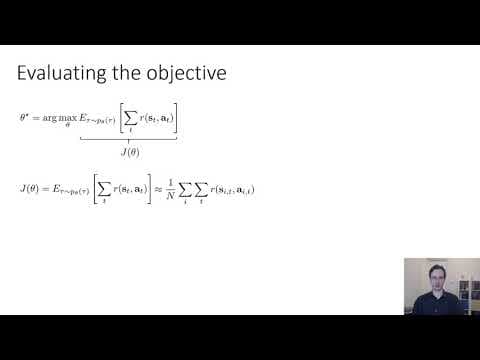
Lecture 5, Part 1 (CS 285)
This segment introduces policy gradient methods, examining the foundational REINFORCE algorithm and its derivation from the policy objective function.
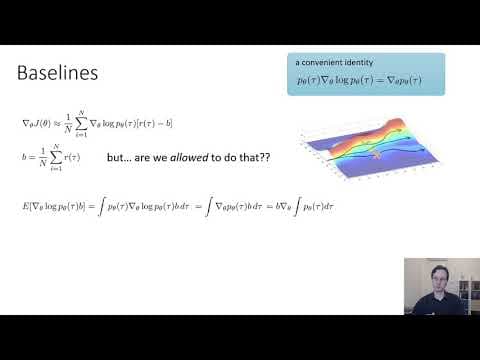
Lecture 5, Part 3 (CS 285)
This part delves into the practical challenges of applying policy gradients, discussing variance reduction techniques such as baseline subtraction and the use of value functions.
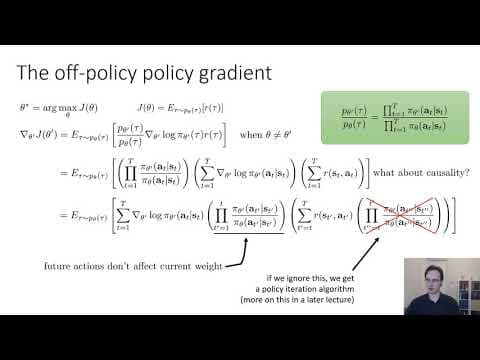
Lecture 5, Part 4 (CS 285)
The lecture concludes with an exploration of actor-critic methods, illustrating how they combine policy-based and value-based approaches to improve learning efficiency.
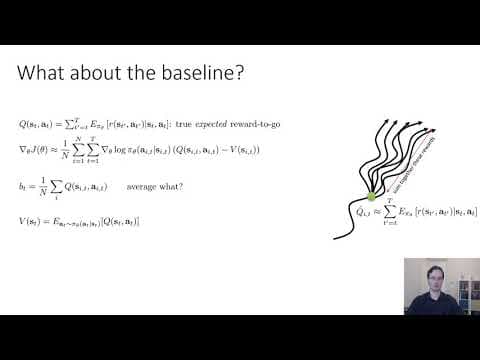
Lecture 6, Part 1 (CS 285)
This lecture introduces advanced policy gradient concepts, focusing on the connection between policy gradients and the Fisher information matrix in natural policy gradients.
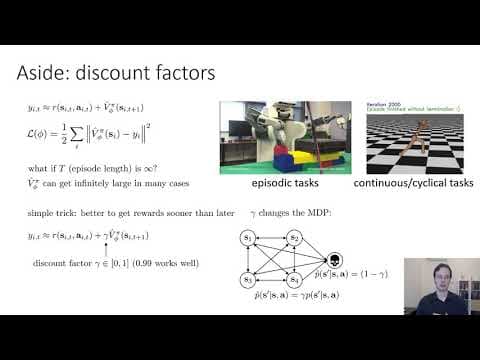
Lecture 6, Part 2 (CS 285)
This segment examines the theoretical underpinnings and practical implementation of Trust Region Policy Optimization (TRPO) algorithms for stable policy updates.