
Nonlinear Dynamics and Chaos
Prof. Steven StrogatzFlows on the line and circle, saddle-node and pitchfork bifurcations, two-dimensional phase planes, limit cycles, Hopf bifurcations, Lorenz equations, strange attractors, and fractals.
Syllabus
22MAE5790-1 Course introduction and overview
This introductory lecture to Cornell MAE 5790 provides an overview of nonlinear dynamics, contrasting linear and nonlinear systems. It introduces one-dimensional systems, fixed points, and their stability, using the logistic equation as a primary example.
MAE5790-2 One dimensional Systems
Linearization for 1-D systems. Existence and uniqueness of solutions. Bifurcations. Saddle-node bifurcation. Bifurcation diagrams.
MAE5790-3 Overdamped bead on a rotating hoop
Equations of motion. When can we neglect the second derivative? Dimensional analysis and scaling. A singular limit.
MAE5790-4 Model of an insect outbreak
Model of spruce budworm outbreaks in the forests of northeastern Canada and United States. Nondimensionalization. Saddle-node bifurcations. Jump phenomena. Hysteresis. Cusp catastrophe.
MAE5790-5 Two dimensional linear systems
Phase plane analysis. Eigenvectors and eigenvalues. Classification of 2-D linear systems. Saddle points. Stable and unstable nodes and spirals. Centers. Non-isolated fixed points.
MAE5790-6 Two dimensional nonlinear systems fixed points
This lecture introduces the analysis of two-dimensional nonlinear systems, focusing on fixed points, linearization using the Jacobian matrix, and the stability of equilibrium solutions. It applies these concepts to the Lotka-Volterra model, examining phase plane dynamics.
MAE5790-7 Conservative Systems
Mechanical systems with one degree of freedom. Particle in a double well. Symmetry. Homoclinic orbits. Energy surface. Theorem about nonlinear centers. Pendulum. Cylindrical phase space.
MAE5790-8 Index theory and introduction to limit cycles
Steven Strogatz introduces index theory for planar vector fields, demonstrating its application to rule out closed trajectories and discussing its implications, including the Hairy Ball Theorem. The session then transitions to the definition and characteristics of limit cycles in nonlinear dynamical systems.
Lecture 9: Testing for Closed Orbits (MAE 5790)
This lecture explores techniques for discerning and proving the existence of closed orbits, examining index theory, Dulac's criterion, and the Poincaré-Bendixson theorem. It illustrates these concepts with examples like oscillatory glycolysis and trapping regions.
Lecture 10: Van der Pol Oscillator (MAE 5790)
This session investigates the van der Pol oscillator, tracing its origins in radio engineering and analyzing both its strongly and weakly nonlinear limits. It covers the Liénard transformation, relaxation oscillations, and the energy method for estimating limit cycle amplitude.
Lecture 11: Averaging Theory for Weakly Nonlinear Oscillators (MAE 5790)
This lecture derives averaged equations for the slowly-varying amplitude and phase of weakly nonlinear oscillators. It applies these concepts to the van der Pol oscillator and the Duffing equation, yielding explicit solutions for amplitude dynamics.
Lecture 12: Bifurcations in Two-Dimensional Systems (MAE 5790)
This lecture analyzes various bifurcations of fixed points and periodic orbits in two-dimensional nonlinear systems, including saddle-node, transcritical, pitchfork, and Hopf bifurcations, referencing Strogatz's "Nonlinear Dynamics and Chaos."
Lecture 13: Hopf Bifurcations in Aeroelastic Instabilities and Chemical Oscillators (MAE 5790)
This session differentiates between supercritical and subcritical Hopf bifurcations, illustrating their relevance in aeroelastic instabilities like airplane wing flutter and various chemical oscillation phenomena. Computer simulations are used to demonstrate these concepts.
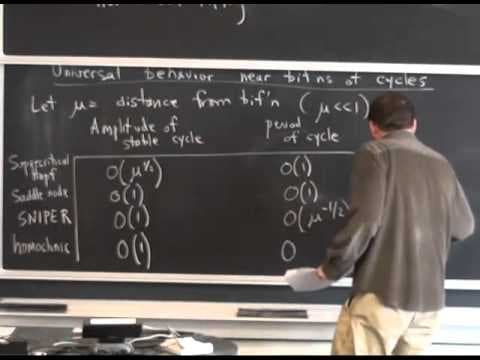
Lecture 14: Global Bifurcations of Cycles (MAE 5790)
This lecture explores global bifurcations of cycles, including Hopf, saddle-node bifurcations of cycles (SNIPER), and homoclinic bifurcations. It discusses coupled oscillators, knotted cycles, and the concept of quasiperiodicity.
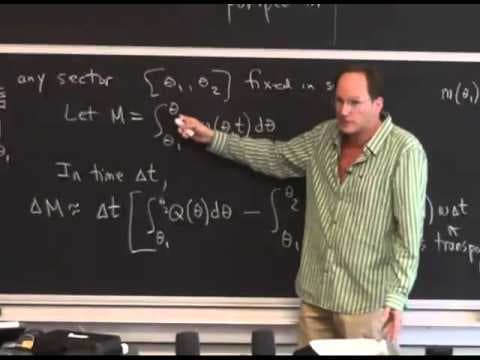
Lecture 15: Chaotic Waterwheel (MAE 5790)
This lecture introduces the chaotic waterwheel, deriving its governing equations through continuity and torque balance. It demonstrates a miraculous exact decoupling of a three-dimensional subsystem, utilizing the orthogonality of Fourier modes.
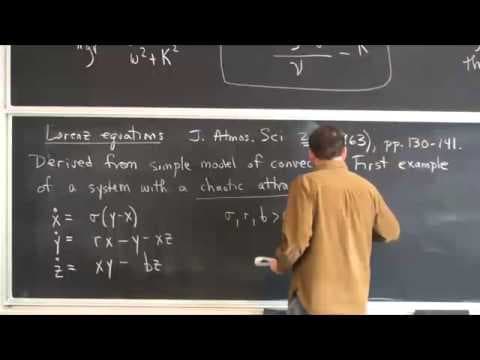
Lecture 16: Waterwheel Equations and Lorenz Equations (MAE 5790)
This lecture analyzes the waterwheel and Lorenz equations, detailing simple properties of the Lorenz system, including volume contraction and the linear stability of its fixed points. References Strogatz's "Nonlinear Dynamics and Chaos."
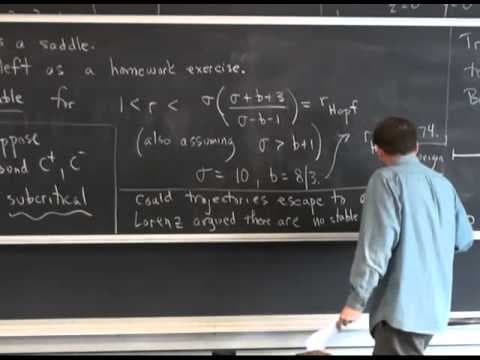
Lecture 17: Chaos in the Lorenz Equations (MAE 5790)
This lecture delves into the chaotic behavior of the Lorenz equations, discussing global stability, boundedness, and the absence of quasiperiodicity. It introduces the strange attractor, butterfly effect, and Lyapunov exponent, defining the predictability horizon for chaotic systems.
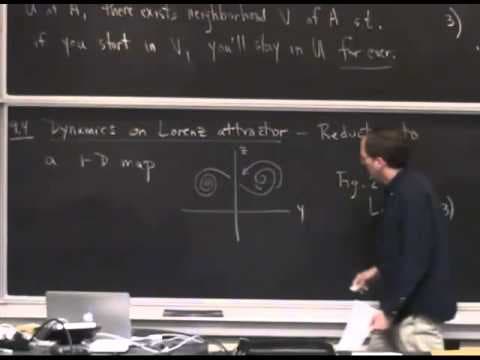
Lecture 18: Strange Attractor for the Lorenz Equations (MAE 5790)
This session defines attractors, chaos, and strange attractors, exploring the dynamics on the Lorenz attractor. It introduces the Lorenz map for reduction to a 1-D system and uses cobweb diagrams to rule out stable limit cycles for specific parameters.
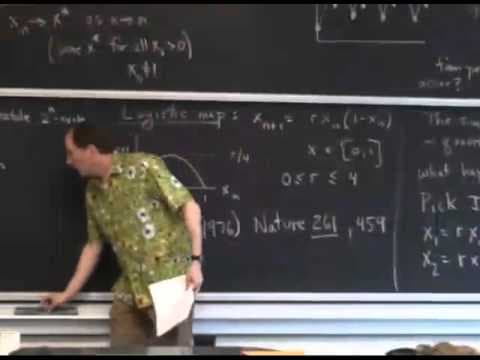
Lecture 19: One-Dimensional Maps (MAE 5790)
This lecture examines one-dimensional maps, focusing on the logistic map as a model for complex dynamics and the period-doubling route to chaos. It analyzes fixed points, their stability, and the iconic orbit diagram, including flip bifurcations.
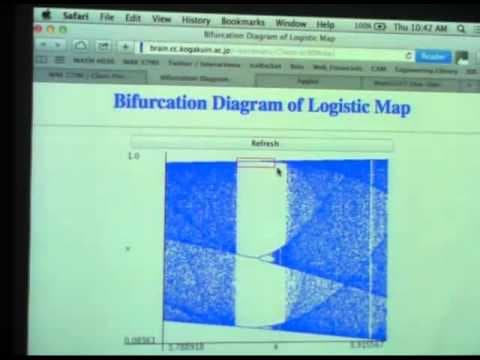
Lecture 20: Universal Aspects of Period Doubling (MAE 5790)
This lecture investigates the universal aspects of period doubling, using online applets to explore the logistic map's self-similar fractal structure and periodic windows. It introduces Feigenbaum's work, the tangent bifurcation, and universal scaling constants alpha and delta.
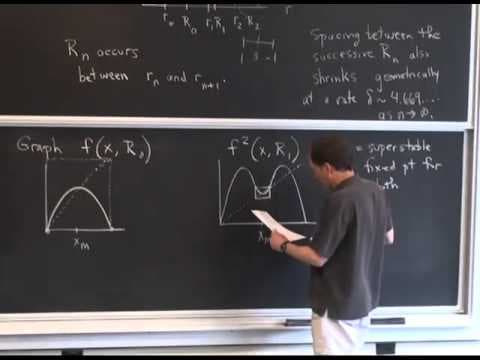
Lecture 21: Feigenbaum's Renormalization Analysis of Period Doubling (MAE 5790)
This lecture explains Feigenbaum's renormalization analysis, building intuition from self-similarity in period doubling and defining the renormalization transformation. It presents the functional equation for alpha and the universal function 'g' to explain these universal aspects.
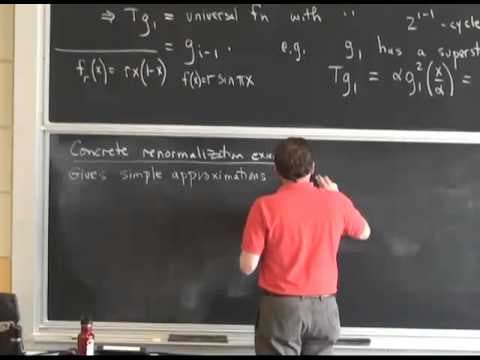
Lecture 22: Renormalization: Function Space and a Hands-On Calculation (MAE 5790)
This lecture introduces the concept of an infinite-dimensional function space, where the renormalization transformation acts as a mapping. It identifies the universal function 'g' as a saddle point and the scaling factor delta as an unstable eigenvalue, demonstrating a concrete renormalization calculation.