MAE5790-1 Course introduction and overview
1:16:31MAE5790-2 One dimensional Systems
1:16:44MAE5790-3 Overdamped bead on a rotating hoop
1:13:12MAE5790-4 Model of an insect outbreak
1:15:16MAE5790-5 Two dimensional linear systems
1:15:20MAE5790-6 Two dimensional nonlinear systems fixed points
1:07:17MAE5790-7 Conservative Systems
1:17:13MAE5790-8 Index theory and introduction to limit cycles
1:13:55Testing for Closed Orbits
1:16:52Van der Pol Oscillator
1:05:58Averaging Theory for Weakly Nonlinear Oscillators
1:16:08Bifurcations in Two-Dimensional Systems
46:54Hopf Bifurcations in Aeroelastic Instabilities and Chemical Oscillators
1:07:57Global Bifurcations of Cycles
1:16:23Chaotic Waterwheel
1:14:12Waterwheel Equations and Lorenz Equations
1:12:42Chaos in the Lorenz Equations
1:16:36Strange Attractor for the Lorenz Equations
1:13:48One-Dimensional Maps
1:14:35Universal Aspects of Period Doubling
1:11:56Feigenbaum's Renormalization Analysis of Period Doubling
1:15:59Renormalization: Function Space and a Hands-On Calculation
1:08:32Feigenbaum's Renormalization Analysis of Period Doubling

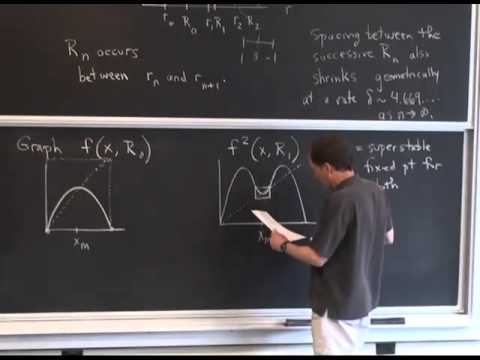
This lecture explains Feigenbaum's renormalization analysis, building intuition from self-similarity in period doubling and defining the renormalization transformation. It presents the functional equation for alpha and the universal function 'g' to explain these universal aspects.
Superstable fixed points and cycles. Intuition behind renormalization, based on self-similarity. Renormalization transformation. Defining a family of universal functions. Explaining geometrically where the universal aspects of period doubling come from. Functional equation for alpha and the universal function g.
Reading: Strogatz, "Nonlinear Dynamics and Chaos", Sections 10.7.
Universal Aspects of Period Doubling
Next · Lecture 22Renormalization: Function Space and a Hands-On Calculation