
Principles of Microeconomics
Constrained utility maximization, demand elasticity, production functions, competitive equilibrium, welfare theorems, monopoly pricing, oligopoly, externalities, and asymmetric information.
Syllabus
22Introduction and Supply & Demand
This introductory lecture establishes the foundational principles of microeconomics, defining its scope and rigorously developing the core concepts of supply and demand to analyze market mechanisms.
Preferences and Utility Functions
This lecture introduces the foundational concepts of consumer preferences and utility functions within microeconomic theory. It develops indifference curves, their properties, and the crucial relationship between marginal utility and the marginal rate of substitution.
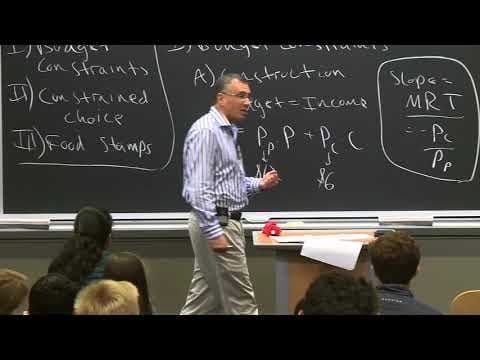
Budget Constraints and Constrained Choice
This lecture, part of MIT's Principles of Microeconomics, develops the core economic model of consumer choice under explicit budget constraints, detailing the implications for utility maximization and demand.
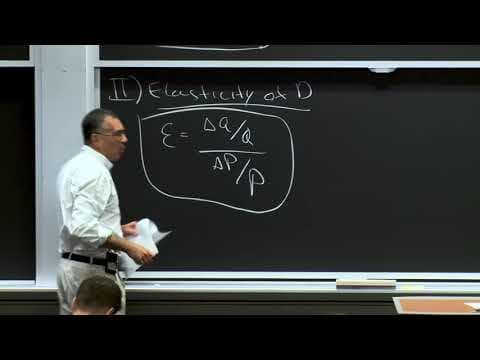
Demand Curves and Income/Substitution Effects
This lecture derives individual and market demand curves, examining the critical concepts of price elasticity of demand and the decomposition of price changes into income and substitution effects.
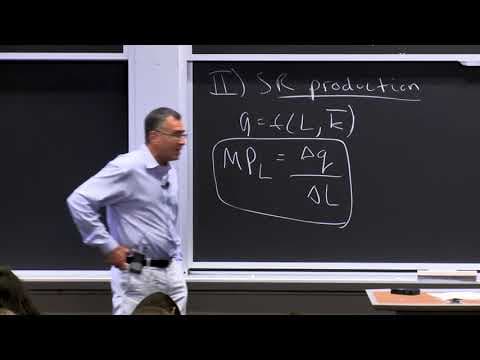
Production Theory
This lecture introduces core concepts in producer theory, detailing the production function, short-run vs. long-run production, and the technical rate of substitution. It further examines returns to scale and measures of productivity within microeconomic frameworks.
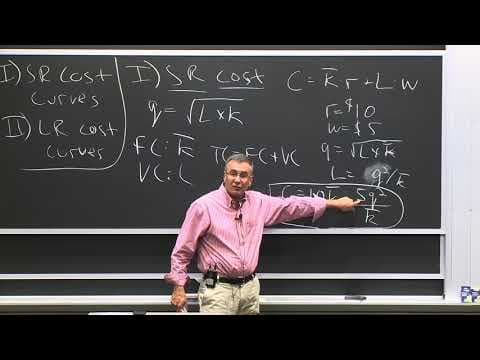
Costs
This lecture, part of MIT's Principles of Microeconomics, extends producer theory by detailing the derivation and implications of short-run and long-run cost curves, including concepts such as total, average, and marginal costs.
Competition I
This lecture concludes the analysis of production costs from prior sessions, then formally introduces the model of perfect competition. It details the conditions for short-run profit maximization for firms operating within such a market structure.
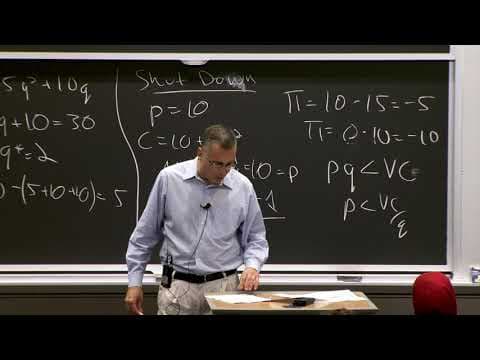
Competition II
This lecture explicates the core tenets of perfect competition, examining short-run profit maximization, short-run equilibrium dynamics, and the long-run implications of competitive markets.
Supply and Demand \u0026 Consumer/Producer Surplus
This session introduces the fundamental concepts of supply and demand curves, meticulously deriving and illustrating consumer surplus and producer surplus in market analysis.
Welfare Economics
This lecture systematically explores the principles of welfare economics, demonstrating how competitive markets maximize societal welfare and analyzing the effects of government interventions.
Monopoly I
This lecture transitions from perfect competition to monopoly, focusing on the distinct mechanisms of monopoly profit maximization and the subsequent welfare effects on the economy.
Monopoly II
This session delves into the origins of monopolies, examining various regulatory approaches and analyzing the concept of contestable markets as a potential constraint on monopoly power.
Oligopoly
This lecture provides an introduction to oligopoly market structures, employing game theory principles and detailing the Cournot model for analyzing firm behavior and equilibrium outcomes.

Oligopoly II
This lecture extends the analysis of oligopolies, examining the formation and stability of cartels, comparing different equilibrium types, and exploring price competition among many firms.
Input Markets I—Labor Market
This lecture initiates the study of factor markets, specifically focusing on the labor market by explicating the determinants of factor demand and factor supply for labor.
Input Markets II—Labor and Capital
This session continues the examination of factor markets, illustrating key principles through the practical example of minimum wage policy and its effects on the labor market.
Making Choices Over Time
This lecture explores intertemporal decision-making, demonstrating how capital markets and the pricing of future resources influence economic choices in real-world scenarios.
Increasing Savings \u0026 Introduction to Trade
This lecture addresses strategies for increasing savings as a driver of economic growth and provides an initial framework for understanding the fundamental concepts of international trade.
International Trade: Welfare and Policy
This session rigorously analyzes the welfare economics of international trade, focusing on comparative advantage and how these principles inform and shape trade policy decisions.
Uncertainty
This lecture explicates the economic framework for decision-making under uncertainty, introducing core concepts that model agents' choices when outcomes are not guaranteed.
Efficiency and Equity
This lecture introduces the critical concepts of efficiency and equity in resource allocation, discussing the identification of socially optimal allocations, sources of inequality, and leakage.
Government Redistribution and Taxation
This lecture extends the discourse on equity and efficiency, analyzing the mechanisms of government redistribution programs and the economic impacts of taxation within the United States.