
Game Theory
Rigorous undergraduate introduction to strategic reasoning: dominance, Nash equilibrium, backward induction, subgame perfection, evolutionary games, asymmetric information, and auctions.
Game theory, microeconomics, macroeconomics, financial theory, market microstructure, and mechanism design.
Complete university lecture courses in economics & finance.
Rigorous undergraduate introduction to strategic reasoning: dominance, Nash equilibrium, backward induction, subgame perfection, evolutionary games, asymmetric information, and auctions.
Applies administrative tax, education, and census datasets to intergenerational mobility, neighborhood effects, innovation, health disparities, and tax policy.
Nobel laureate Robert Shiller examines the theory, history, and behavioral foundations of risk management, portfolio diversification, efficient markets, real estate, banking, and regulation.
Nobel laureates Esther Duflo and Abhijit Banerjee analyze poverty traps, randomized controlled trials, nutrition, preventive health, education incentives, microcredit, insurance, and institutional governance.
Andrew Lo's foundational financial economics sequence covering framework of financial analysis, present value relations, yield curves, fixed-income securities, equities, portfolio theory, and market efficiency.
Intrinsic discounted cash flow valuation, equity risk premiums, cost of capital, growth estimation, terminal value, relative multiples, and valuing private and distressed firms.
Two complementary economics talks paired around a central intellectual tension.
Two Nobel-winning MIT perspectives on global prosperity: centuries-long political institutions from above versus randomized empirical interventions on the ground.


Self-contained lectures, Nobel addresses, and research colloquia you can watch in one sitting.
Simon Johnson presents his Nobel Prize lecture, elucidating the long-term impact of disease environments and European mortality rates on the formation of institutions and subsequent economic prosperity in former colonial territories. This work connects historical epidemiological conditions to modern institutional development.
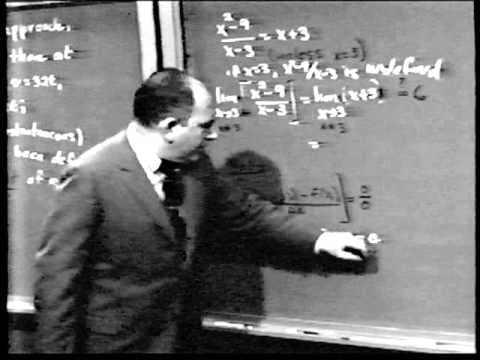
The first lecture in Unit II of MIT's "Calculus Revisited" series, focusing on the derivation of basic functions.
Professor Raj Chetty delivers a keynote address on leveraging large-scale data to analyze and inform policies for improving economic mobility through higher education.
Shows how deferred-acceptance matching algorithms redesign markets where prices cannot clear—including medical residency matching, public school choice, and paired kidney transplants.
Traces two centuries of archival data on female labor participation, marriage bars, birth-control timing, and 'greedy jobs' driving persistent earnings gaps.
Shows how randomized field evaluations transform development economics from sweeping ideological debates into cumulative empirical engineering.



Written text, unwritten constitutional norms, game-theoretic dominance, and externalities
Yale University · MIT


Cognitive heuristics, nudges, neighborhood causal inference, and gender history
Princeton University · University of Chicago · Harvard University

Microeconomic incentives, macro policy, institutional divergence, and RCT poverty research
MIT

Game theory across economics, evolutionary biology, and public ethics
Yale University · Stanford University · Harvard University