
The Human Brain
Prof. Nancy KanwisherNancy Kanwisher charts functional organization of the human cortex through lesion neuropsychology, fMRI, diffusion tractography, visual object recognition, navigation, number, language, and theory of mind.

Syllabus
171. Introduction to the Human Brain
Professor Nancy Kanwisher introduces the study of the human brain, employing a case study to illustrate functional localization within the visual cortex. The lecture establishes the methodological approaches and core questions of cognitive neuroscience.

2. Neuroanatomy
This lecture provides a foundational overview of human neuroanatomy, covering cortical structures, primary functional regions, and the organization of topographic maps within the brain. It serves as preparation for subsequent dissection sessions.
4. Cognitive Neuroscience Methods I
This lecture introduces fundamental methodologies in cognitive neuroscience, including functional magnetic resonance imaging (fMRI), event-related potentials (ERPs), magnetoencephalography (MEG), and transcranial magnetic stimulation (TMS). It also covers insights from neuropsychology patient studies and intracranial recordings in human and nonhuman primates.
5. Cognitive Neuroscience Methods II
This lecture, part of MIT's "The Human Brain" course, continues the examination of fundamental research methodologies in cognitive neuroscience. It details advanced techniques for studying brain function, building upon initial discussions of neuroimaging and electrophysiological methods.

6. Introduction to the Human Brain
This lecture reviews human brain anatomy and function, specifically addressing face recognition mechanisms and various experimental methods in neuroimaging, including fMRI design and data interpretation. It also touches on cortical specialization for distinct visual stimuli.
7. Category Selectivity, Controversies, and MVPA
This lecture critically examines the functional organization of the ventral visual pathway, detailing controversies regarding category selectivity and exploring the application of multi-voxel pattern analysis (MVPA) in fMRI research.
8. Navigation I
This lecture explores the neural mechanisms underpinning spatial navigation and scene perception. It details the functional organization of brain structures, including the hippocampus and parahippocampal place area, that facilitate environmental understanding and wayfinding.
9. Navigation II
This lecture continues the analysis of neural mechanisms underlying human scene perception and spatial navigation, examining the specific brain regions and cognitive processes involved in constructing and utilizing environmental representations.

Lecture 10: Development, Nature & Nurture I (9.13)
This lecture investigates the developmental organization of the human cortex during infancy and childhood, analyzing the interplay between genetic predispositions and environmental experience.
Lecture 11: Development, Nature & Nurture II (9.13)
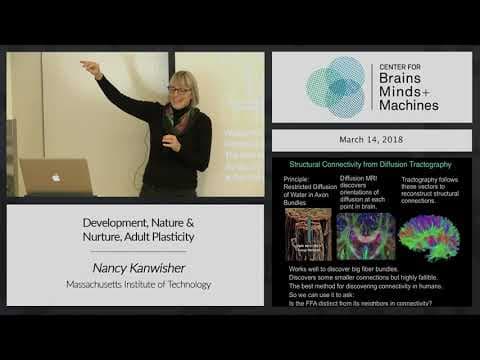
Continuing the analysis of cortical organization, this session delves into the relative contributions of genes and experience, further exploring cortical plasticity into adulthood.

Lecture 16: Music (9.13)
This lecture examines the functional neurological organization underlying human musical perception and production, identifying specialized brain regions involved in processing music.

Lecture 18: Language I (9.13)
This session introduces the fundamental organization of language processing in the brain, addressing the complex and long-debated relationship between thought and linguistic structures.
Lecture 21: Brain Networks (9.13)
This lecture investigates the major white matter tracts of the human brain, analyzing how these networks predict functional connectivity and correlations between distinct brain regions.

Lecture 13: Number (9.13)
This lecture explores the neural representation of numerical concepts in the human brain, detailing how abstract numerical cognition is implemented neurologically.
Lecture 15: Hearing and Speech (9.13)
This lecture explores the species-specific auditory mechanisms for human speech and music, outlining ongoing research into the functional organization of these specialized skills.

Lecture 20: Theory of Mind & Mentalizing (9.13)
This lecture focuses on the human capacity for 'Theory of Mind,' analyzing how the brain's specialized regions enable the ability to infer and understand the mental states of others.

Lecture 24: Attention and Awareness (9.13)
This session distinguishes between conscious and unconscious perceptual information processing, examining the neural mechanisms that mediate attention and awareness in the human mind.