
Sensation and Perception in Cognitive Neuroscience
Jeremy WolfeNeurobiological and psychophysical investigation of sensory processing, covering retinal circuitry, primary visual cortex, spatial frequency channels, color constancy, auditory localization, and attention.
Syllabus
20Introduction to Perception
This lecture introduces the foundational concepts and organizational structure of the course, outlining key domains within sensation and perception in cognitive neuroscience.

Frequency Selectivity and Nonlinearity in Hearing
The session delves into the mechanical principles of the inner ear, elucidating how hair cells transduce sound stimuli into neural signals, focusing on frequency selectivity and nonlinear responses.

Sound Localization, Pitch, Timbre, and Loudness / Psychophysical Methods
This lecture explores the neural and anatomical mechanisms underlying sound localization, detailing how the brain interprets cues for sound source origin. It also touches on psychophysical methods.

Pitch Perception and Scene Analysis
The lecture examines how the auditory system constructs pitch and timbre percepts, and begins to explore auditory scene analysis — interpreting a complex waveform as distinct sound sources.

Auditory Scene Analysis
This session elaborates on auditory scene analysis, focusing on how the brain segregates and groups auditory inputs to infer the underlying sound sources contributing to a composite waveform.

Auditory Scene Analysis (cont'd) and Speech Perception
This lecture extends auditory scene analysis to speech perception, covering the production of vowels and consonants, formant-vowel quality relationships, and the Yanny-Laurel illusion.
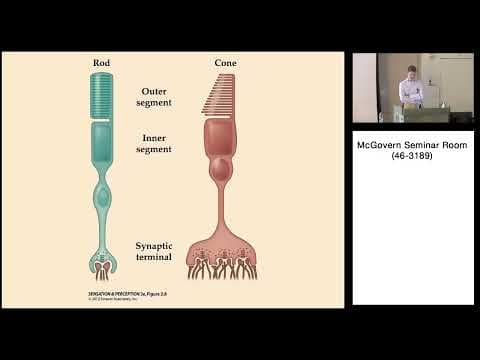
The Eye and Retina
The lecture details the anatomical and physiological mechanisms by which photoreceptor cells and retinal circuitry encode visual information, initiating the process of visual perception.

The Eye and the Retina (cont'd)
Continuing the discussion on retinal function, this lecture further explores the cellular and neural processes involved in registering visual information within the retina.

Lateral Geniculate Nucleus (LGN) / Primary Visual Cortex (V1)
This lecture explicates the functional roles of the Lateral Geniculate Nucleus and Primary Visual Cortex (V1) in processing visual information, tracing the hierarchical pathway from retina to cortex.

Mid-Level Vision
This session introduces mid-level vision, exploring the brain's hierarchical interpretation of visual signals beyond primary feature extraction, leading to perceptual organization.
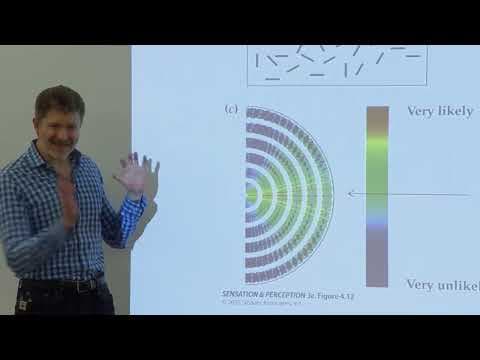
Mid-Level Vision (cont'd)
The lecture continues on mid-level vision, focusing on how the brain infers object contours, colors, and other emergent properties from raw sensory input, addressing perceptual ambiguities.

Lightness Perception, Color Perception
This session covers the mechanisms of lightness and color perception, elucidating how the brain constructs stable percepts of object reflectance and hue despite varying illumination conditions.

Color Perception (cont'd), Motion Perception
Building on color perception, the lecture transitions to motion perception, examining how the brain processes inputs from cone cells to infer dynamic changes and movement in the visual field.

Motion Perception (cont'd)
This lecture continues the exploration of motion perception, delving deeper into the neural circuits and computational strategies the brain employs to detect and interpret movement.

Depth Perception
The lecture introduces various cues for depth perception, explaining how the brain infers the relative proximity and distance of objects within the visual field, from monocular to binocular cues.

Depth Perception (cont'd)
This session continues the examination of depth perception, with a particular focus on the contribution of binocular vision and stereopsis to the accurate perception of distance and three-dimensional space.

The Generic Viewpoint Assumption; Object Recognition
This lecture introduces the generic viewpoint assumption and begins to investigate the complex processes by which the brain identifies objects, addressing how it handles ambiguous visual input.

Object Recognition (cont'd), Texture Perception
The session extends object recognition to facial processing and introduces texture perception, contrasting human visual system mechanisms with convolutional neural networks in texture recognition.

Texture Perception (cont'd)
This lecture continues to discuss texture perception, delving into the specific mechanisms within both the human visual and auditory systems that underpin the recognition of textural properties.

Attention
This lecture examines various theories of attention, analyzing how the visual and auditory systems selectively track, identify, and prioritize objects and information in a complex environment.