
Simons Institute: Theoretical Foundations of Modern Machine Learning
Simons Institute FacultySimons Institute research symposium investigating the algorithmic and complexity-theoretic foundations of non-convex optimization, overparameterized generalization, and statistical-computational gaps.
Syllabus
19Theoretical Foundations of Modern Machine Learning Paradigms
This talk explores the foundational role of theoretical computer science (TCS) in shaping modern machine learning paradigms and applications, drawing insights from Google's perspective.
Foundations, Privacy & Generalization Challenges in Modern Machine Learning
Katrina Ligett discusses the pivotal contributions and ongoing challenges for theoretical computer science in advancing the state of modern machine learning.
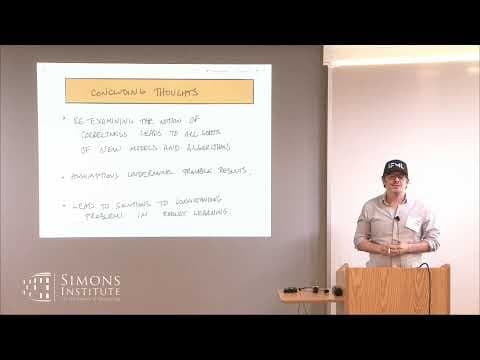
Efficient Algorithms for Reliable Machine Learning
Adam Klivans presents new learning models where algorithms either certify accuracy or abstain, moving beyond traditional distributional assumptions toward provably correct, reliable machine learning.
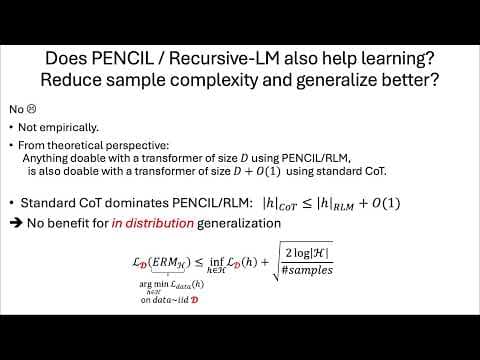
Computational Thinking on Learning Models
This lecture examines the application of computational thinking principles to a variety of learning models, highlighting their structural properties and theoretical limits.
On the Komlós Conjecture
Nikhil Bansal discusses recent progress on the Komlós conjecture, including an improved O((log n)^{1/4}) bound for discrepancy of unit vectors and its relation to the Beck-Fiala conjecture.
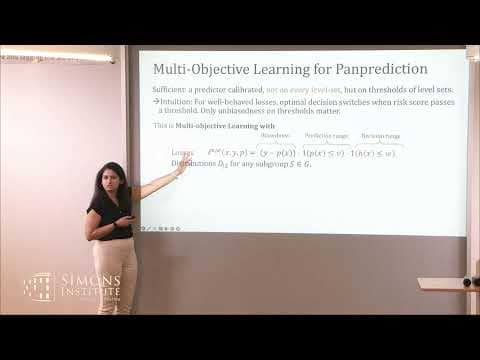
Multi-objective Learning: An Algorithmic Toolbox for Optimal Predictions Anytime Anywhere!
Nika Haghtalab introduces multi-objective learning as a unifying framework, providing an algorithmic toolbox for learning models with guarantees across diverse tasks, enhancing fairness and robustness in ML.
Approximately Packing Dijoins Via Nowhere-Zero Flows
R Ravi explores Woodall's conjecture on dijoins, proving that digraphs with minimum dicut size $\tau$ contain $\lfloor \tau/k \rfloor$ disjoint dijoins if the underlying graph has a nowhere-zero k-flow.
Lightning Talks!
This session features a series of concise 'lightning talks' by multiple speakers, highlighting diverse contemporary topics and emerging research in theoretical computer science and machine learning.
Venturing out into the world with AI
Jon Kleinberg discusses the societal implications and interaction challenges as AI systems become increasingly integrated into the real world, examining ethical and algorithmic considerations.
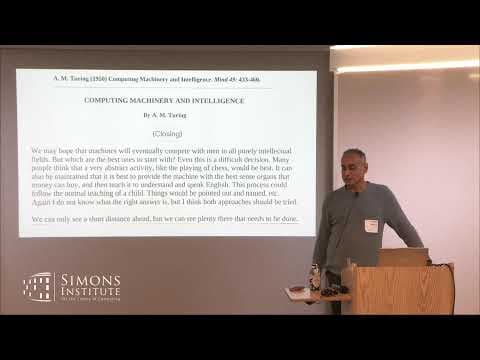
Unfamiliar Terrain
Prabhakar Raghavan explores challenges and novel approaches in navigating new data landscapes and problem domains within the field of modern machine learning.
Astral Space: Convex Analysis at Infinity
Robert Schapire introduces 'Astral Space,' a compact extension of Euclidean space for analyzing minimizers of convex functions at infinity, developing a robust theoretical framework.
AI and Safety
Ron Rivest discusses critical aspects of AI safety, exploring methods and theoretical frameworks to ensure robust, secure, and reliable operation of artificial intelligence systems.
The Role of TCS in Understanding (AI) Consciousness
Lenore Blum introduces the Conscious Turing Machine (CTM), aligning it with major theories of consciousness and demonstrating how TCS provides insights into potential machine consciousness.
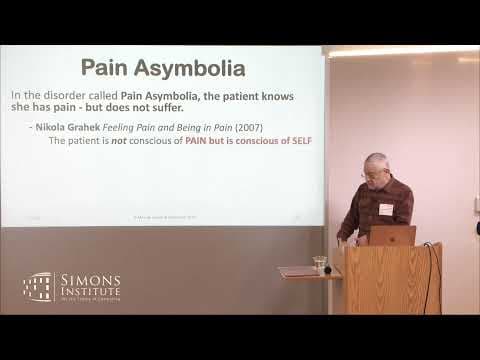
The Conscious Turing Machine (CTM), a formally defined Theoretical model of Consciousness
Manuel Blum formally defines the Conscious Turing Machine (CTM) as a 7-tuple model for consciousness, offering theoretical insights into the binding problem and the generation of pain.
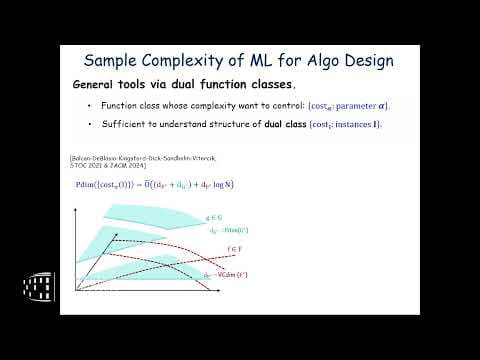
Theory of Modern AI: Learning Theoretic, Game Theoretic, and Algorithmic Perspectives
Nina Balcan explores the multifaceted theoretical underpinnings of modern AI, integrating learning theoretic, game theoretic, and algorithmic perspectives to explain AI's capabilities and limitations.
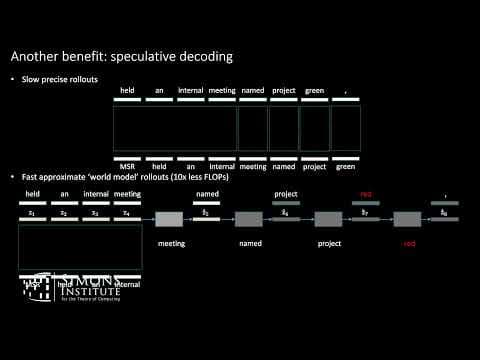
An Occam's Razor Principle for Transformers?
John Langford investigates a novel Occam's Razor principle for transformer models, suggesting that simpler learned states lead to vastly improved generalization and extrapolation, challenging traditional PAC theory.
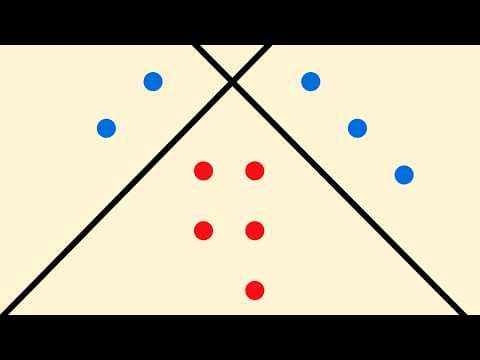
Red Points and Blue Points
Santosh Vempala presents a simple algorithm for separating red and blue points in n-dimensional space, improving complexity for separation by an intersection of k halfspaces under a soft margin.
Latent Variable models and Subset Smoothing
Ravi Kannan introduces the 'Subset Smoothed' polytope K' for learning latent variable models, addressing challenges where data points lie far outside the latent polytope K due to significant perturbations.
Enhanced and Efficient Reasoning in Large Language Models
Les Valiant proposes a principled and efficient approach to enhance reasoning in Large Language Models, aiming to justify trust in content generation beyond fluent prose and improve reliability.