
The Theoretical Minimum: Classical Mechanics
Prof. Leonard SusskindClassical mechanics taught from the perspective of a modern theoretical physicist: phase-space determinism, the principle of stationary action, Euler-Lagrange equations, symmetries, Noether's theorem, and Hamiltonians.
Syllabus
10Classical Mechanics Lecture 1: Deterministic State Laws & Conservation of Information
Begins physics not with inclined planes, but with discrete state-space graphs—proving that valid classical dynamical laws must be reversible (minus-first law: conservation of information).
Classical Mechanics | Lecture 2
This lecture critically examines Aristotle's historical laws of motion, elucidating their conceptual frameworks and highlighting how their inherent limitations paved the way for the development of modern classical mechanics.
Classical Mechanics Lecture 3: Principle of Stationary Action & Euler-Lagrange Equations
Derives the calculus of variations and Euler-Lagrange equations for arbitrary generalized coordinates—the formalism underlying general relativity and quantum field theory.
Classical Mechanics | Lecture 4
This lecture explores fundamental principles of classical mechanics, focusing on the interplay between symmetry and conservation laws, and introducing the principle of least action within the Lagrangian formalism.
Classical Mechanics Lecture 5: Continuous Symmetries & Emmy Noether's Theorem
Proves Noether's deep theorem directly from Lagrangian invariance: translation yields linear momentum, rotation yields angular momentum, and time-shift yields energy.
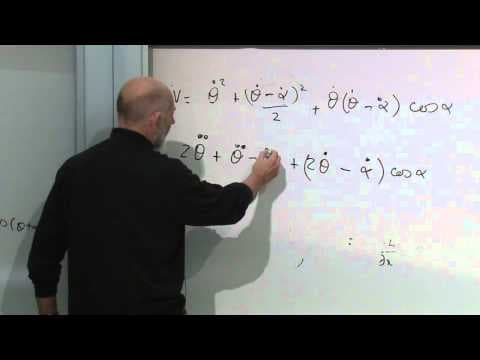
Classical Mechanics Lecture 6: Legendre Transforms, Hamilton's Equations & Liouville's Theorem
Transforms L(q, q̇) into H(q, p) on phase space and proves Liouville's theorem—showing phase-space volume is incompressible just like continuous information.
Classical Mechanics | Lecture 7
Professor Susskind explores the foundational Liouville's Theorem within Hamiltonian mechanics, demonstrating its critical role in establishing the time-reversibility of classical mechanical systems. The lecture rigorously develops the phase space dynamics and their implications.
Classical Mechanics | Lecture 8
Professor Susskind develops the formalism of angular momentum within the Hamiltonian framework, meticulously deriving its equations of motion. The lecture introduces Poisson Brackets as a fundamental tool for analyzing conserved quantities in classical dynamics.
Lecture 9: Magnetic and Electrostatic Forces (TM-CM)
This lecture formally introduces the fundamental principles of magnetic and electrostatic forces, deriving their relationships to corresponding magnetic fields and potentials. Core concepts of classical electromagnetism are established.
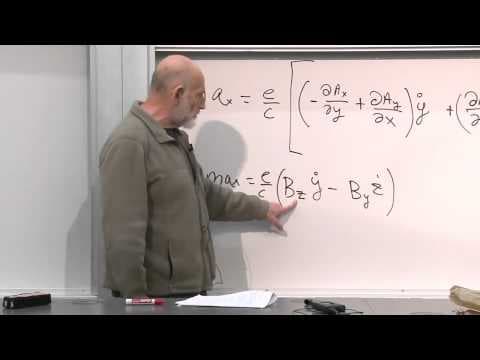
Lecture 10: Particles in Electric and Magnetic Fields (TM-CM)
The final lecture concludes the discussion on particle dynamics within electric and magnetic fields, synthesizing their interrelation within the framework of classical physics. This session reinforces electromagnetism's role in classical mechanics.