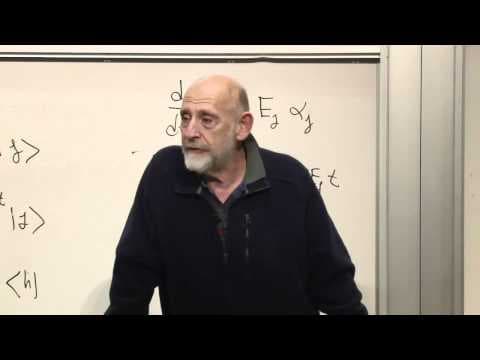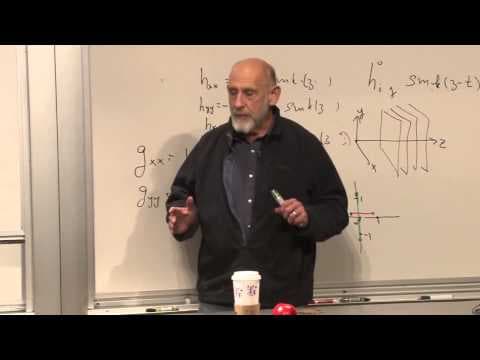
The Theoretical Minimum: General Relativity
Equivalence principle, Riemannian metric geometry, covariant derivatives, Christoffel symbols, Riemann curvature tensor, Einstein field equations, Schwarzschild black holes, and gravitational waves.
Felix Bloch Professor of Theoretical Physics
Complete university lecture series taught by Leonard Susskind.
Equivalence principle, Riemannian metric geometry, covariant derivatives, Christoffel symbols, Riemann curvature tensor, Einstein field equations, Schwarzschild black holes, and gravitational waves.
Leonard Susskind builds quantum mechanics from two-state spin systems: complex vector spaces, Hermitian operators, tensor products, quantum entanglement, Bell inequalities, and wavefunctions.
Classical mechanics taught from the perspective of a modern theoretical physicist: phase-space determinism, the principle of stationary action, Euler-Lagrange equations, symmetries, Noether's theorem, and Hamiltonians.
Self-contained public lectures, keynote addresses, and research seminars.
Builds quantum mechanics from two-state spin systems and Dirac bra-ket algebra rather than messy wave-equation PDEs—the foundation of Susskind's 'Theoretical Minimum'.
Professor Susskind's fourth lecture on classical mechanics, forming a foundational component of Stanford's comprehensive modern physics curriculum.
Proposes that Einstein-Rosen wormhole bridges and Einstein-Podolsky-Rosen entangled states are dual manifestations of the same quantum-gravitational phenomenon.
Leonard Susskind begins a deep exploration into string theory, discussing its implications for understanding fundamental physics and the limitations of reductionist paradigms.
Leonard Susskind elucidates the black hole information paradox, detailing the principle of black hole complementarity and the profound implications of the holographic principle for quantum gravity, presented at Perimeter Institute.

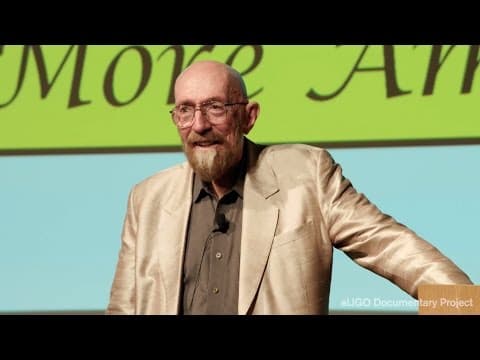
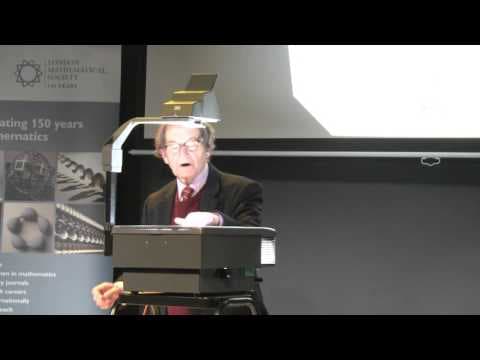
Physical law, LIGO gravitational waves, singularity topology, and AdS/CFT entanglement
Cornell University · Caltech · University of Oxford +2
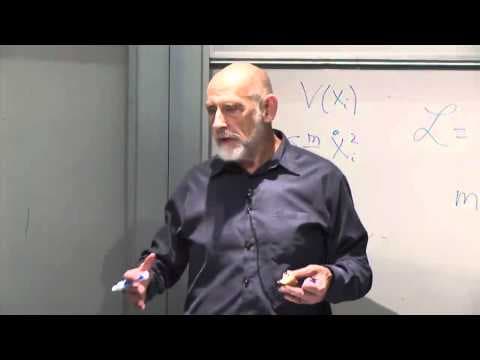
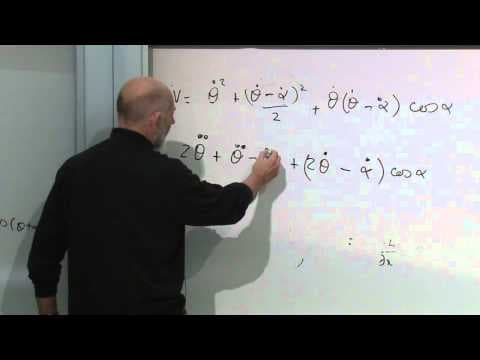
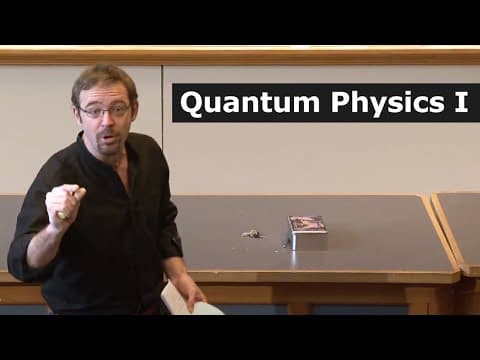
Variational mechanics, Hamiltonian phase space, superposition, and operators
Stanford University · MIT
Search or browse every recorded session across courses and talks.