Human Behavioral Biology
Interdisciplinary exploration of the biological underpinnings of behavior—integrating evolutionary game theory, kin selection, molecular genetics, behavioral genetics, endocrinology, and neurobiology.
Faculty & visiting speakers
Complete university courses recorded at Stanford University.
Interdisciplinary exploration of the biological underpinnings of behavior—integrating evolutionary game theory, kin selection, molecular genetics, behavioral genetics, endocrinology, and neurobiology.
Spatial descriptions, Denavit-Hartenberg forward and inverse kinematics, manipulator Jacobians, Lagrangian dynamics, trajectory generation, and operational-space force control.
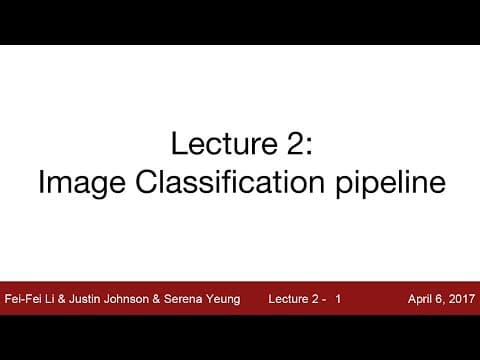
Linear classifiers, computational graphs, backpropagation, convolutional architectures, batch normalization, training dynamics, object detection, semantic segmentation, and generative visual models.
Stephen Boyd develops applied linear algebra and matrix exponential dynamics: least-squares estimation, singular value geometry, autonomous state trajectories, controllability, and LQR design.
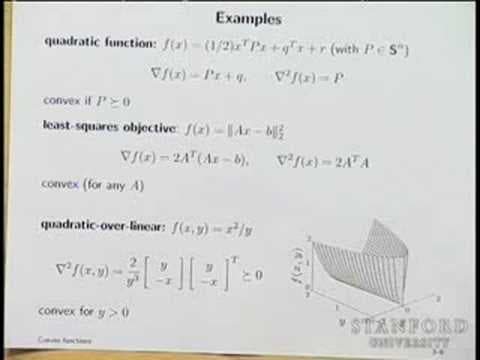
Stephen Boyd's classic Stanford graduate sequence on convex sets, convex functions, duality, KKT conditions, interior-point methods, and engineering/ML modeling.
Equivalence principle, Riemannian metric geometry, covariant derivatives, Christoffel symbols, Riemann curvature tensor, Einstein field equations, Schwarzschild black holes, and gravitational waves.
Leonard Susskind builds quantum mechanics from two-state spin systems: complex vector spaces, Hermitian operators, tensor products, quantum entanglement, Bell inequalities, and wavefunctions.
Research seminar examining self-attention architectures across language modeling, multimodal reasoning, robotics, biology, and scaling laws with leading industry and academic pioneers.
Classical mechanics taught from the perspective of a modern theoretical physicist: phase-space determinism, the principle of stationary action, Euler-Lagrange equations, symmetries, Noether's theorem, and Hamiltonians.
Self-contained seminars, public lectures, and invited talks.
Donald Knuth's 24th annual Christmas lecture, detailing the elegant 'Dancing Links' algorithm and its surprising effectiveness for solving exact covering problems across diverse applications.
Stanford Professor Andrew Ng introduces the foundational course in Machine Learning (CS 229), outlining key topics from statistical pattern recognition to modern applications.
An introductory lecture from Stanford's CS106A, outlining core programming principles, object-oriented design, and the fundamentals of Java for aspiring computer scientists.
Stanford Professor Brad Osgood delves into the Fourier Transform, exploring its theoretical underpinnings and practical applications in engineering and scientific problem-solving.
Builds quantum mechanics from two-state spin systems and Dirac bra-ket algebra rather than messy wave-equation PDEs—the foundation of Susskind's 'Theoretical Minimum'.
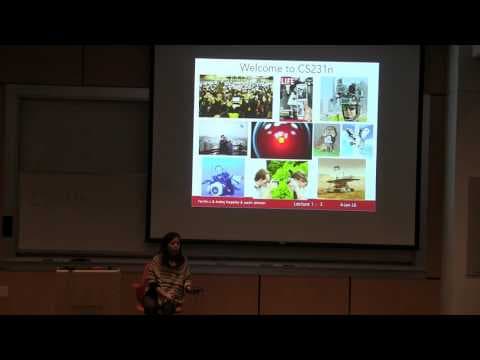
Andrej Karpathy introduces Stanford's CS231n course, providing an overview of convolutional neural networks and their historical context in visual recognition.
Physical law, LIGO gravitational waves, singularity topology, and AdS/CFT entanglement
Cornell University · Caltech · University of Oxford +2
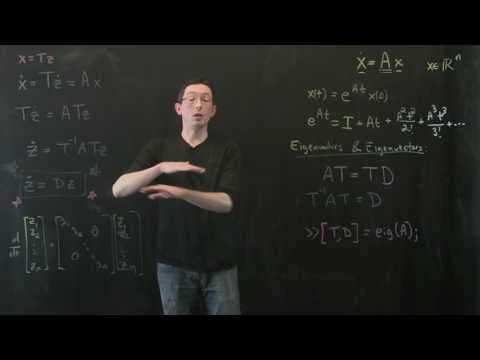
Matrix exponentials, stability eigenvalues, feedback regulators, and nonlinear locomotion
Stanford University · University of Washington · MIT
Metaphysics of consciousness, neurobiology of behavior, and theories of justice
Yale University · Stanford University · Harvard University
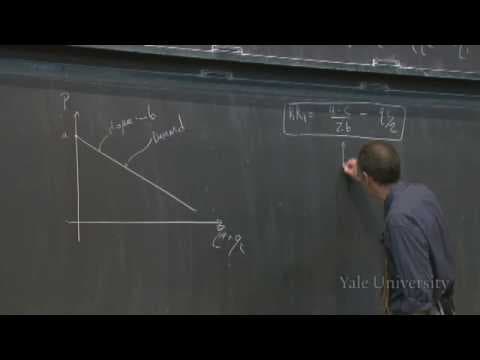
Game theory across economics, evolutionary biology, and public ethics
Yale University · Stanford University · Harvard University
Browse every recorded lecture from Stanford University.