
Transformers United
Stanford Guest ResearchersResearch seminar examining self-attention architectures across language modeling, multimodal reasoning, robotics, biology, and scaling laws with leading industry and academic pioneers.
Syllabus
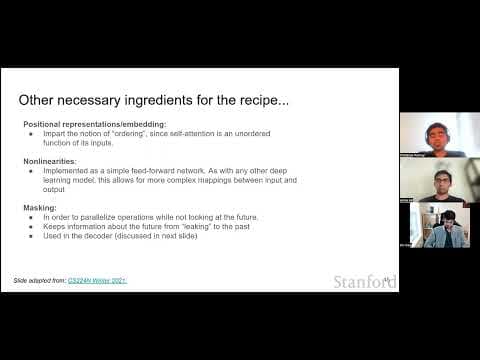
9Stanford CS25: V1 I Transformers United: DL Models that have revolutionized NLP, CV, RL
This introductory lecture for Stanford's CS25 series details the foundational Transformer architecture, including its attention mechanisms, encoder-decoder structure, and essential components. It contextualizes the model's impact across NLP, computer vision, and reinforcement learning applications.
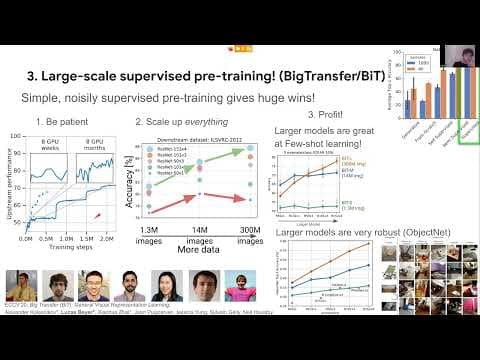
Stanford CS25: V1 I Transformers in Vision: Tackling problems in Computer Vision
In this talk, Lucas discusses some of the ways transformers have been applied to problems in Computer Vision.
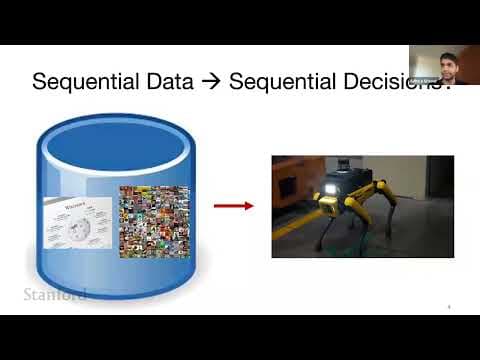
Stanford CS25: V1 I Decision Transformer: Reinforcement Learning via Sequence Modeling
This lecture introduces the Decision Transformer architecture, reframing reinforcement learning as a conditional sequence modeling problem. It details how this approach, by conditioning an autoregressive model on desired returns, states, and actions, generates optimal future actions, matching or exceeding state-of-the-art offline RL baselines.
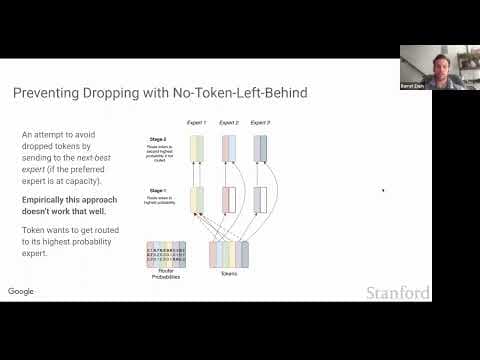
Stanford CS25: V1 I Mixture of Experts (MoE) paradigm and the Switch Transformer
This lecture introduces the Mixture of Experts (MoE) paradigm, contrasting it with traditional dense models by selectively activating parameters for each input. It details the Switch Transformer, an architecture addressing MoE's complexity, communication costs, and training instability, demonstrating its application to large-scale language models with significant pre-training speedups.
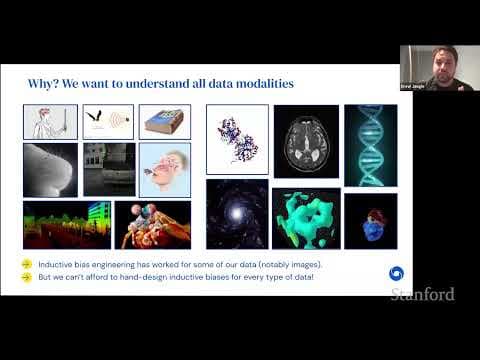
Stanford CS25: V1 I DeepMind's Perceiver and Perceiver IO: new data family architecture
Drew Jaegle presents DeepMind's Perceiver and Perceiver IO, exploring an asymmetric attention mechanism that allows these architectures to scale to high-dimensional and multimodal data without domain-specific assumptions, outperforming standard Transformers.

Stanford CS25: V1 I Self Attention and Non-parametric transformers (NPTs)
This session from Stanford's CS25 course introduces the foundational intuitions behind Transformer architectures, then delves into the theoretical and practical aspects of Non-Parametric Transformers (NPTs), a model recently accepted at NeurIPS.
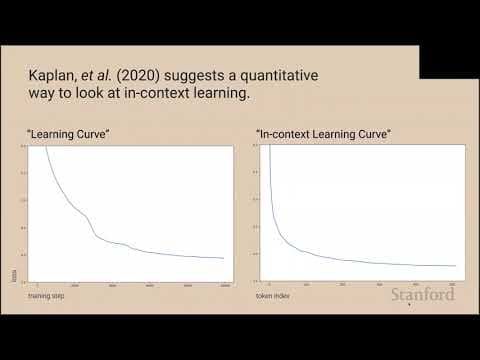
Stanford CS25: V1 I Transformer Circuits, Induction Heads, In-Context Learning
This lecture explores mechanistic interpretability in transformer language models, focusing on "induction head circuits." It elucidates how these attention head pairs enable in-context learning by allowing models to repeat or translate text, and mimic functions from prior examples.
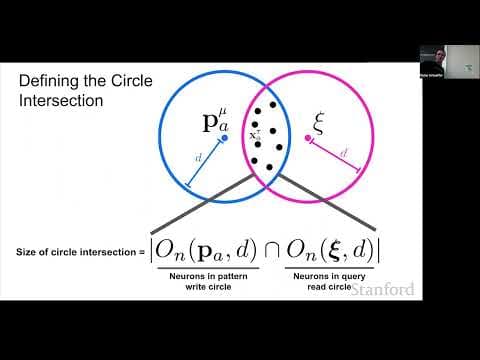
Neuroscience-Inspired Artificial Intelligence (CS25)
This lecture explores how attention mechanisms within Transformers can approximate sparse distributed memory, drawing parallels to neuroscience for advanced AI architectures. It analyzes the computational mechanisms enabling such approximations.
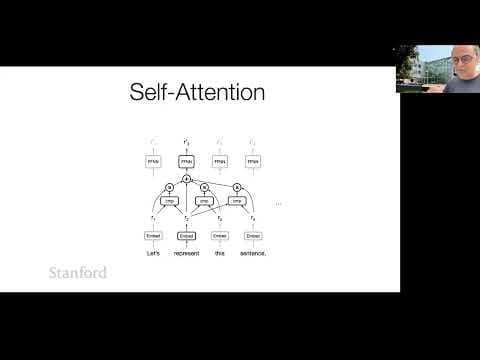
How I Learned to Stop Worrying and Love the Transformer (CS25)
Ashish Vaswani, a co-author of "Attention Is All You Need," discusses the foundational motivations and historical evolution of the Transformer model. The session concludes with an overview of promising future research directions in Transformer architectures.