Transformers United: DL Models that have revolutionized NLP, CV, RL
22:43Transformers in Vision: Tackling problems in Computer Vision
1:08:36Decision Transformer: Reinforcement Learning via Sequence Modeling
1:20:42Mixture of Experts (MoE) paradigm and the Switch Transformer
1:05:44DeepMind's Perceiver and Perceiver IO: new data family architecture
58:58Self Attention and Non-parametric transformers (NPTs)
1:05:43Transformer Circuits, Induction Heads, In-Context Learning
59:34Neuroscience-Inspired Artificial Intelligence
1:22:14How I Learned to Stop Worrying and Love the Transformer
1:20:38Transformer Circuits, Induction Heads, In-Context Learning

This lecture explores mechanistic interpretability in transformer language models, focusing on "induction head circuits." It elucidates how these attention head pairs enable in-context learning by allowing models to repeat or translate text, and mimic functions from prior examples.
"Neural network parameters can be thought of as compiled computer programs. Somehow, they encode sophisticated algorithms, capable of things no human knows how to write a computer program to do. Mechanistic interpretability seeks to reverse engineer neural networks into human understandable algorithms. Previous work has tended to focus on vision models; this talk will explore how we might reverse engineer transformer language models.
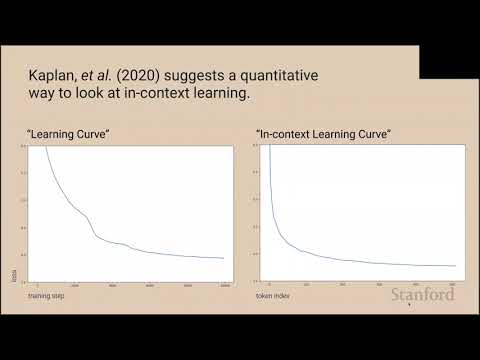
In particular, we'll focus on what we call ""induction head circuits"", a mechanism that appears to be significantly responsible for in-context learning. Using a pair of attention heads, these circuits allow models to repeat text from earlier in the context, translate text seen earlier, mimic functions from examples earlier in the context, and much more. The discovery of induction heads in the learning process appears to drive a sharp phase change, creating a bump in the loss curve, pivoting models learning trajectories, and greatly increasing their capacity for in-context learning, in the span of just a few hundred training steps."
Self Attention and Non-parametric transformers (NPTs)
Next · Lecture 8Neuroscience-Inspired Artificial Intelligence