
Introduction to Linear Dynamical Systems
Prof. Stephen BoydStephen Boyd develops applied linear algebra and matrix exponential dynamics: least-squares estimation, singular value geometry, autonomous state trajectories, controllability, and LQR design.
Syllabus
20Lecture 1 | Introduction to Linear Dynamical Systems
Professor Stephen Boyd, of the Electrical Engineering department at Stanford University, gives an overview of the course, Introduction to Linear Dynamical Systems (EE263).
Lecture 2 | Introduction to Linear Dynamical Systems
Professor Stephen Boyd, of the Electrical Engineering department at Stanford University, lectures on linear functions for the course, Introduction to Linear Dynamical Systems (EE263).
Lecture 3 | Introduction to Linear Dynamical Systems
Professor Stephen Boyd, of the Electrical Engineering department at Stanford University, gives a review of linear algebra for the course, Introduction to Linear Dynamical Systems (EE263).
Lecture 4 | Introduction to Linear Dynamical Systems
Professor Stephen Boyd, of the Electrical Engineering department at Stanford University, lectures on orthonormal sets of vectors and QR factorization for the course, Introduction to Linear Dynamical Systems (EE263).
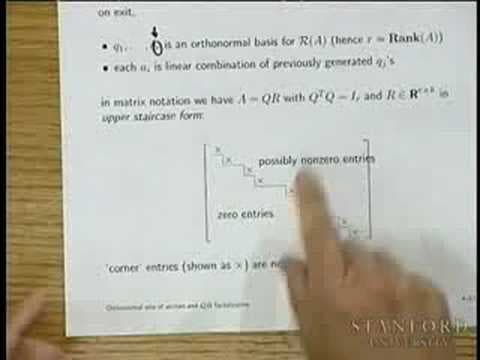
Lecture 5 | Introduction to Linear Dynamical Systems
Professor Stephen Boyd, of the Electrical Engineering department at Stanford University, lectures on QR factorization and least squares for the course, Introduction to Linear Dynamical Systems (EE263).
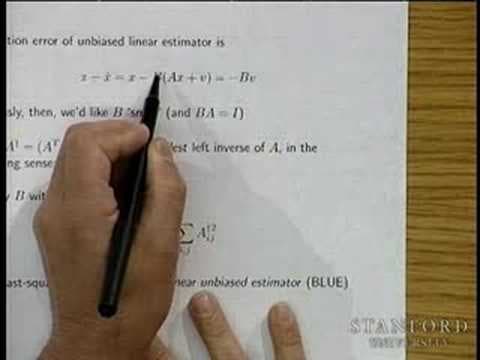
Lecture 6 | Introduction to Linear Dynamical Systems
Professor Stephen Boyd, of the Electrical Engineering department at Stanford University, lectures on the applications of least squares for the course, Introduction to Linear Dynamical Systems (EE263).
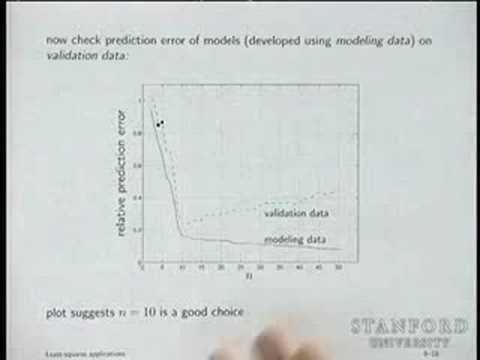
Lecture 7 | Introduction to Linear Dynamical Systems
Professor Stephen Boyd, of the Electrical Engineering department at Stanford University, lectures on regularized least squares and the Gauss-Newton method for the course, Introduction to Linear Dynamical Systems (EE263).
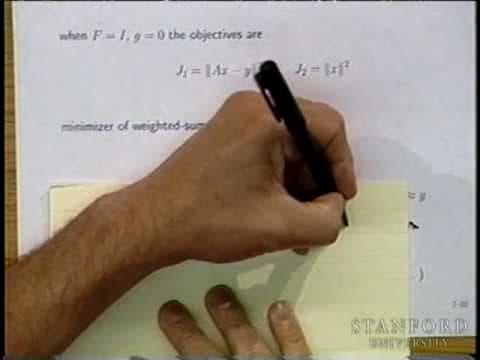
Lecture 8: Least-Norm Solutions of Underdetermined Equations (EE263)
This lecture delves into the methodology for finding least-norm solutions to underdetermined equations, a crucial concept in applied linear algebra. It specifically examines scenarios where the number of variables exceeds the number of independent equations.
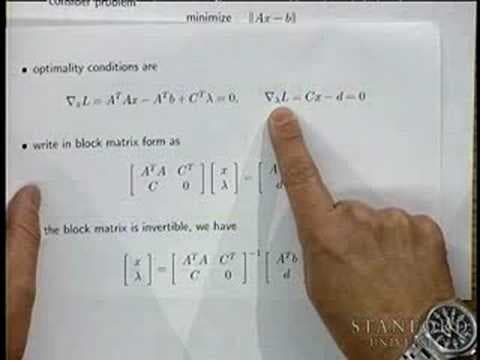
Lecture 9: Autonomous Linear Dynamical Systems (EE263)
The session focuses on the theoretical underpinnings and practical implications of autonomous linear dynamical systems. It covers the fundamental principles governing system evolution without external inputs.
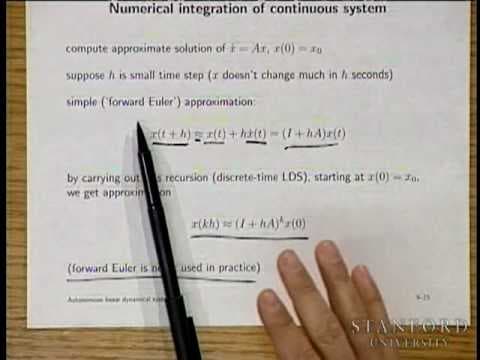
Lecture 10: Autonomous Linear Dynamical Systems in Electrical Engineering (EE263)
This lecture connects autonomous linear dynamical systems to specific applications within Electrical Engineering, illustrating how theoretical models are utilized in practical circuit and signal analysis.
Lecture 11: Solutions via Laplace Transform and Matrix Exponentials (EE263)
This lecture explores two powerful methods for solving linear dynamical systems: the Laplace transform and the use of matrix exponentials. It contrasts their applications in determining system responses.
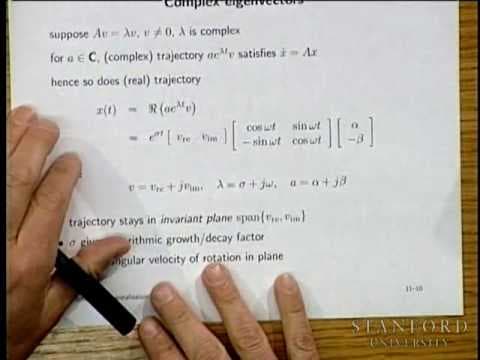
Lecture 12: Matrix Exponentials, Eigenvectors, and Diagonalization in LDS (EE263)
The lecture elaborates on the interplay between matrix exponentials, eigenvectors, and diagonalization in the context of linear dynamical systems. It demonstrates how these concepts simplify system analysis.
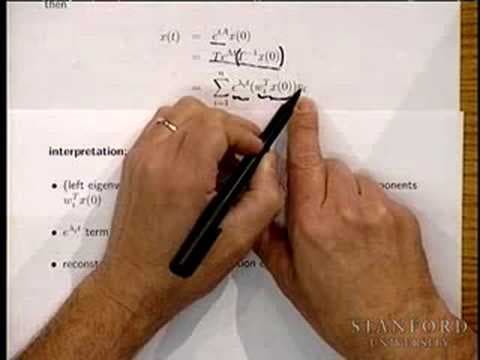
Lecture 13: Generalized Eigenvectors, Diagonalization, and Jordan Canonical Form (EE263)
This session introduces the concepts of generalized eigenvectors and their role in diagonalization, leading to a detailed examination of the Jordan canonical form. It clarifies how these are applied to non-diagonalizable matrices.
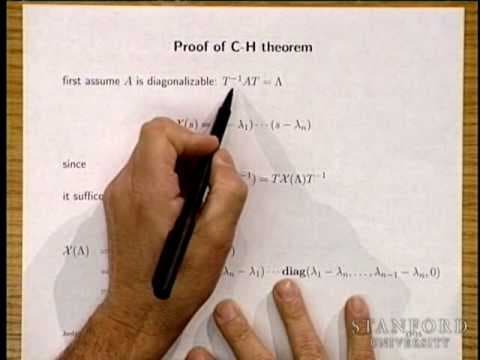
Lecture 14: Applications of Jordan Canonical Form in LDS and Electrical Engineering (EE263)
This lecture demonstrates the practical utility of the Jordan canonical form in analyzing linear dynamical systems, with particular emphasis on its applications within electrical engineering contexts.
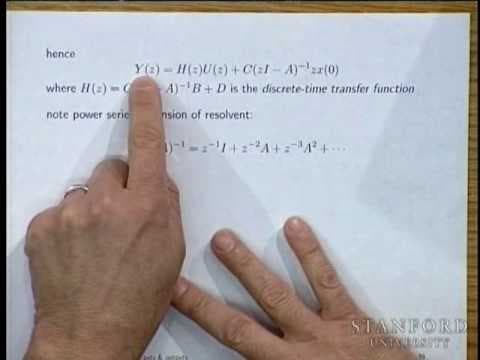
Lecture 15: Inputs, Outputs, and Symmetric Matrices in Linear Dynamical Systems (EE263)
The session covers the fundamental concepts of inputs and outputs in linear dynamical systems, alongside an in-depth discussion of symmetric matrices and their properties. It emphasizes their role in system behavior.
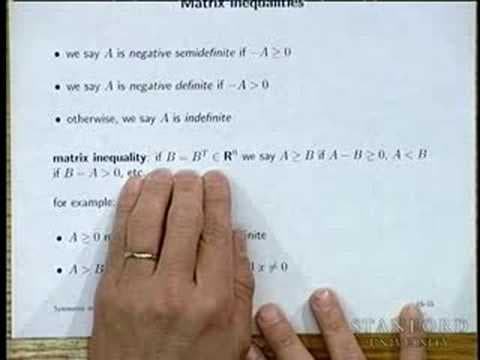
Lecture 16: Symmetric Matrices, Quadratic Forms, Matrix Norm, and SVDs in LDS (EE263)
This lecture integrates symmetric matrices, quadratic forms, matrix norms, and Singular Value Decompositions (SVDs) to analyze linear dynamical systems. It highlights the power of these tools for system characterization.
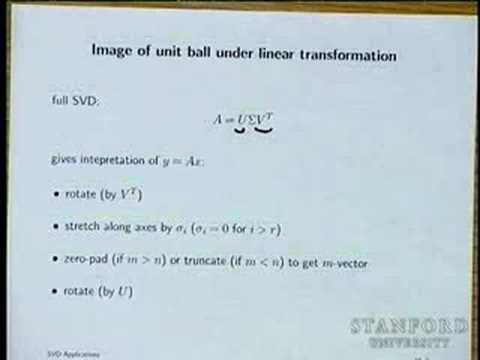
Lecture 17: Applications of Singular Value Decomposition in LDS and Electrical Engineering (EE263)
This lecture explores the diverse applications of Singular Value Decomposition (SVD) within linear dynamical systems and various electrical engineering problems. It showcases SVD's utility in data analysis and system reduction.
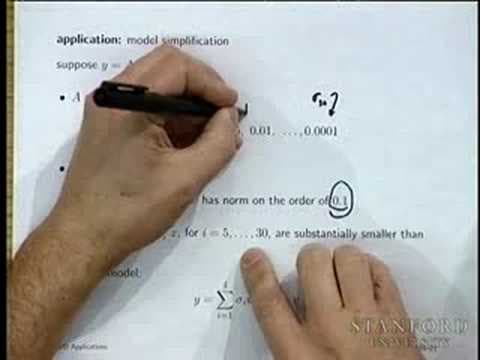
Lecture 18: Applications of SVD, Controllability, and State Transfer in Electrical Engineering (EE263)
The lecture covers the practical applications of SVD, alongside the critical concepts of controllability and state transfer, particularly within electrical engineering contexts. It illustrates how to manipulate system states.
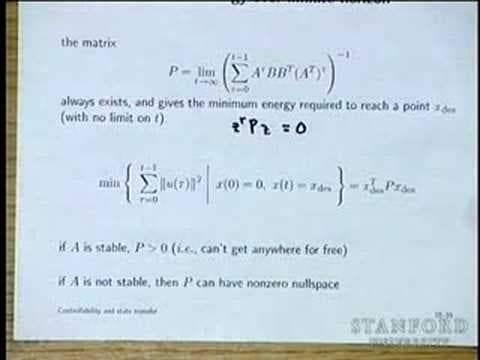
Lecture 19: Controllability and State Transfer in Modern Electrical Engineering (EE263)
This session deeply examines the concepts of controllability and state transfer and their crucial role in modern electrical engineering design and analysis. It explains how to drive a system to a desired state.
Lecture 20: Observability and State Estimation (EE263)
This final lecture covers the essential concepts of observability and state estimation in linear dynamical systems, providing methods to infer internal system states from external measurements. It concludes the core topics.