
Convex Optimization I
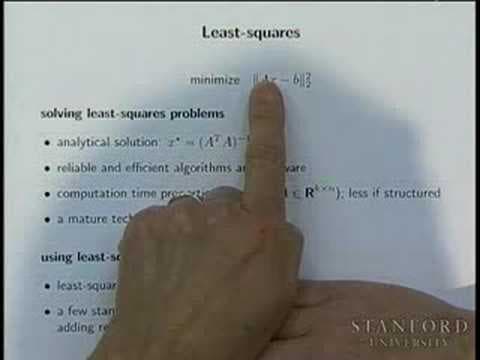
Stephen Boyd's classic Stanford graduate sequence on convex sets, convex functions, duality, KKT conditions, interior-point methods, and engineering/ML modeling.
Control theory, dynamical systems, signal processing, convex optimization, robotics, and electrical engineering.
Complete university lecture courses in engineering & robotics.
Stephen Boyd's classic Stanford graduate sequence on convex sets, convex functions, duality, KKT conditions, interior-point methods, and engineering/ML modeling.
Systems engineering case study of the Space Shuttle taught by NASA's former Space Shuttle program manager and astronauts: main engines, thermal protection tiles, avionics, aerodynamics, and Columbia/Challenger lessons.
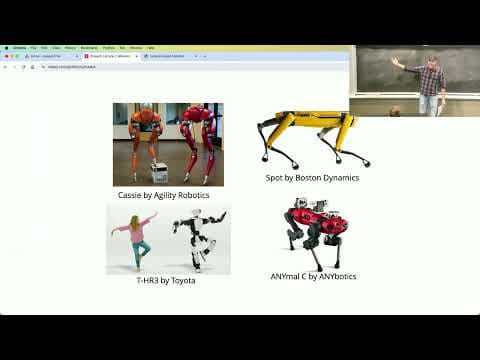
Nonlinear dynamics, phase-portrait geometry, dynamic programming, trajectory optimization, Lyapunov sum-of-squares verification, legged locomotion, and contact-rich manipulation.
From CMOS transistors, combinational logic, and sequential state machines up through instruction set architectures, pipelining, out-of-order execution, caches, DRAM controllers, and hardware accelerators.
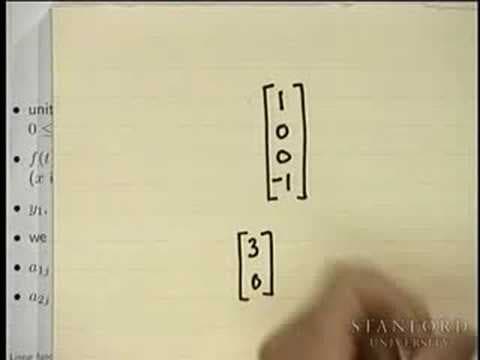
Stephen Boyd develops applied linear algebra and matrix exponential dynamics: least-squares estimation, singular value geometry, autonomous state trajectories, controllability, and LQR design.
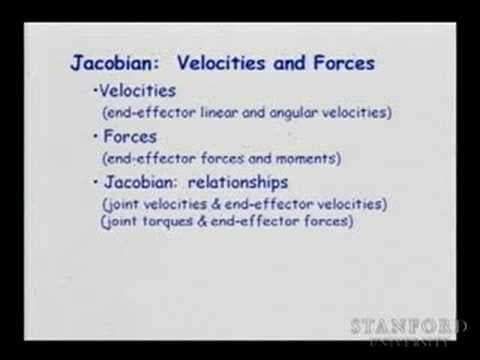
Spatial descriptions, Denavit-Hartenberg forward and inverse kinematics, manipulator Jacobians, Lagrangian dynamics, trajectory generation, and operational-space force control.
Two complementary engineering talks paired around a central intellectual tension.
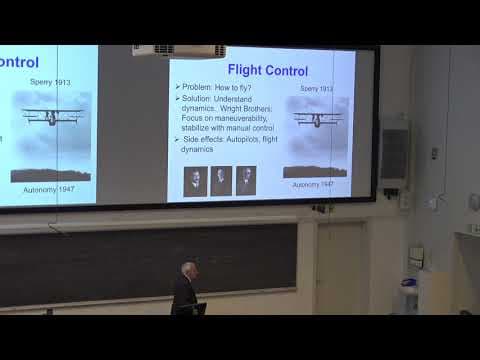
How classical feedback control tames unstable physical systems—and how dynamic balance turned legged robotics from rigid statics into athletic motion.
Self-contained lectures, Nobel addresses, and research colloquia you can watch in one sitting.
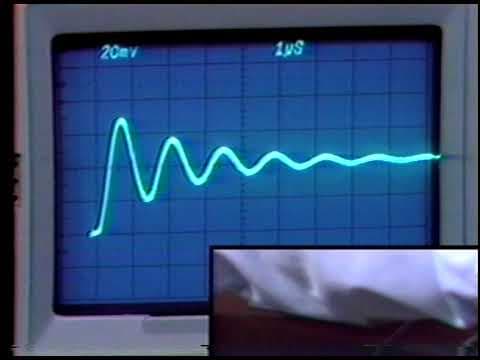
A core lecture from MIT's 6.302 course, providing a detailed analysis of operational amplifier compensation strategies for stable circuit design.
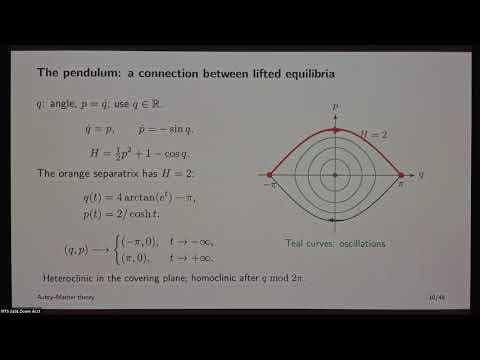
Explore the intricate connections between Aubry-Mather theory in dynamical systems, the complete devil's staircase, and their surprising implications for fractional quantum Hall effects.
An in-depth MIT lecture on developing system dynamics models, focusing on predator-prey interactions, carrying capacity, and the structure of reinforcing and balancing feedback loops.
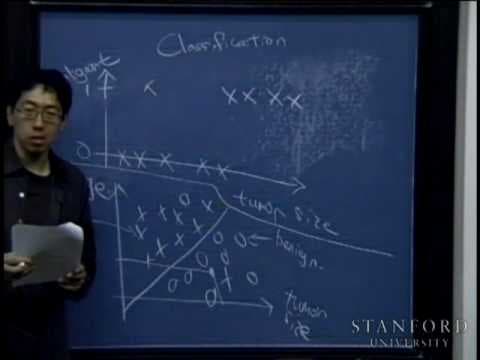
Stanford Professor Andrew Ng introduces the foundational course in Machine Learning (CS 229), outlining key topics from statistical pattern recognition to modern applications.
From MIT OpenCourseWare, this lecture rigorously dissects the Chernobyl accident, analyzing the inherent design flaws of the RBMK reactor and the cascade of human errors exacerbated by Soviet institutional culture.
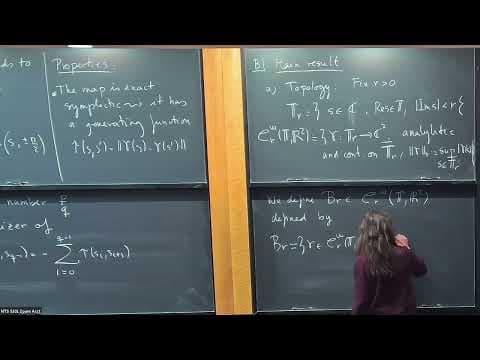
A rigorous exploration of Kupka-Smale genericity in analytic strongly convex billiards, detailing conditions for maximal chaotic behavior and the existence of transverse homoclinic intersections.
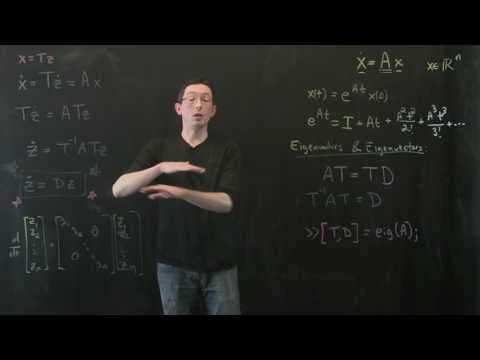
Matrix exponentials, stability eigenvalues, feedback regulators, and nonlinear locomotion
Stanford University · University of Washington · MIT