
The Theoretical Minimum: General Relativity
Prof. Leonard SusskindEquivalence principle, Riemannian metric geometry, covariant derivatives, Christoffel symbols, Riemann curvature tensor, Einstein field equations, Schwarzschild black holes, and gravitational waves.
Syllabus
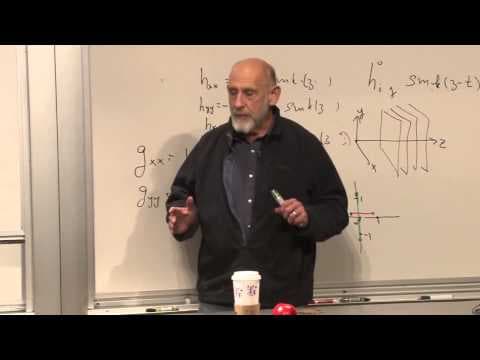
10General Relativity Lecture 10
Professor Susskind derives the weak-field approximation of Einstein's field equations, demonstrating their transformation into wave equations. He then develops the theory of gravitational waves from these solutions.
General Relativity Lecture 9
This lecture by Leonard Susskind rigorously derives the Einstein field equations, demonstrating the equivalence between spacetime curvature, quantified by the Einstein tensor, and the distribution of energy and momentum, represented by the stress-energy tensor. This constitutes a fundamental pillar of general relativity.
General Relativity Lecture 8
This lecture develops the coordinate transformations necessary for constructing Penrose diagrams, then applies them to illustrate the causal structure and physical processes involved in black hole formation within the framework of General Relativity.
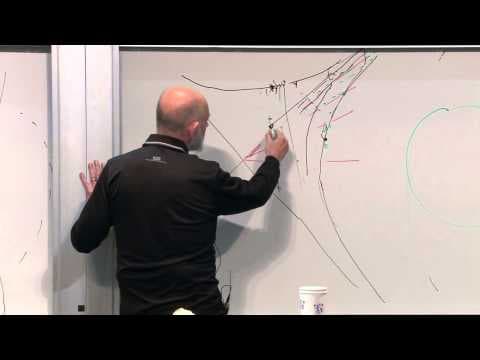
General Relativity Lecture 7
This lecture delves into the intricate physics of black holes, utilizing coordinate transformations and spacetime diagrams to provide a robust conceptual framework for understanding their fundamental properties and geometry within General Relativity.
General Relativity Lecture 6
Leonard Susskind elucidates the core physics of black holes, detailing the properties of event horizons, photon spheres, and gravitational singularities within the framework of Einstein's General Theory of Relativity.
General Relativity Lecture 5
October 22, 2012 - Leonard Susskind derives the spacetime metric for a gravitational field, and introduces the relativistic mathematics that describe a black hole.
General Relativity Lecture 4
This lecture introduces the fundamental concepts of gravity within Einstein's General Theory of Relativity, analyzing basic gravitational fields and their geometric implications for spacetime. It situates gravity within the broader framework of modern physics.
Lecture 3: Riemannian Geometry and General Relativity (TM-GR)
This lecture deepens the exploration of Riemannian geometry, establishing its fundamental role as the mathematical framework for Einstein's General Theory of Relativity. Key concepts of curved spacetime are rigorously derived.
Lecture 2: Tensor Analysis and Notation in General Relativity (TM-GR)
This session lays critical groundwork for general relativity, meticulously introducing proper notation and the essential principles of tensor analysis required for describing spacetime curvature.
Lecture 1: Introduction to General Relativity and the Equivalence Principle (TM-GR)
This introductory lecture broadly surveys the core concepts of general relativity, focusing on the profound implications and formulation of Einstein's equivalence principle. The conceptual shift from special relativity is highlighted.