
Introduction to the New Testament History and Literature
Prof. Dale B. MartinHistorical-critical study of early Christian texts within Greco-Roman and Second Temple Jewish society, from Pauline letters and synoptic Gospels to apocalyptic literature.
Syllabus
221. Introduction: Why Study the New Testament?
This introductory lecture establishes a critical, historical methodology for studying the New Testament, framing it as a collection of ancient documents rather than solely as scripture. It outlines the pedagogical approach for engaging with the texts from an ancient perspective.
2. From Stories to Canon
This lecture delineates the historical processes and criteria, including apostolic authority and theological appropriateness, that shaped the formation and consensus of the New Testament canon. It also examines the instrumental role of the codex in this development.
3. The Greco-Roman World
This lecture examines the historical and cultural forces that shaped the New Testament world, detailing Alexander's Hellenization, the structure of the Greek polis, Roman social dynamics, and the Pax Romana's role in early Christian expansion.
4. Judaism in the First Century
This lecture examines the historical context of First-Century Judaism, detailing the impact of Hellenization under the Seleucid and Ptolemaic empires, the Maccabean Revolt, and the socio-political implications of the Roman occupation, culminating in the Jewish War and the destruction of the Second Temple.
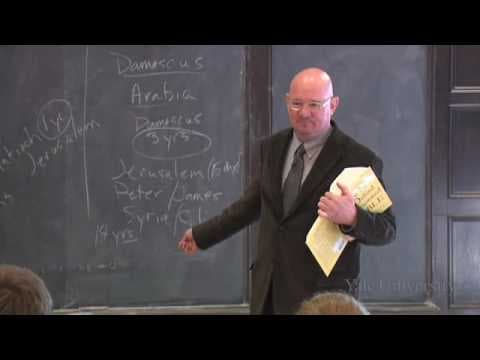
5. The New Testament as History
This lecture performs a historical-critical analysis of the New Testament accounts of Paul's travels and the Jerusalem council in The Acts of the Apostles and Galatians, evaluating their congruence and historical accuracy.
6. The Gospel of Mark
This lecture analyzes the Gospel of Mark through a historical-critical lens, examining its narrative construction of the suffering Messiah and its apocalyptic passages predicting the destruction of the Jewish temple.
7. The Gospel of Matthew
This lecture analyzes the paradoxical presentation of Jesus and the Torah within the Gospel of Matthew, examining its depiction of Jesus as a teacher, founder of the Church, and a model for disciples. It explores Matthew's likely audience and its implications for early Christian community formation.
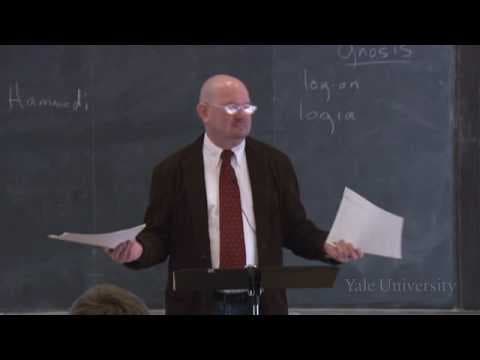
Lecture 8: The Gospel of Thomas (RLST 152)
This lecture examines the Gospel of Thomas, a collection of logia from the Nag Hammadi Codices. It analyzes its Gnostic theological underpinnings, contrasting them with canonical Gospel narratives.
Lecture 9: The Gospel of Luke (RLST 152)
This session investigates the careful structure of Luke-Acts, emphasizing themes of Jesus' Jewish piety, his prophetic rejection, and status reversal. The analysis highlights the author's theological purpose over strict historicity.
Lecture 10: The Acts of the Apostles (RLST 152)
This lecture analyzes Stephen's speech and the depiction of Jerusalem's destruction in Acts and Luke, demonstrating how sources were edited. It explores key themes: the Gospel's spread to Gentiles and Jesus as the prophet-martyr.
Lecture 11: Johannine Christianity: The Gospel (RLST 152)
This lecture contrasts the Gospel of John with the Synoptics, focusing on its unique dialogues, 'signs,' and thematic repetitions. It also examines the high Christology and sectarian nature of the Johannine community.
Lecture 12: Johannine Christianity: The Letters (RLST 152)
This session explores the Christology of the Gospel of John and its echo in 1 John, where Jesus is presented as divine. It considers 1, 2, and 3 John as reflections of a sectarian community defending Jesus' dual nature against Docetism.
Lecture 13: The Historical Jesus (RLST 152)
This lecture addresses the methodological challenges of constructing the 'historical Jesus' from contradictory New Testament accounts. It outlines scholarly principles for evaluating historical data, prioritizing multiple attestations and theological dissimilarity.
Lecture 14: Paul as Missionary (RLST 152)
This lecture traces diverse historical interpretations of Apostle Paul, from early Christian martyr to Augustine's and Luther's psychological theologian. It reconstructs the historical Paul as an apocalyptic missionary to the Gentiles.
Lecture 15: Paul as Pastor (RLST 152)
This session analyzes 1 and 2 Corinthians, exploring Paul's pastoral responses to Corinthian church divisions over social status, idol-sacrificed food, sexual conduct, glossolalia, and resurrection. It also considers the defensive tone of 2 Corinthians 10-13.
Lecture 16: Paul as Jewish Theologian (RLST 152)
This lecture examines Paul's complex treatment of the Jewish Law in Galatians and Romans. It highlights his demotion of the Law in Galatians and his nuanced defense in Romans, perhaps linked to his mission to foster church unity.
Lecture 17: Paul's Disciples (RLST 152)
This lecture addresses pseudepigraphy in ancient literature, focusing on Colossians and Ephesians as likely pseudonymous Pauline works. It contrasts their realized eschatology and high Christology with undisputed Pauline letters.
Lecture 18: Arguing with Paul? (RLST 152)
This lecture explores the diversity of early Christian views on Jewish Law and Christology, focusing on the Book of James. It contrasts James' emphasis on works and Jewish wisdom tradition with Pauline teachings on faith, noting definitional differences.
Lecture 19: The "Household" Paul: The Pastorals (RLST 152)
This lecture contrasts the Pastoral Epistles' pro-family, anti-ascetic stance with views in undisputed Pauline letters, where marriage primarily curbs sexual desire. It analyzes how the Pastorals recast the church as a patriarchal household, prescribing roles for church offices.
Lecture 20: The "Anti-household" Paul: Thecla (RLST 152)
This lecture analyzes The Acts of Paul and Thecla, a narrative akin to Greco-Roman novels, redirecting eroticism towards asceticism. It discusses the text's anti-marriage, anti-family message and its potential feminist interpretation with Thecla as the hero.
Lecture 21: Interpreting Scripture: Hebrews (RLST 152)
This lecture explores ancient methods of scriptural interpretation through the Letter to the Hebrews. It details how Hebrews argues for Jesus' superior liturgy and priesthood by reinterpreting Hebrew Bible passages to encourage early Christians.
Lecture 22: Interpreting Scripture: Medieval Interpretations (RLST 152)
This lecture contrasts the historical-critical method, prioritizing authorial intent and original context, with pre-modern allegorical interpretations by figures like Origen and Augustine. It traces the shift to historical criticism from the Reformation onwards.