Relativity & Cosmology: From Spacetime to Quantum Gravity
This study path begins with the foundational principles of spacetime and its classical implications, progressing through the computational tools that model cosmic evolution. It culminates in advanced theoretical frameworks that probe the quantum nature of gravity and the universe's earliest moments.
Explore the universe's grand design, from the curvature of spacetime to the quantum origins of the cosmos.
6steps13htotal runtime
Step 1 of 6
Path progress0 of 6 watched
Curriculum sequence
6Step 1·Cornell University·Nima Arkani-Hamed· 7:17:30

The Future of Fundamental Physics: Spacetime and Quantum Amplitudes
This lecture provides a foundational understanding of how spacetime emerges from fundamental physical principles, setting the stage for subsequent explorations of its curvature and quantum nature.
Step 2·Perimeter Institute·Andrew Pontzen· 53:02

The Universe in a Box: Astrophysical Simulation and Supercomputing
Building on the conceptual understanding of spacetime, this lecture introduces the practical computational methods used to model and understand the large-scale structure and evolution of the universe.

Asymptotic Symmetries and Detectors: Part 2
Having explored classical and computational aspects, this lecture delves into the observable phenomena of gravitational waves and their connection to asymptotic symmetries, bridging theory with detection.
de Sitter Quantum Cosmology: Part 1
This lecture transitions from classical and observational aspects to the quantum realm, introducing the foundational challenges of quantum cosmology in an expanding universe.
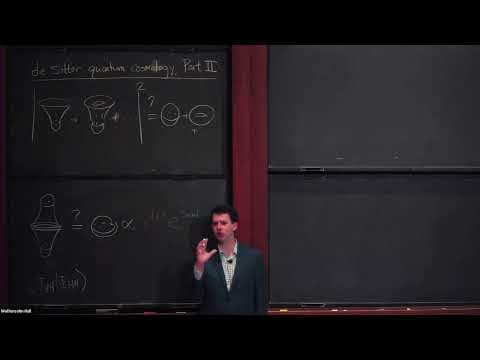
de Sitter Quantum Cosmology: Part 2
Expanding on the initial quantum cosmology concepts, this lecture further explores quantum fluctuations and information paradoxes within inflationary models, deepening the understanding of the early universe.
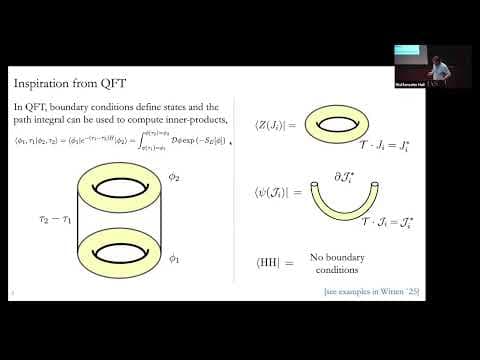
On the Hilbert Space of Quantum Gravity from the Gravitational Path Integral
The final step addresses the most advanced theoretical challenges, examining how a consistent Hilbert space for quantum gravity can be constructed from the gravitational path integral.
Companion reading for this sequence
Amazon Associate
