Patrick Winston
Ford Professor of Artificial Intelligence and Computer Science · MIT · Distinguished · author of Make It Clear
Patrick Winston is Ford Professor of Artificial Intelligence and Computer Science at MIT and directed the MIT Artificial Intelligence Laboratory from 1972 to 1997.
- lectures
- 24
- series
- 1
- hours
- 20
Start here

Series and courses
MIT 6.034: Artificial Intelligence
Open the course
- 1Knowledge Representations: Classes, Trajectories & Transitions
- 2Cognitive Architectures: GPS, SOAR, Subsumption & The Society of Mind
- 3Introduction and Scope of Artificial Intelligence
- 4Reasoning: Goal Trees and Problem Solving
Show 19 moreShow fewer
- 5Reasoning: Goal Trees and Rule-Based Expert Systems
- 6Search: Depth-First, Hill Climbing, Beam Search
- 7Search: Optimal, Branch and Bound, A*
- 8Search: Games, Minimax, and Alpha-Beta Pruning
- 9Constraints: Interpreting Line Drawings
- 10Constraints: Search and Domain Reduction
- 11Constraints in Visual Object Recognition: Alignment Theory and Face Recognition
- 12Introduction to Learning and Nearest Neighbors in AI
- 13Learning: Identification Trees and Disorder
- 14Neural Networks and Backpropagation
- 15Deep Neural Networks: MIT Artificial Intelligence
- 16Genetic Algorithms: MIT Artificial Intelligence
- 17Learning: Sparse Spaces and Phonological Generalization
- 18Learning: Near Misses and Felicity Conditions in AI
- 19Learning: Support Vector Machines
- 20Learning: Boosting Algorithms
- 21Probabilistic Inference I
- 22Probabilistic Inference II
- 23Model Merging, Cross-Modal Coupling, and Course Summary
Talks
In these lectures
- Start presentations with an empowerment promise rather than a joke to clearly signal what the audience will learn.How to Speak
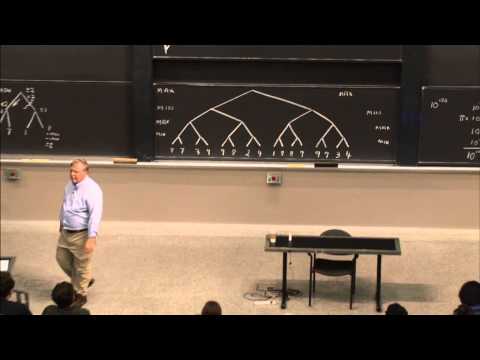
- Exhaustive search of a full game tree is computationally impossible due to the exponential growth of leaf nodes.Search: Games, Minimax, and Alpha-Beta Pruning
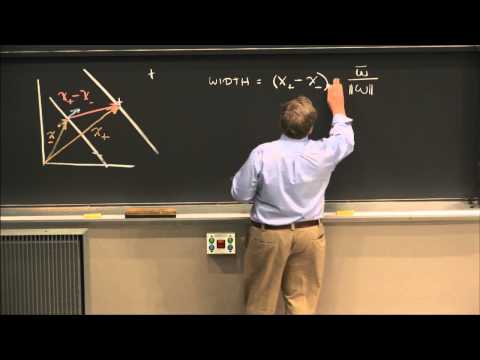
- Support vector machines maximize the separation margin between positive and negative examples.Learning: Support Vector Machines
Draws on
People cited in the lectures, at the moment of the citation.
- Marvin MinskyMentioned regarding his theories on thinking layers and emotion machines
- David MarrComputer scientist cited for his catechism and work on vision.
- Seymour PapertLecturer whose speaking style and board pointing habits were observed.
- Noam ChomskyLinguist whose definition of language focuses on combining concepts without limit.
- Henrik IbsenPlaywright of Hedda Gabler, cited for the use of props.
- Professor WinstonLecturer himself, mentioned in an anecdote
About
Patrick Winston is Ford Professor of Artificial Intelligence and Computer Science at MIT and directed the MIT Artificial Intelligence Laboratory from 1972 to 1997. His lectures here cover MIT 6.034, from minimax and support vector machines to backpropagation, plus his talk 'How to Speak'.
Taught with
Same subject, AI & Machine Learning
Connections
30Their places, courses, books and lectures.
Institution1
Lectures24
- How to Speak
- Search: Games, Minimax, and Alpha-Beta Pruning
- Learning: Support Vector Machines
- Constraints: Search and Domain Reduction
- Learning: Identification Trees and Disorder
- Cognitive Architectures: GPS, SOAR, Subsumption & The Society of Mind
Show 18 moreShow fewer
- Neural Networks and Backpropagation
- Constraints: Interpreting Line Drawings
- Learning: Near Misses and Felicity Conditions in AI
- Reasoning: Goal Trees and Problem Solving
- Knowledge Representations: Classes, Trajectories & Transitions
- Probabilistic Inference I
- Learning: Boosting Algorithms
- Deep Neural Networks: MIT Artificial Intelligence
- Introduction and Scope of Artificial Intelligence
- Introduction to Learning and Nearest Neighbors in AI
- Search: Optimal, Branch and Bound, A*
- Reasoning: Goal Trees and Rule-Based Expert Systems
- Probabilistic Inference II
- Learning: Sparse Spaces and Phonological Generalization
- Genetic Algorithms: MIT Artificial Intelligence
- Model Merging, Cross-Modal Coupling, and Course Summary
- Constraints in Visual Object Recognition: Alignment Theory and Face Recognition
- Search: Depth-First, Hill Climbing, Beam Search