Opening Artificial Life For Bigger & Safer Computing
Artificial Life For Bigger & Safer Computing
- Length
- 1 h 19 min
- Level
- Graduate
- Recorded
- Santa Fe Institute2019 · Public Lecture
Opening Artificial Life For Bigger & Safer Computing
Chapter 1 of 10: Before the lecture
Ackley demonstrates a demon horde sort, where local rules and random numbers order data with no central control.
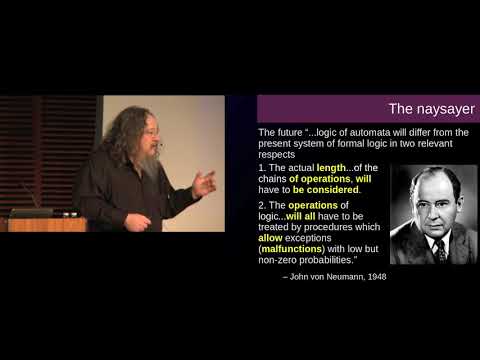
Artificial life offers David Ackley a model for computer architecture that scales indefinitely and resists attack. At the Santa Fe Institute, he starts from von Neumann's 1948 prediction that computers must eventually tolerate error rather than rely on rigid determinism. Ackley then defines life as systems that dynamically preserve pattern, comparing definitions from Chris Langton, Gerald Joyce and Lee Smolin. He casts conventional architecture as a centralized dictatorship in which bits have no agency, and traces security flaws to that design. Demonstrations of tiled computing fabrics, a decentralized demon horde sort and generalized crystal cellular automata show local rules producing self-healing computation.
Artificial life offers David Ackley a model for computer architecture that scales indefinitely and resists attack. At the Santa Fe Institute, he starts from von Neumann's 1948 prediction that computers must eventually tolerate error rather than rely on rigid determinism. Ackley then defines life as systems that dynamically preserve pattern, comparing definitions from Chris Langton, Gerald Joyce and Lee Smolin. He casts conventional architecture as a centralized dictatorship in which bits have no agency, and traces security flaws to that design. Demonstrations of tiled computing fabrics, a decentralized demon horde sort and generalized crystal cellular automata show local rules producing self-healing computation.
Von Neumann's 1948 writing on automata
Webster's Unabridged 1913
Your comment is kept while you sign up.Sign in


